Department of Computer Science, University of Helsinki, Helsinki, Finland.
Department of Psychology and Logopedics, University of Helsinki, Helsinki, Finland.
Sci Rep. 2020 May 6;10(1):7671. doi: 10.1038/s41598-020-63828-5.
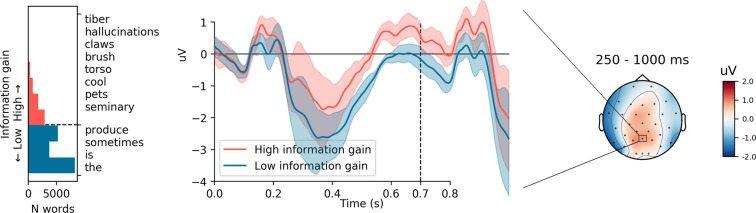
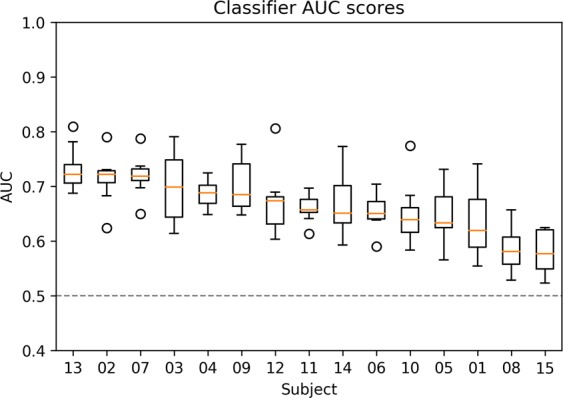
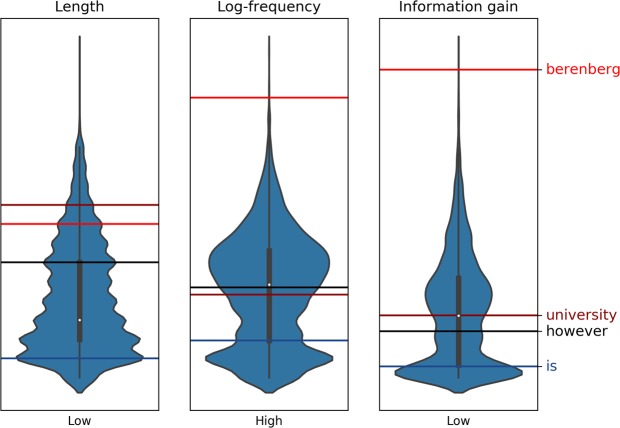
The human brain processes language to optimise efficient communication. Studies have shown extensive evidence that the brain's response to language is affected both by lower-level features, such as word-length and frequency, and syntactic and semantic violations within sentences. However, our understanding on cognitive processes at discourse level remains limited: How does the relationship between words and the wider topic one is reading about affect language processing? We propose an information theoretic model to explain cognitive resourcing. In a study in which participants read sentences from Wikipedia entries, we show information gain, an information theoretic measure that quantifies the specificity of a word given its topic context, modulates word-synchronised brain activity in the EEG. Words with high information gain amplified a slow positive shift in the event related potential. To show that the effect persists for individual and unseen brain responses, we furthermore show that a classifier trained on EEG data can successfully predict information gain from previously unseen EEG. The findings suggest that biological information processing seeks to maximise performance subject to constraints on information capacity.
人类大脑通过处理语言来优化高效的沟通。研究表明,大量证据表明,大脑对语言的反应不仅受到词长、频率等低级特征的影响,还受到句子中句法和语义违规的影响。然而,我们对语篇层面的认知过程的理解仍然有限:单词之间的关系以及阅读的更广泛主题如何影响语言处理?我们提出了一个信息论模型来解释认知资源分配。在一项参与者阅读维基百科条目的句子的研究中,我们展示了信息增益,这是一种信息论度量,用于量化给定主题上下文的单词的特异性,调节 EEG 中与单词同步的脑活动。具有高信息增益的单词放大了事件相关电位中的缓慢正移。为了表明该效果对于个体和看不见的脑反应仍然存在,我们还表明,基于 EEG 数据训练的分类器可以成功地从以前看不见的 EEG 预测信息增益。研究结果表明,生物信息处理旨在在信息容量的限制下最大化性能。