Drug Delivery Research Laboratory, Department of Pharmaceutical Sciences, Dr. H. S. Gour Vishwavidyalaya, Sagar, M.P., 470003, India.
Department of Pathology, Index Medical College, Hospital & Research Centre, Indore, M.P., India.
Drug Deliv Transl Res. 2020 Aug;10(4):1095-1110. doi: 10.1007/s13346-020-00770-z.
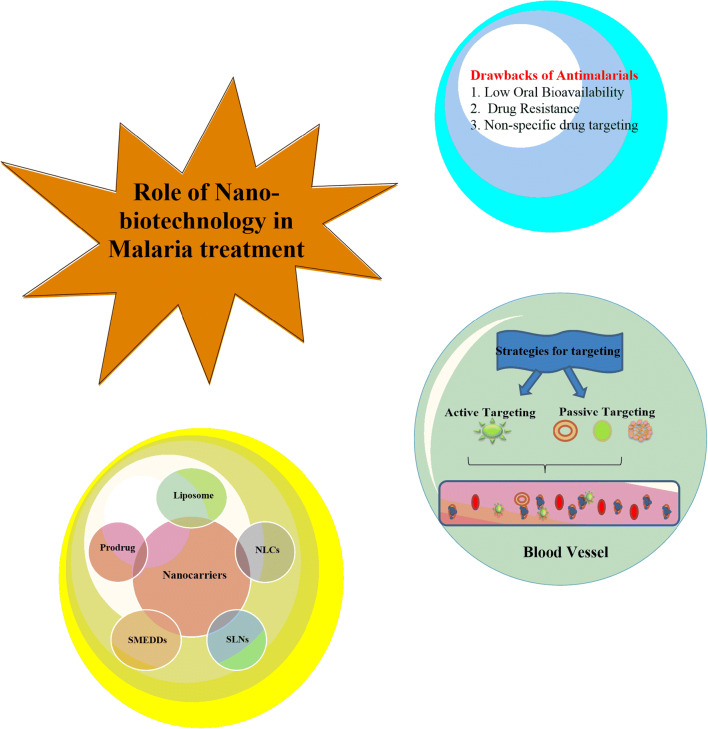
Malaria is one of the major infectious diseases that remains a constant challenge to human being mainly due to the emergence of drug-resistant strains of parasite and also the availability of drugs, which are non-specific for their pharmacodynamic activity and known to be associated with multiple side effects. The disease has acquired endemic proportions in tropical countries where the hygienic conditions are not satisfactory while the environmental conditions favor the proliferation of parasite and its transmission, particularly through the female anopheles. It is obvious that to square up the problems, there is a need for designing and development of more effective drugs, which can combat the drug-resistant strains of the parasite. Molecular biology of the parasite and its homing into host cellular tropics provide multiple drug targets that could judiciously be considered for engineering and designing of new generation antimalarial drugs and also drug delivery systems. Though the recent reports document that against malaria parasite the vaccine could be developed, nevertheless, due to smart mutational change overs by the parasite, it is able to bypass the immune surveillance. The developed vaccine therefore failed to assure absolute protection against the malarial infection. In the conventional mode of treatment antimalarial drugs, the dose and dosage regimen that is followed at large crops up the contraindicative manifestations, and hence compromising the effective treatment. The emerging trends and new updates in contemporary biological sciences, material sciences, and drug delivery domain have enabled us with the availability of a multitude of mode and modules which could plunge upon the nanotechnology in particular to treat this challenging infection. The nanotechnology-based option may be tuned or customized as per the requirements to mark and target i.e. the infected RBCs, for targeted drug delivery. Graphical abstract.
疟疾是一种主要的传染病,仍然是人类面临的一个持续挑战,主要是由于寄生虫耐药株的出现,以及药物的可用性,这些药物对其药效不具有特异性,并且已知与多种副作用有关。这种疾病在热带国家已经流行起来,这些国家的卫生条件不理想,而环境条件有利于寄生虫的繁殖和传播,特别是通过雌性疟蚊。显然,为了解决这些问题,需要设计和开发更有效的药物,这些药物可以对抗寄生虫的耐药株。寄生虫的分子生物学及其进入宿主细胞的生态位为药物靶点提供了多种选择,这些靶点可以明智地用于设计新一代抗疟药物和药物输送系统。尽管最近的报告表明可以针对疟疾寄生虫开发疫苗,但由于寄生虫的智能突变,它能够绕过免疫监测。因此,开发的疫苗未能确保对疟疾感染的绝对保护。在传统的抗疟药物治疗模式中,剂量和剂量方案在很大程度上会出现禁忌症状,从而影响有效治疗。当代生物科学、材料科学和药物输送领域的新兴趋势和新进展使我们能够获得多种模式和模块,这些模式和模块可以特别利用纳米技术来治疗这种具有挑战性的感染。基于纳米技术的选择可以根据需要进行调整或定制,以标记和靶向目标,即感染的 RBCs,用于靶向药物输送。