Graduate School of Physical Therapy, Sahmyook University, Seoul 01795, Korea.
Department of Physical Therapy, Andong Science College, Andong 36616, Korea.
Int J Environ Res Public Health. 2020 May 5;17(9):3203. doi: 10.3390/ijerph17093203.
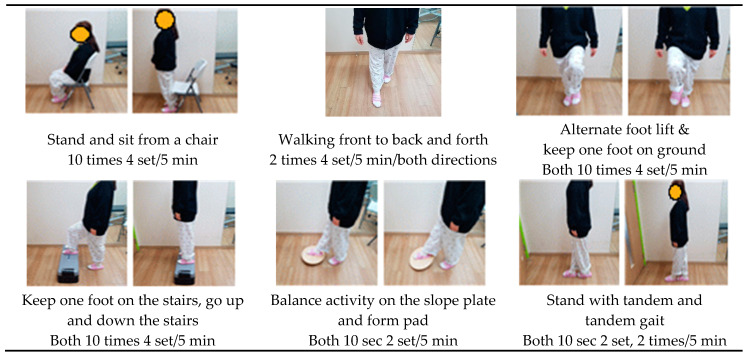
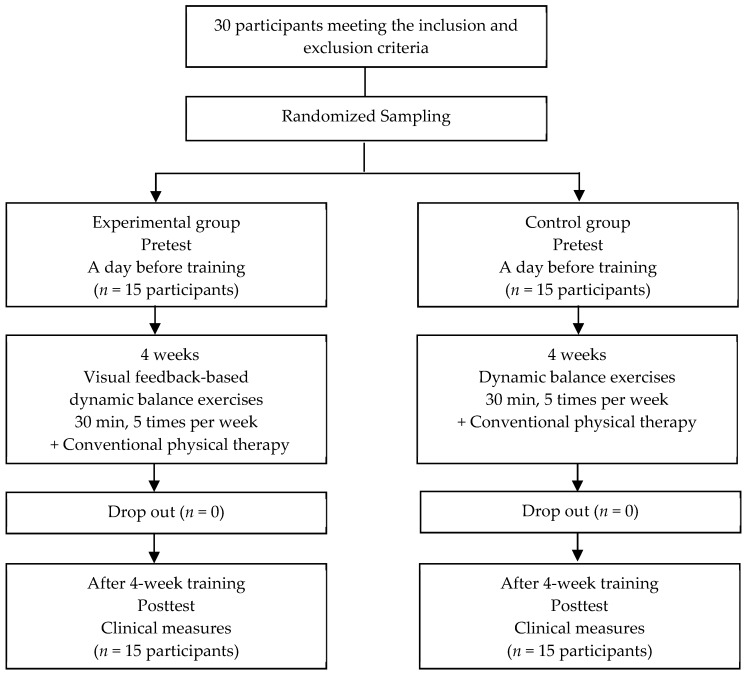
The aim of this study was to compare the effects of dynamic balance exercises with and without visual feedback on recovery from total knee arthroplasty. The participants were 30 women who underwent total knee arthroplasty more than one week before the study, and were randomly allocated into two groups. The average ages of the experimental and control groups were 70.13 and 69.00 years, respectively. The dynamic balance exercise with visual feedback (VF) group practiced dynamic balance exercises using a laser pointer for five 30-min sessions over a 4-week period. The dynamic balance exercise without visual feedback (control) group practiced dynamic balance exercises for five 30 min sessions over a 4 week period. The following clinical measures were used for assessing physical function, balance ability, and depression. Compared with the control group, the VF group showed significant improvements in the physical performance test, Western Ontario and McMaster Universities Arthritis Index (WOMAC), confidence ellipse area (CEA), path length (PL), average velocity (AV), and Timed Up and Go test (TUG test) ( < 0.05). Furthermore, the VF group showed significant improvements in all post-surgery outcome measures compared with the pre-surgery values ( < 0.05). The above results indicated that the dynamic balance exercises based on visual feedback improved physical function and balance ability in patients following total knee arthroplasty, suggesting the need for effective rehabilitation programs for patients with total knee arthroplasty.
本研究旨在比较有和没有视觉反馈的动态平衡练习对全膝关节置换术后恢复的影响。参与者为 30 名女性,她们在研究前一周以上接受了全膝关节置换术,并被随机分配到两组。实验组和对照组的平均年龄分别为 70.13 岁和 69.00 岁。有视觉反馈的动态平衡练习(VF)组使用激光笔进行了 5 次 30 分钟的动态平衡练习,共进行了 4 周。无视觉反馈的动态平衡练习(对照组)组在 4 周内进行了 5 次 30 分钟的动态平衡练习。以下临床指标用于评估身体机能、平衡能力和抑郁情况。与对照组相比,VF 组在身体表现测试、西安大略和麦克马斯特大学关节炎指数(WOMAC)、置信椭圆面积(CEA)、路径长度(PL)、平均速度(AV)和起身行走测试(TUG 测试)( < 0.05)方面均有显著改善。此外,VF 组在所有术后结果测量中与术前值相比均有显著改善( < 0.05)。上述结果表明,基于视觉反馈的动态平衡练习可改善全膝关节置换术后患者的身体机能和平衡能力,提示需要为全膝关节置换术后患者制定有效的康复计划。