Graduate School of Physical Therapy, Sahmyook University, Seoul 01795, Korea.
Department of Physical Therapy, Seoul Now Hospital, Seongnam 13591, Korea.
Int J Environ Res Public Health. 2021 Mar 3;18(5):2513. doi: 10.3390/ijerph18052513.
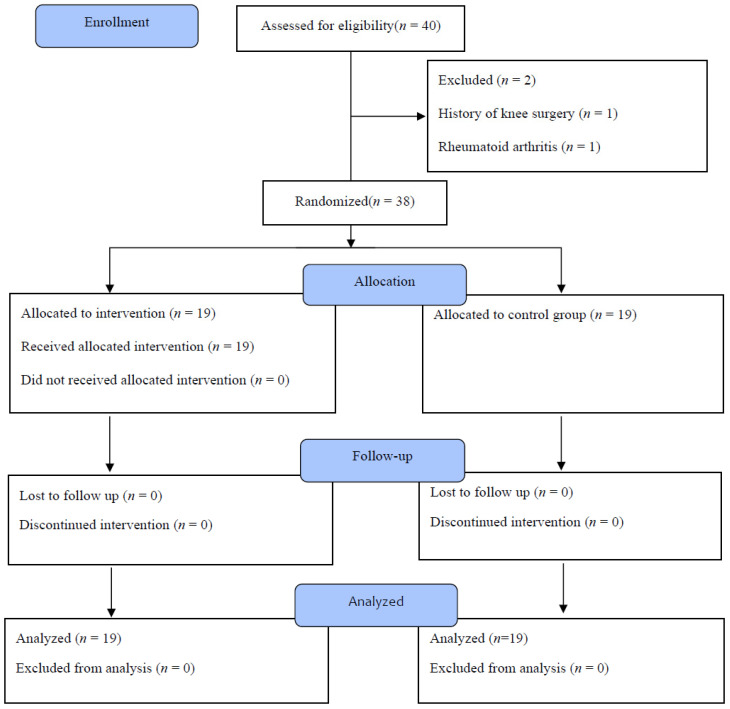
Total knee arthroplasty (TKA) is used to treat end-stage osteoarthritis. However, this surgical procedure affects the mechanical receptor function and impairs the ability to balance. Dynamic balance training has been reported to improve stability and self-confidence and safely yield increased physical activity. This study aimed to investigate the effect of dynamic balance training on physical function, the ability to balance and quality of life among patients who underwent TKA. Thirty-eight participants were assigned to either the progressive dynamic balance training (PDBT) with physical therapy group ( = 19) or the control group ( = 19). The experimental group undertook a dynamic balance program with physical therapy for 30 minutes per day, five times per week for six weeks, while the control group undertook physical therapy only. A continuous passive motion exercise was performed for 20 minutes after training by both groups. The outcomes were evaluated using the Western Ontario and McMaster Universities (WOMAC) Osteoarthritis Index, pain pressure threshold (PPT), range of motion (ROM), Knee Outcome Survey-Activities of Daily Living (KOS-ADLS), Multifunction Force Measuring Plate, timed up and go (TUG) test and Short-Form Health Survey 36 (SF-36). Physical function (WOMAC Osteoarthritis Index, ROM and KOS-ADLS score) and the ability to balance (TUG test score, confidence ellipse area, path length and average velocity) significantly improved ( < 0.05) in the experimental group compared with the control group. In contrast, the physical component summary score for the SF-36 regarding quality of life significantly improved ( < 0.05); however, the mental component summary score for the SF-36 and PPT did not significantly differ between the groups. Therefore, we suggest that PDBT with physical therapy has positive effects on physical function, the ability to balance and quality of life among patients who underwent TKA.
全膝关节置换术(TKA)用于治疗终末期骨关节炎。然而,这种手术会影响机械感受器的功能,并损害平衡能力。有研究报道,动态平衡训练可以提高稳定性和自信心,并安全地增加身体活动量。本研究旨在探讨动态平衡训练对 TKA 患者身体功能、平衡能力和生活质量的影响。
38 名参与者被分为渐进式动态平衡训练(PDBT)与物理治疗组(n=19)和对照组(n=19)。实验组接受每天 30 分钟、每周 5 次、为期 6 周的动态平衡训练与物理治疗,对照组仅接受物理治疗。两组在训练后均进行 20 分钟的持续被动运动。
使用 Western Ontario and McMaster Universities (WOMAC) Osteoarthritis Index、疼痛压力阈值(PPT)、关节活动度(ROM)、膝关节结局调查-日常生活活动(KOS-ADLS)、多功能测力板、计时起立行走(TUG)测试和 Short-Form Health Survey 36(SF-36)评估结果。与对照组相比,实验组的身体功能(WOMAC 骨关节炎指数、ROM 和 KOS-ADLS 评分)和平衡能力(TUG 测试评分、置信椭圆面积、路径长度和平均速度)显著改善(<0.05)。相反,SF-36 的生理成分综合评分(physical component summary score)在生活质量方面显著提高(<0.05);然而,SF-36 的心理成分综合评分和 PPT 在两组之间没有显著差异。
因此,我们建议 TKA 患者进行 PDBT 与物理治疗可以积极改善身体功能、平衡能力和生活质量。