Department of Gender in Primary and Transmural Care, Radboud University Medical Center, Postbus 9101, 6500 HB Nijmegen; Geert Grooteplein 21 - route 117, 6525 EZ, Nijmegen, the Netherlands.
BMC Public Health. 2020 May 7;20(1):640. doi: 10.1186/s12889-020-08743-0.
Intimate partner violence (IPV) affects almost one in three women worldwide. However, disclosing violence or seeking help is difficult for affected women. eHealth may represent an effective alternative to the standard support offers, which often require face-to-face interaction, because of easy accessibility and possibility of anonymous usage. In the Netherlands we are developing SAFE, an eHealth intervention for female victims of IPV, which will be evaluated in a randomized controlled trial and a process evaluation, followed by an open feasibility study to assess real-world user data.
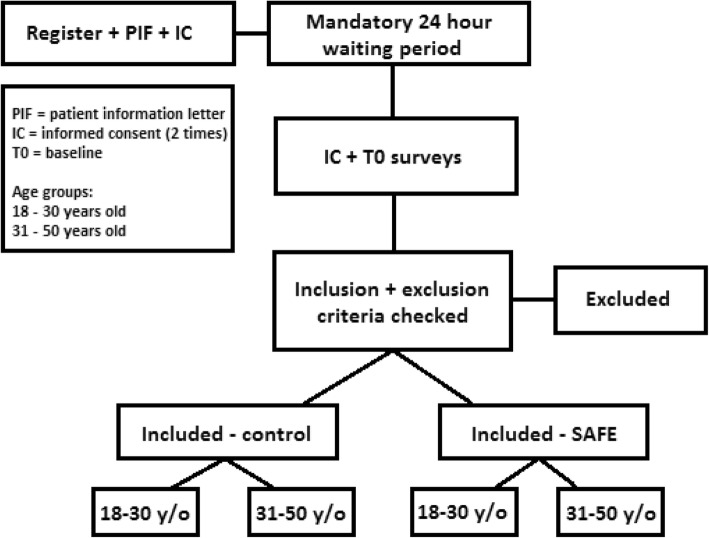
METHODS/DESIGN: The randomized controlled trial is a two-arm parallel design comparing an intervention arm and a control group. The groups both have access to eHealth but differ in the offer of interactive features compared to static information. Both groups complete questionnaires at three or four time points (baseline, three months, six months, 12 months) with self-efficacy at 6 months as the primary outcome, measured with the General Self-Efficacy (GSE) scale. The process evaluation consists of quantitative data (from the website and from web evaluation questionnaires) and qualitative data (from interviews) on how the website was used and the users' experiences.
eHealth has the potential to reach a large number of women who experience IPV. The internet-based design can lower access barriers and encourage help-seeking behavior ultimately reducing the lag time between subjective awareness and protective action.
Trial registered on 15 August 2017 at the Netherlands Trial Register NL7108 (NTR7313).
全球近三分之一的女性遭受过亲密伴侣暴力(IPV)。然而,受影响的女性往往难以披露暴力行为或寻求帮助。由于 eHealth 易于获取且可匿名使用,因此可能是对通常需要面对面互动的标准支持服务的有效替代。在荷兰,我们正在开发一种用于 IPV 女性受害者的 eHealth 干预措施 SAFE,该干预措施将在一项随机对照试验和过程评估中进行评估,随后进行开放可行性研究以评估实际用户数据。
方法/设计:随机对照试验采用两臂平行设计,比较干预组和对照组。两组都可以使用 eHealth,但提供的互动功能与静态信息不同。两组均在三个或四个时间点(基线、三个月、六个月和十二个月)完成问卷,六个月时的自我效能作为主要结局,使用一般自我效能感(GSE)量表进行测量。过程评估包括网站和网站评估问卷的定量数据以及关于网站使用情况和用户体验的定性数据。
eHealth 有可能接触到大量遭受 IPV 的女性。基于互联网的设计可以降低准入障碍,鼓励寻求帮助的行为,最终减少主观意识和保护行为之间的滞后时间。
试验于 2017 年 8 月 15 日在荷兰试验注册中心 NL7108(NTR7313)注册。