Hydro-Climate Extremes Lab, Ghent University, Ghent, Belgium.
Ann N Y Acad Sci. 2020 Jul;1472(1):123-138. doi: 10.1111/nyas.14357. Epub 2020 May 7.
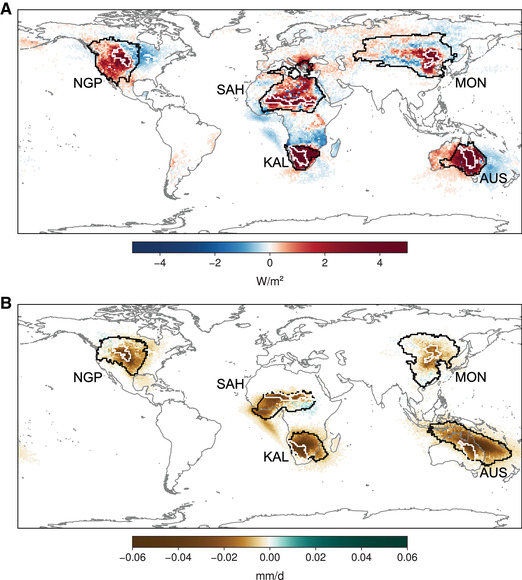
The land biosphere is a crucial component of the Earth system that interacts with the atmosphere in a complex manner through manifold feedback processes. These relationships are bidirectional, as climate affects our terrestrial ecosystems, which, in turn, influence climate. Great progress has been made in understanding the local interactions between the terrestrial biosphere and climate, but influences from remote regions through energy and water influxes to downwind ecosystems remain less explored. Using a Lagrangian trajectory model driven by atmospheric reanalysis data, we show how heat and moisture advection affect gross carbon production at interannual scales and in different ecoregions across the globe. For water-limited regions, results show a detrimental effect on ecosystem productivity during periods of enhanced heat and reduced moisture advection. These periods are typically associated with winds that disproportionately come from continental source regions, as well as positive sensible heat flux and negative latent heat flux anomalies in those upwind locations. Our results underline the vulnerability of ecosystems to the occurrence of upwind climatic extremes and highlight the importance of the latter for the spatiotemporal propagation of ecosystem disturbances.
陆地生物圈是地球系统的一个关键组成部分,通过多种反馈过程与大气相互作用。这些关系是相互的,因为气候会影响我们的陆地生态系统,而陆地生态系统反过来又会影响气候。人们在理解陆地生物圈和气候之间的局部相互作用方面已经取得了很大进展,但通过能量和水分流入下风生态系统对远程区域的影响仍有待进一步探索。本研究利用大气再分析数据驱动的拉格朗日轨迹模型,展示了热量和水汽平流如何在年际尺度上以及在全球不同生态区影响总碳生产。对于水分限制地区,结果表明,在增强的热量和减少的水汽平流期间,对生态系统生产力会产生不利影响。这些时期通常与主要来自大陆源区的风有关,以及那些上风位置的感热通量为正和潜热通量为负的异常。我们的研究结果强调了生态系统对上风气候极端事件发生的脆弱性,并突出了后者对生态系统干扰的时空传播的重要性。