Department of Urology, The Johns Hopkins University School of Medicine, Baltimore, Maryland.
Department of Urology, Astellas Pharma Global Development Inc, Northbrook, Illinois.
Neurourol Urodyn. 2020 Jun;39(5):1378-1386. doi: 10.1002/nau.24348. Epub 2020 May 8.
To characterize the epidemiology and treatment patterns of adult men (≥40 years) diagnosed with, or treated for, overactive bladder (OAB) and/or benign prostatic hyperplasia (BPH).
This retrospective observational study used data extracted from the IBM MarketScan Commercial Claims and Encounters database and the Medicare Supplemental Coordination of Benefits database. Men with BPH and/or OAB were identified and observed to assess treatment and diagnostic patterns.
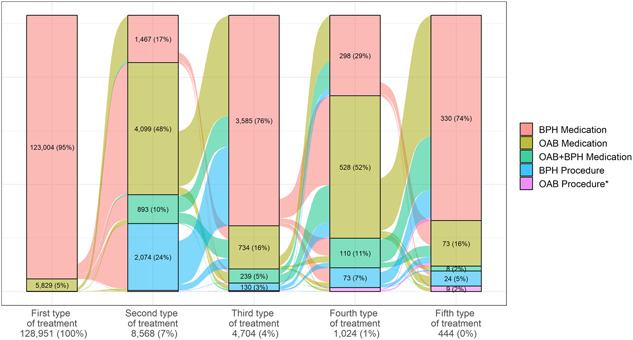
Within the entire study sample (N = 462 400), BPH diagnosis (61.5%) and BPH treatment (73.7%) were more common than the corresponding values for OAB (25.8% and 7.0%, respectively). Notably, among diagnosed individuals, the dispensation of a corresponding treatment was more likely in individuals diagnosed with BPH (183 672 out of 284 416 = 64.6%) compared with OAB (16 468 out of 119 236 = 13.8%). Among newly diagnosed and/or treated patients (n = 196 576), only 60.3% received treatment. Among treated patients, most experienced only a single type of treatment (93.4%), 6.6% went on to receive a secondary treatment and 3.5% a tertiary. The most common primary treatment was alpha-blocker monotherapy (76.9%) followed by tadalafil monotherapy (16.4%). Among those untreated at first diagnosis, the median time between diagnosis and treatment initiation was 128 days.
Diagnosis and management of OAB among males are challenging given the inherent overlap in symptoms observed with BPH. Unsurprisingly, we found that BPH is diagnosed and treated more frequently than OAB; but the differences between diagnosis and treatment patterns for the two conditions highlight the potential undertreatment of OAB and misdirection of therapy for men with a combination of voiding and storage symptoms.
描述成年男性(≥40 岁)中诊断为或治疗过膀胱过度活动症(OAB)和/或良性前列腺增生(BPH)的患者的流行病学和治疗模式。
本回顾性观察性研究使用了从 IBM MarketScan 商业索赔和就诊数据库以及 Medicare 补充福利协调数据库中提取的数据。确定了患有 BPH 和/或 OAB 的男性,并对其治疗和诊断模式进行了评估。
在整个研究样本(N=462400)中,BPH 的诊断(61.5%)和治疗(73.7%)比 OAB(分别为 25.8%和 7.0%)更为常见。值得注意的是,在诊断为 OAB 的人群中,接受相应治疗的可能性较小(在 119236 名被诊断为 OAB 的患者中,有 16468 名患者接受了治疗,占 13.8%),而在诊断为 BPH 的人群中,接受相应治疗的可能性更大(在 284416 名被诊断为 BPH 的患者中,有 183672 名患者接受了治疗,占 64.6%)。在新诊断和/或治疗的患者(n=196576)中,仅有 60.3%接受了治疗。在接受治疗的患者中,大多数仅接受了单一类型的治疗(93.4%),6.6%接受了二级治疗,3.5%接受了三级治疗。最常见的一线治疗是α受体阻滞剂单药治疗(76.9%),其次是他达拉非单药治疗(16.4%)。在首次诊断时未接受治疗的患者中,从诊断到开始治疗的中位时间为 128 天。
鉴于男性中观察到的 BPH 症状与 OAB 症状存在固有重叠,因此男性中 OAB 的诊断和治疗具有挑战性。不出所料,我们发现 BPH 的诊断和治疗频率高于 OAB;但这两种疾病的诊断和治疗模式之间的差异突出表明,OAB 的潜在治疗不足,以及对同时存在排尿和储存症状的男性的治疗方向有误。