Ozer Muhammet, Bengi Goksel, Colak Rumeysa, Cengiz Ozan, Akpinar Hale
Dokuz Eylul University, Department of Internal Medicine, Izmir, Turkey.
Capital Health Regional Medical Center, Department of Internal Medicine, Trenton, NJ, USA.
Medicine (Baltimore). 2020 May;99(19):e20067. doi: 10.1097/MD.0000000000020067.
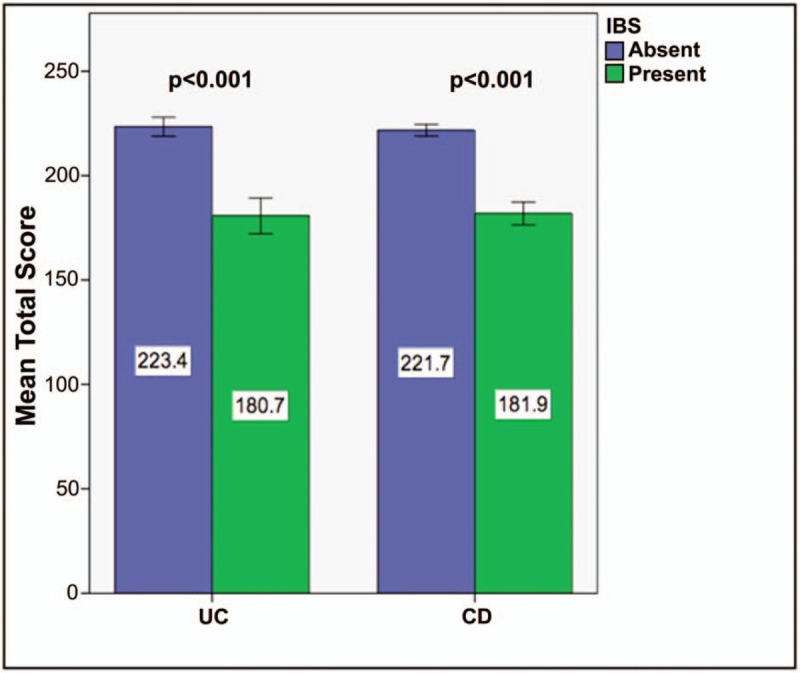
Irritable bowel syndrome (IBS)-like symptoms tend to be common in inflammatory bowel disease (IBD) patients even during the long-standing remission phase, and quality of life (QOL) seem to reduce in IBD patients with such symptoms. Thus, the aim of this study was to define the prevalence of IBS-like symptoms in inactive IBD patients using Rome IV criteria and evaluate the effect of IBS-like symptoms on QOL.Total 137 patients with IBD (56 with ulcerative colitis (UC) and 81 with Crohn disease (CD), who had been in long-standing remission according to the clinical scoring system and 123 control participants were included. These patients completed questionnaires to evaluate IBS-like symptoms according to Rome IV criteria, and the impact of these symptoms on the QOL of inactive IBD patients was compared with and without IBS-like symptoms according to disease-specific inflammatory bowel disease questionnaire (IBDQ).Depending on our research, IBS-like symptoms were found in 32% (18/56) of patients with inactive UC, 35% (29/81) of patients with inactive CD, and 13.8% (17/123) of control participants (P < .001). The QOL seemed to be significantly lower in both inactive UC and CD patients with IBS-like symptoms than in those without such symptoms (P < .001).In conclusion, we defined that the prevalence of IBS-like symptoms in IBD patients in remission is 2 to 3 times higher than that in healthy control participants, and significantly lower IBDQ scores showed QOL was reduced in inactive IBD patients with IBS-like symptoms as compared with patients without IBS-like symptoms.
即使在炎症性肠病(IBD)患者长期缓解期,肠易激综合征(IBS)样症状也往往很常见,并且有此类症状的IBD患者生活质量(QOL)似乎会降低。因此,本研究的目的是使用罗马IV标准确定非活动期IBD患者中IBS样症状的患病率,并评估IBS样症状对生活质量的影响。共纳入137例IBD患者(56例溃疡性结肠炎(UC)患者和81例克罗恩病(CD)患者),这些患者根据临床评分系统处于长期缓解期,以及123名对照参与者。这些患者完成了根据罗马IV标准评估IBS样症状的问卷,并根据疾病特异性炎症性肠病问卷(IBDQ)比较了有无IBS样症状对非活动期IBD患者生活质量的影响。根据我们的研究,在非活动期UC患者中有32%(18/56)、非活动期CD患者中有35%(29/81)以及对照参与者中有13.8%(17/123)出现IBS样症状(P<0.001)。有IBS样症状的非活动期UC和CD患者的生活质量似乎明显低于无此类症状的患者(P<0.001)。总之,我们确定缓解期IBD患者中IBS样症状的患病率比健康对照参与者高2至3倍,并且显著更低的IBDQ评分表明,与无IBS样症状的患者相比,有IBS样症状的非活动期IBD患者生活质量降低。