Clinical Cancer Center, Xiyuan Hospital, China Academy of Chinese Medical Sciences, Beijing 100091, China.
Memorial Sloan Kettering Cancer Center, Bendheim Integrative Medicine Center, New York, NY, USA.
Ann Palliat Med. 2020 Jul;9(4):1804-1811. doi: 10.21037/apm.2020.04.24. Epub 2020 Apr 27.
Over half of patients with advanced cancer report appetite loss or anorexia. Previous studies have shown the benefit of acupuncture for cancer-related nausea and vomiting, but limited evidence exists for its role in appetite improvement. Our study aimed to evaluate the feasibility and safety of auricular acupuncture to improve appetite for cancer patients with advanced disease.
We performed a two-arm parallel, pilot randomized controlled trial (RCT) of auricular acupuncture versus usual care control in patients with stage III or IV cancer who experienced appetite loss. The primary outcome was changed in the Simplified Nutritional Appetite Questionnaire (SNAQ; score range, 4-20) between two groups from baseline to weeks 2 and 4, with secondary outcomes including change in weight, as well as an additional evaluation at week 8 for durability of treatment effects. We used independent two-sample t-test for the change in mean score for each outcome during or after treatment. We assessed the interaction between time and treatment from baseline to weeks 2, 4, and 8 using mixed-effects models by ANOVA test.
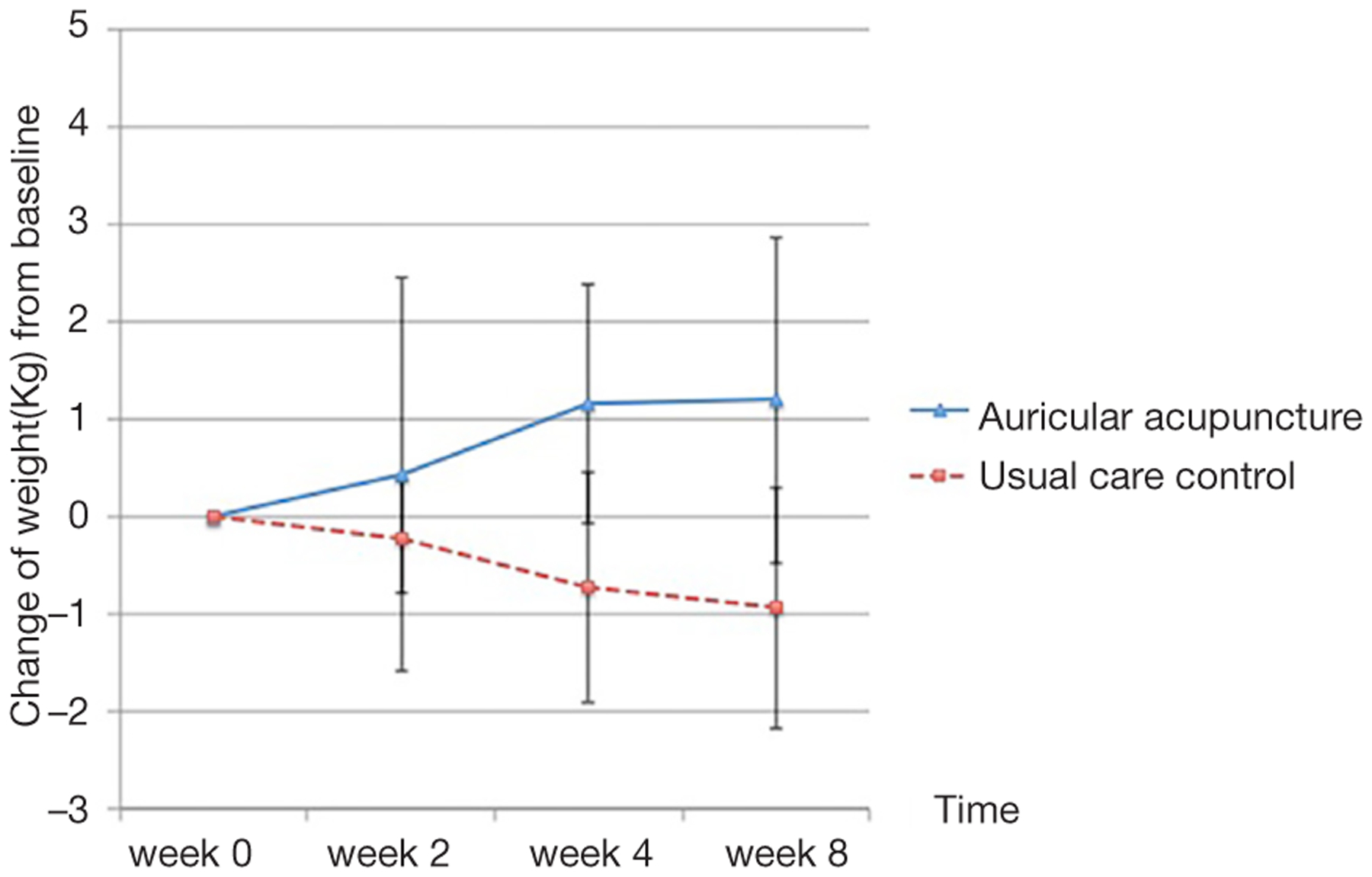
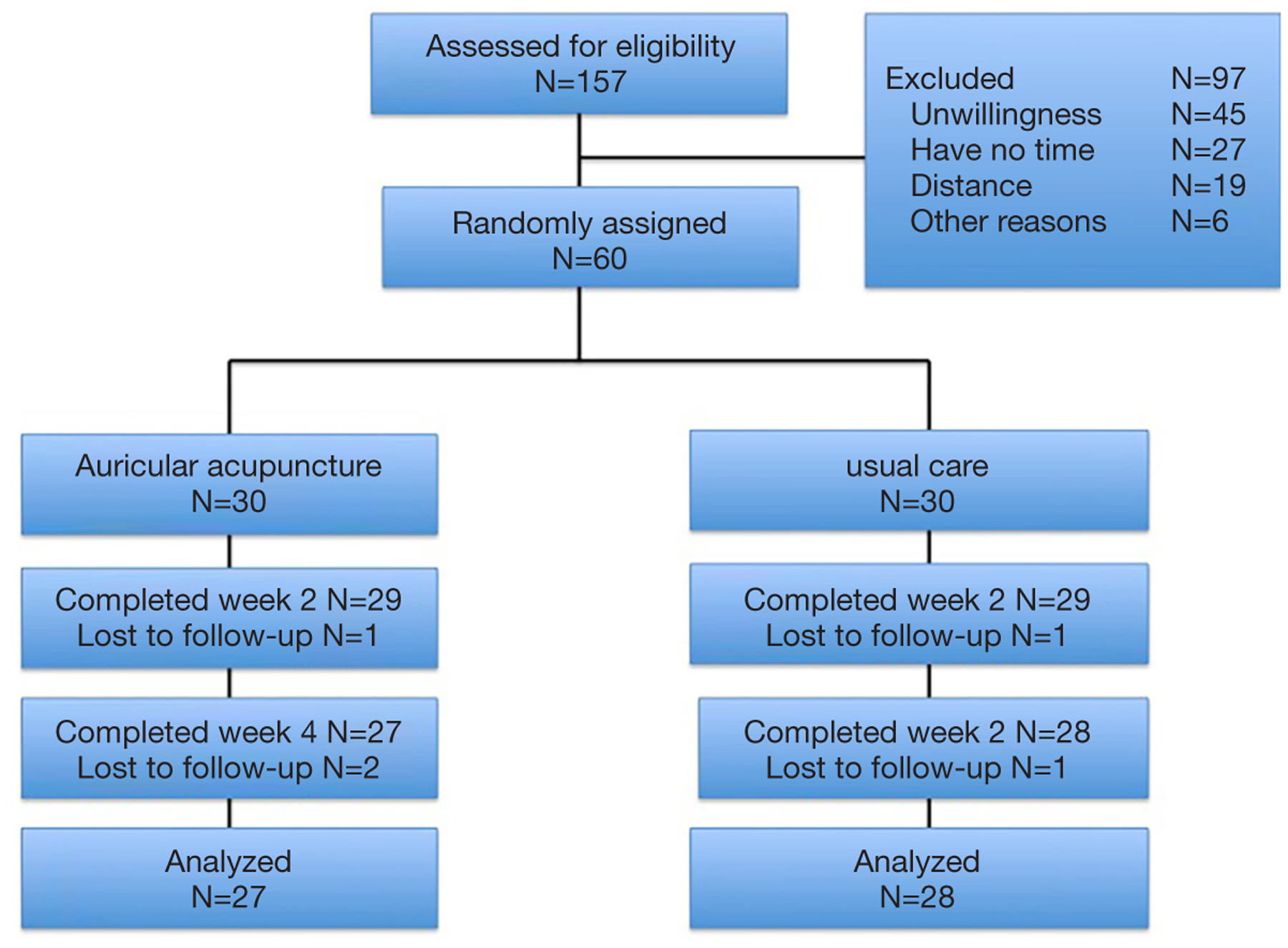
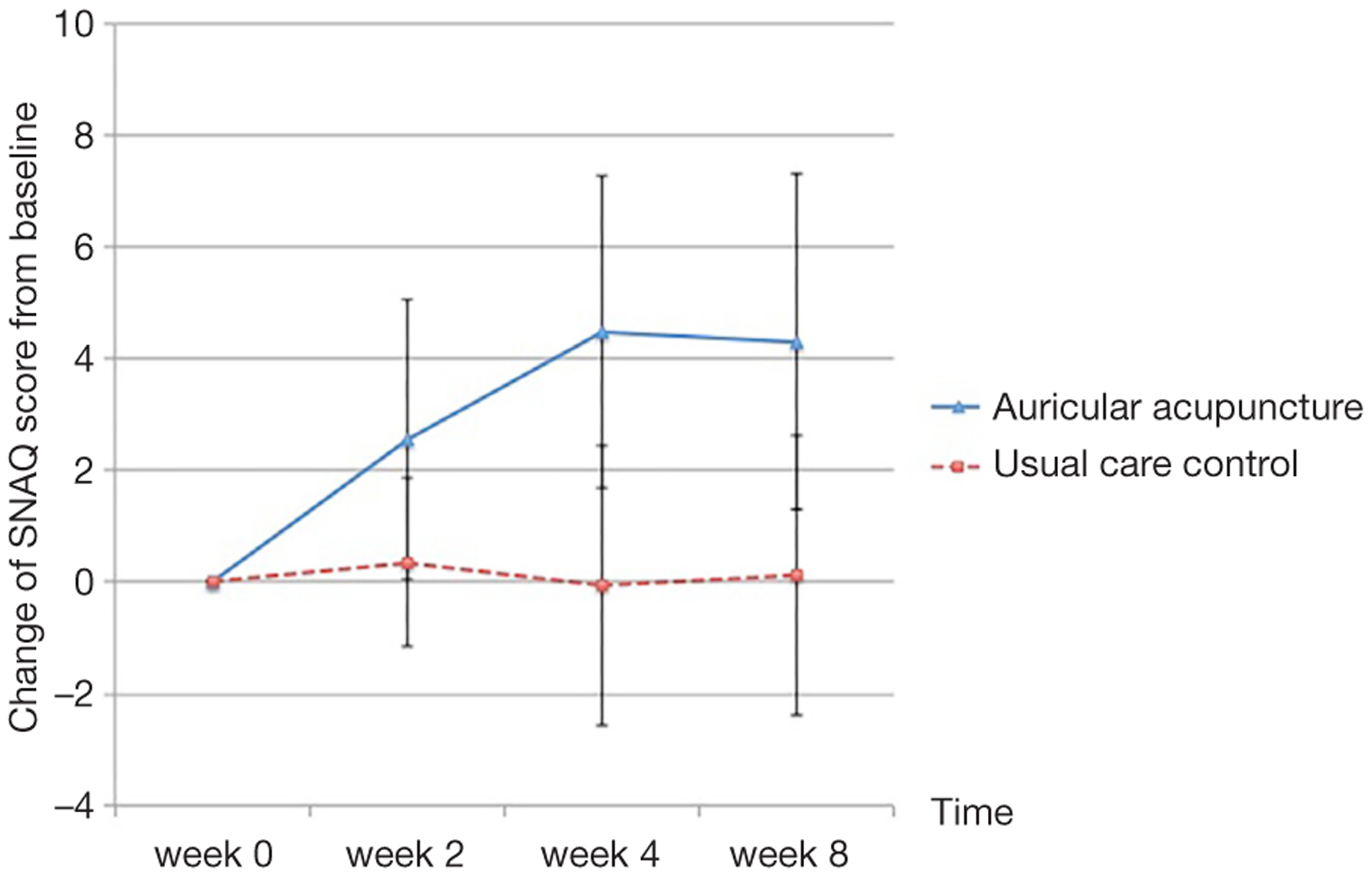
We randomized 55 patients to auricular acupuncture (N=27) or control group (N=28). By week 4, the auricular acupuncture group had a significantly higher escalation in the SNAQ score than the control group compared with baseline [mean difference 3.69; 95% confidential interval (95% CI): 2.5, 4.8; P<0.001] and experienced a 51.4% improvement in appetite. From baseline to weeks 2 and 4, patients lost a little weight in the control group but gained weight in the auricular acupuncture group. Between baseline and week 4, change in the SNAQ score was significantly associated with change in weight (P=0.001). No adverse events (AEs) were reported during the study.
Compared to usual care, auricular acupuncture is feasible and safe to improve appetite and help patients with advanced cancer gain weight.
超过一半的晚期癌症患者报告食欲下降或厌食。先前的研究表明针灸对癌症相关恶心和呕吐有益,但对其改善食欲的作用证据有限。我们的研究旨在评估耳针改善晚期癌症患者食欲的可行性和安全性。
我们对 III 期或 IV 期癌症且经历食欲下降的患者进行了耳针与常规护理对照的双臂平行、初步随机对照试验 (RCT)。主要结局是两组患者从基线到第 2 周和第 4 周的简化营养食欲问卷 (SNAQ) 变化(评分范围 4-20),次要结局包括体重变化,以及治疗效果持久度的第 8 周额外评估。我们使用独立的两样本 t 检验来评估治疗过程中和治疗后每个结局的均值变化。我们通过方差分析混合效应模型评估从基线到第 2、4 和 8 周的时间和治疗之间的交互作用。
我们将 55 名患者随机分为耳针组(N=27)或对照组(N=28)。到第 4 周时,与基线相比,耳针组的 SNAQ 评分明显升高[平均差值 3.69;95%置信区间 (95% CI):2.5, 4.8;P<0.001],且食欲改善了 51.4%。从基线到第 2 周和第 4 周,对照组患者体重略有下降,而耳针组患者体重增加。从基线到第 4 周,SNAQ 评分的变化与体重的变化显著相关(P=0.001)。研究期间未报告不良事件 (AE)。
与常规护理相比,耳针改善晚期癌症患者的食欲和帮助他们增加体重是可行且安全的。