Gonzalo Maria José, Li Yi-Cheng, Chen Kai-Yi, Gil David, Montoro Teresa, Nájera Inmaculada, Baixauli Carlos, Granell Antonio, Monforte Antonio José
Instituto de Biología Molecular y Celular de Plantas, Universitat Politècnica de València-Consejo Superior de Investigaciones Científicas, Valencia, Spain.
Department of Agronomy, National Taiwan University, Taipei, Taiwan.
Front Plant Sci. 2020 Apr 24;11:326. doi: 10.3389/fpls.2020.00326. eCollection 2020.
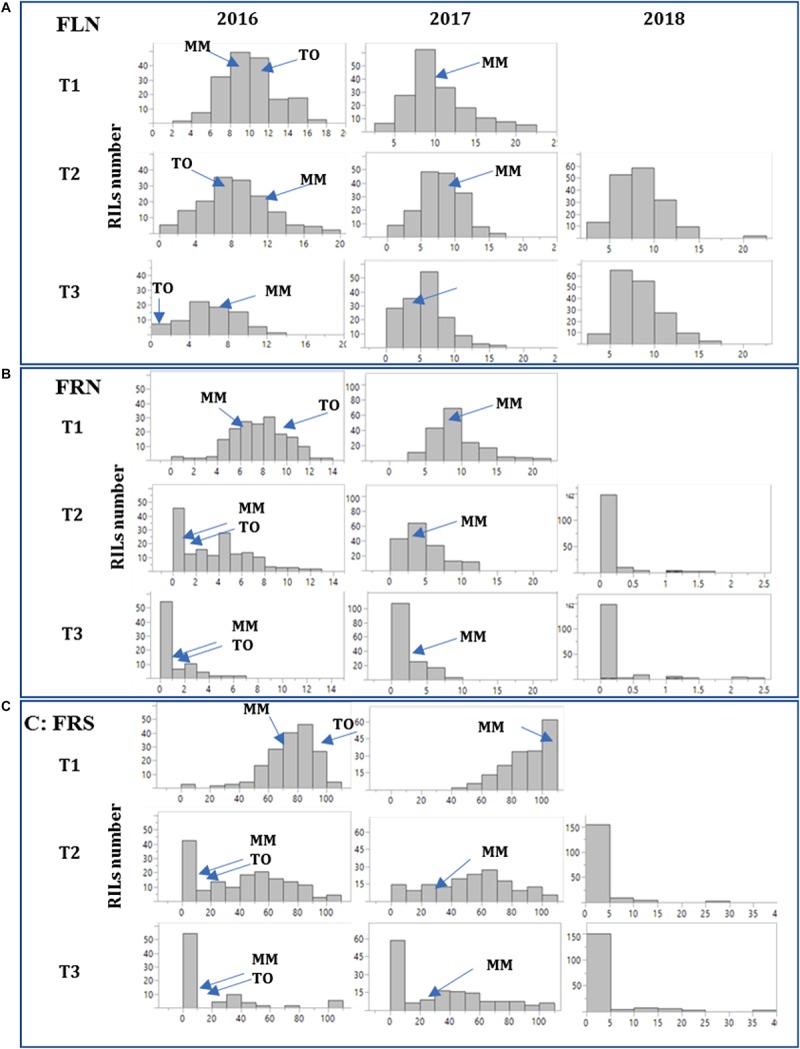
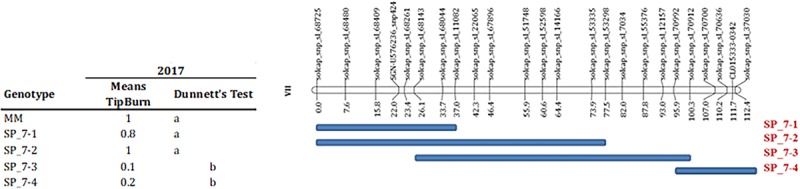
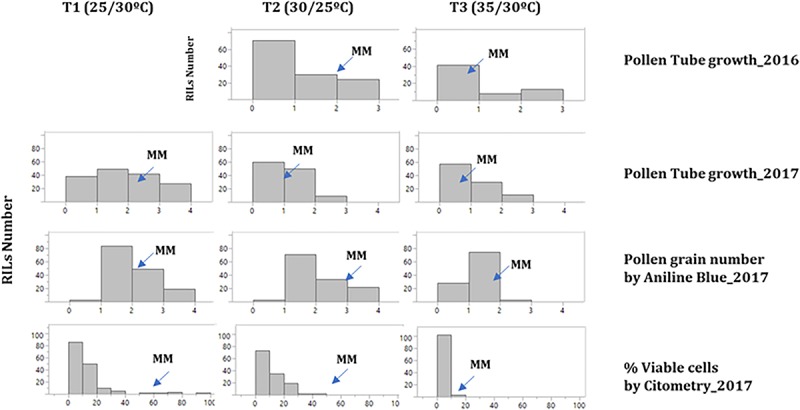
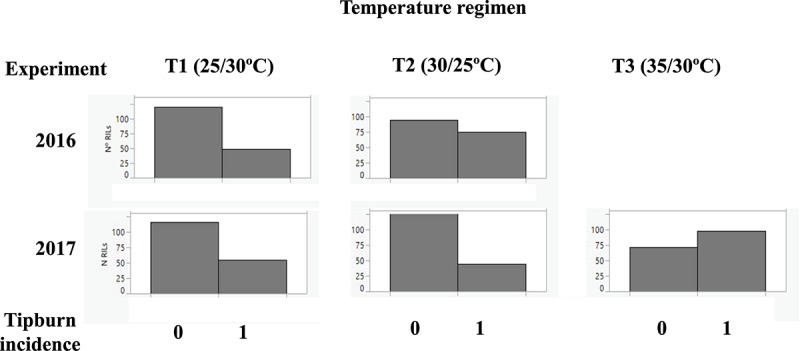
Global climate change is increasing the range of temperatures that crop plants must face during their life cycle, giving negative effects to yields. In this changing scenario, understanding the genetic control of plant responses to a range of increasing temperature conditions is a prerequisite to developing cultivars with increased resilience. The current work reports the identification of Quantitative Trait Loci (QTL) involved in reproductive traits affected by temperature, such as the flower number (FLN) and fruit number (FRN) per truss and percentage of fruit set (FRS), stigma exsertion (SE), pollen viability (PV) and the incidence of the physiological disorder tipburn (TB). These traits were investigated in 168 Recombinant Inbred Lines (RIL) and 52 Introgression Lines (IL) derived from the cross between var. "MoneyMaker" and accession TO-937. Mapping populations were cultivated under increased temperature regimen conditions: T1 (25°C day/21°C night), T2 (30°C day/25°C night) and T3 (35°C day/30°C night). The increase in temperature drastically affected several reproductive traits, for example, FRS in Moneymaker was reduced between 75 and 87% at T2 and T3 when compared to T1, while several RILs showed a reduction of less than 50%. QTL analysis allowed the identification of genomic regions affecting these traits at different temperatures regimens. A total of 22 QTLs involved in reproductive traits at different temperatures were identified by multi-environmental QTL analysis and eight involved in pollen viability traits. Most QTLs were temperature specific, except QTLs on chromosomes 1, 2, 4, 6, and 12. Moreover, a QTL located in chromosome 7 was identified for low incidence of TP in the RIL population, which was confirmed in ILs with introgressions on chromosome 7. Furthermore, ILs with introgressions in chromosomes 1 and 12 had good FRN and FRS in T3 in replicated trials. These results represent a catalog of QTLs and pre-breeding materials that could be used as the starting point for deciphering the genetic control of the genetic response of reproductive traits at different temperatures and paving the road for developing new cultivars adapted to climate change.
全球气候变化正在扩大作物在其生命周期中必须面对的温度范围,对产量产生负面影响。在这种不断变化的情况下,了解植物对一系列不断升高的温度条件的反应的遗传控制是培育具有更强适应力品种的先决条件。当前的研究报告了对受温度影响的生殖性状相关数量性状位点(QTL)的鉴定,这些性状包括每穗花数(FLN)、每穗果实数(FRN)、坐果率(FRS)、柱头外露(SE)、花粉活力(PV)以及生理病害顶烧(TB)的发生率。在由“MoneyMaker”品种与TO - 937种质杂交产生的168个重组自交系(RIL)和52个导入系(IL)中对这些性状进行了研究。将作图群体在升高的温度条件下种植:T1(白天25°C/夜间21°C)、T2(白天30°C/夜间25°C)和T3(白天35°C/夜间30°C)。温度升高对几个生殖性状产生了显著影响,例如,与T1相比,在T2和T3时,“MoneyMaker”的坐果率降低了75%至87%,而一些RIL的降低幅度小于50%。QTL分析使得能够鉴定出在不同温度条件下影响这些性状的基因组区域。通过多环境QTL分析共鉴定出22个参与不同温度下生殖性状的QTL以及8个参与花粉活力性状的QTL。除了位于第1、2、4、6和12号染色体上的QTL外,大多数QTL是温度特异性的。此外,在RIL群体中鉴定出位于第7号染色体上的一个与低顶烧发生率相关的QTL,该QTL在第7号染色体上有导入片段的IL中得到了证实。此外,在重复试验中,第1和12号染色体上有导入片段的IL在T3时具有良好的果实数和坐果率。这些结果代表了一个QTL目录和预育种材料,可作为解读不同温度下生殖性状遗传反应的遗传控制的起点,并为培育适应气候变化的新品种铺平道路。