Hamid Maroof, Khuroo Anzar Ahmad, Malik Akhtar Hussain, Ahmad Rameez, Singh Chandra Prakash, Dolezal Jiri, Haq Shiekh Marifatul
Centre for Biodiversity & Taxonomy, Department of Botany, University of Kashmir, Srinagar, India.
Space Applications Centre, Indian Space Research Organization, Ahmedabad, India.
Front Plant Sci. 2020 Apr 24;11:421. doi: 10.3389/fpls.2020.00421. eCollection 2020.
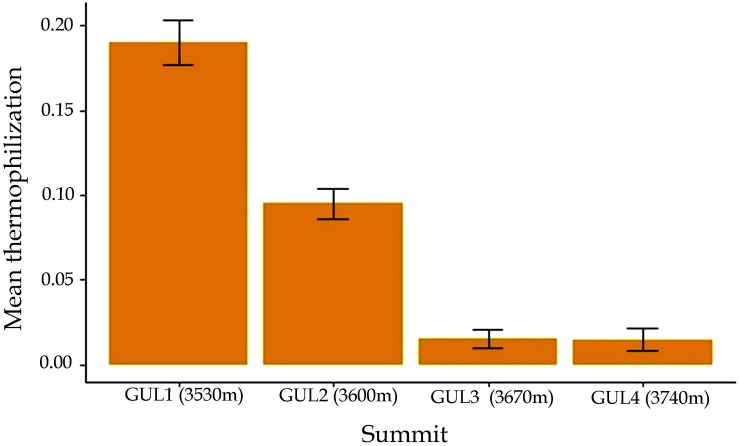
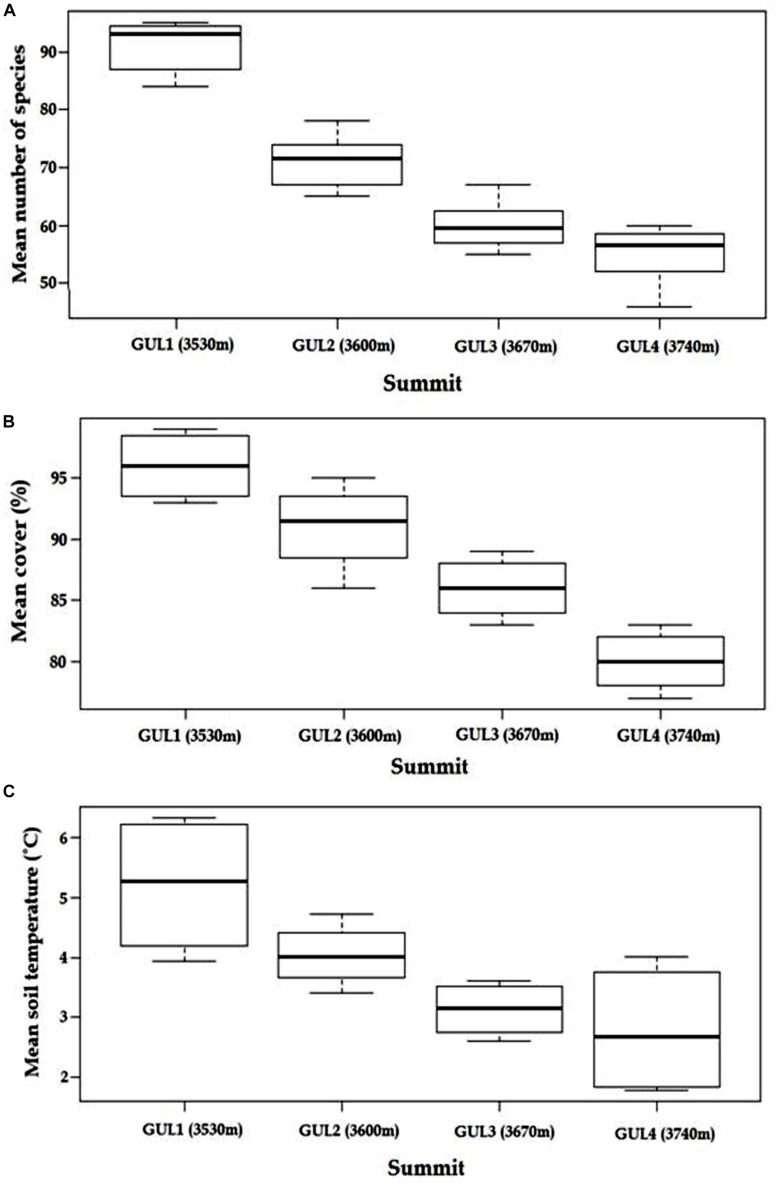
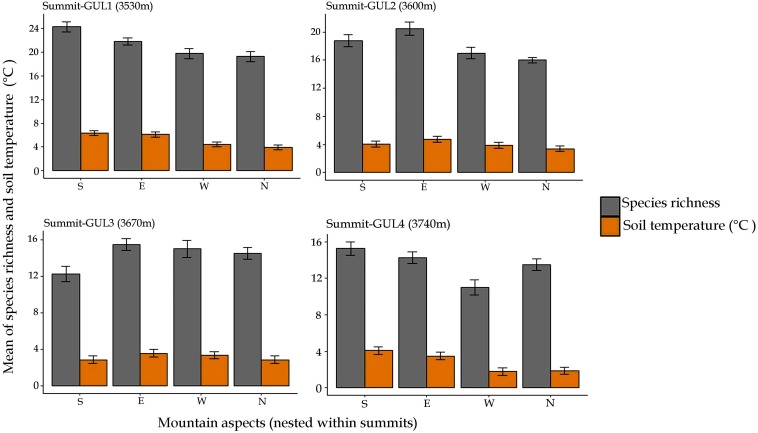
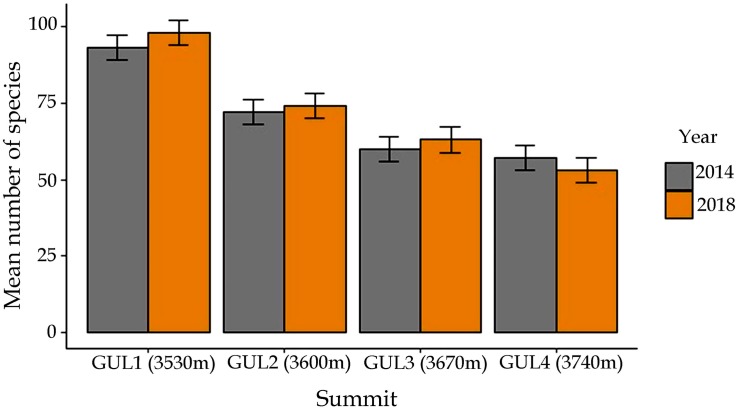
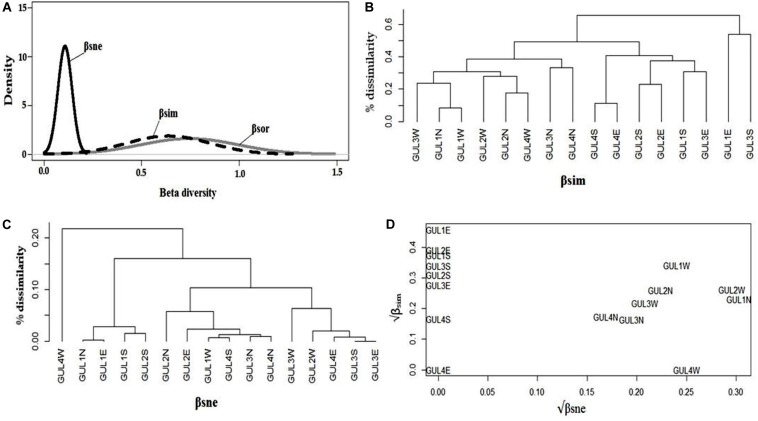
Under the contemporary climate change, the Himalaya is reported to be warming at a much higher rate than the global average. However, little is known about the alpine vegetation responses to recent climate change in the rapidly warming Himalaya. Here we studied vegetation dynamics on alpine summits in Kashmir Himalaya in relation to measured microclimate. The summits, representing an elevation gradient from treeline to nival zone (3530-3740 m), were first surveyed in 2014 and then re-surveyed in 2018. The initial survey showed that the species richness, vegetation cover and soil temperature decreased with increasing elevation. Species richness and soil temperature differed significantly among slopes, with east and south slopes showing higher values than north and west slopes. The re-survey showed that species richness increased on the lower three summits but decreased on the highest summit (nival zone) and also revealed a substantial increase in the cover of dominant shrubs, graminoids, and forbs. The nestedness-resultant dissimilarity, rather than species turnover, contributed more to the magnitude of β-diversity among the summits. High temporal species turnover was found on south and east aspects, while high nestedness was recorded along north and west aspects. Thermophilization was more pronounced on the lower two summits and along the northern aspects. Our study provides crucial scientific data on climate change impacts on the alpine vegetation of Kashmir Himalaya. This information will fill global knowledge gaps from the developing world.
在当代气候变化背景下,据报道喜马拉雅地区的变暖速度远高于全球平均水平。然而,对于喜马拉雅地区快速变暖过程中高山植被对近期气候变化的响应,我们却知之甚少。在此,我们研究了克什米尔喜马拉雅地区高山山顶的植被动态及其与实测小气候的关系。这些山顶代表了从林线到雪线的海拔梯度(3530 - 3740米),于2014年首次进行调查,随后在2018年再次调查。初步调查显示,物种丰富度、植被覆盖度和土壤温度随海拔升高而降低。不同坡向的物种丰富度和土壤温度存在显著差异,东坡和南坡的值高于北坡和西坡。再次调查表明,较低的三个山顶上物种丰富度增加,但最高山顶(雪线区域)的物种丰富度下降,同时还发现优势灌木、禾本科植物和草本植物的覆盖度大幅增加。山顶间β多样性的大小更多地是由嵌套性导致的差异而非物种更替造成的。在南坡和东坡发现了较高的时间性物种更替,而在北坡和西坡记录到较高的嵌套性。在较低的两个山顶和北坡,嗜温化现象更为明显。我们的研究提供了关于气候变化对克什米尔喜马拉雅地区高山植被影响的关键科学数据。这些信息将填补来自发展中世界的全球知识空白。