Tan Xinyue, Tang Hanmin, Gong Liuyun, Xie Lina, Lei Yutiantian, Luo Zhenzhen, He Chenchen, Ma Jinlu, Han Suxia
Department of Oncology, The First Affiliated Hospital, Xi'an Jiaotong University, Xi'an, China.
Front Genet. 2020 Apr 24;11:385. doi: 10.3389/fgene.2020.00385. eCollection 2020.
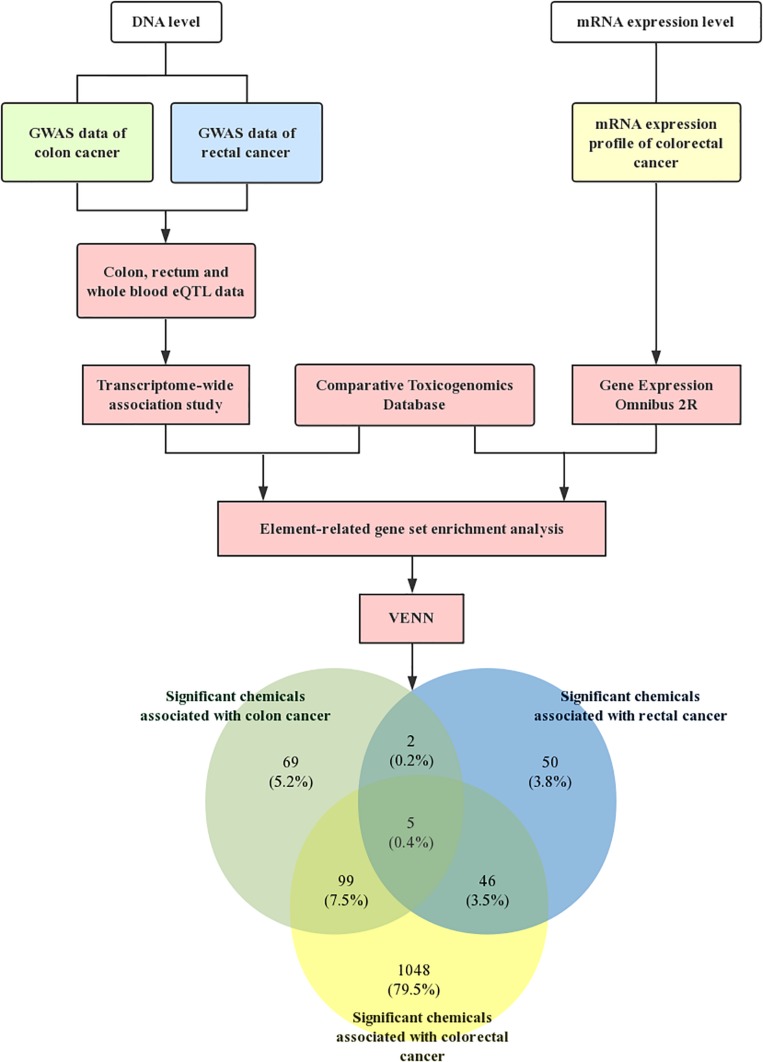
Colorectal cancer (CRC) is the third most common cancer and has the second highest mortality rate in global cancer. Exploring the associations between chemicals and CRC has great significance in prophylaxis and therapy of tumor diseases. This study aims to explore the relationships between CRC and environmental chemicals on genetic basis by bioinformatics analysis. The genome-wide association study (GWAS) datasets for CRC were obtained from the UK Biobank. The GWAS data for colon cancer (category C18) includes 2,581 individuals and 449,683 controls, while that of rectal cancer (category C20) includes 1,244 individuals and 451,020 controls. In addition, we derived CRC gene expression datasets from the NCBI-GEO (GSE106582). The chemicals related gene sets were acquired from the comparative toxicogenomics database (CTD). Transcriptome-wide association study (TWAS) analysis was applied to CRC GWAS summary data and calculated the expression association testing statistics by FUSION software. We performed chemicals related gene set enrichment analysis (GSEA) by integrating GWAS summary data, mRNA expression profiles of CRC and the CTD chemical-gene interaction networks to identify relationships between chemicals and genes of CRC. We observed several significant correlations between chemicals and CRC. Meanwhile, we also detected 5 common chemicals between colon and rectal cancer, including methylnitronitrosoguanidine, isoniazid, PD 0325901, sulindac sulfide, and importazole. Our study performed TWAS and GSEA analysis, linked prior knowledge to newly generated data and thereby helped identifying chemicals related to tumor genes, which provides new clues for revealing the associations between environmental chemicals and cancer.
结直肠癌(CRC)是全球第三大常见癌症,在所有癌症中死亡率位居第二。探索化学物质与结直肠癌之间的关联对于肿瘤疾病的预防和治疗具有重要意义。本研究旨在通过生物信息学分析,在基因层面探索结直肠癌与环境化学物质之间的关系。结直肠癌的全基因组关联研究(GWAS)数据集来自英国生物银行。结肠癌(C18类)的GWAS数据包括2581名个体和449683名对照,而直肠癌(C20类)的GWAS数据包括1244名个体和451020名对照。此外,我们从NCBI-GEO(GSE106582)获得了结直肠癌基因表达数据集。与化学物质相关的基因集来自比较毒理基因组学数据库(CTD)。将转录组范围关联研究(TWAS)分析应用于结直肠癌GWAS汇总数据,并通过FUSION软件计算表达关联测试统计量。我们通过整合GWAS汇总数据、结直肠癌的mRNA表达谱和CTD化学-基因相互作用网络,进行了与化学物质相关的基因集富集分析(GSEA),以确定化学物质与结直肠癌基因之间的关系。我们观察到化学物质与结直肠癌之间存在若干显著相关性。同时,我们还在结肠癌和直肠癌之间检测到5种常见化学物质,包括甲基硝基亚硝基胍、异烟肼、PD 0325901、舒林酸硫化物和咪唑。我们的研究进行了TWAS和GSEA分析,将先验知识与新生成的数据联系起来,从而有助于识别与肿瘤基因相关的化学物质,为揭示环境化学物质与癌症之间的关联提供了新线索。