Richard Manon M S, Knip Marijn, Aalders Thomas, Beijaert Machiel S, Takken Frank L W
Swammerdam Institute for Life Sciences (SILS), Molecular Plant Pathology, University of Amsterdam, Amsterdam, Netherlands.
Front Genet. 2020 Apr 24;11:417. doi: 10.3389/fgene.2020.00417. eCollection 2020.
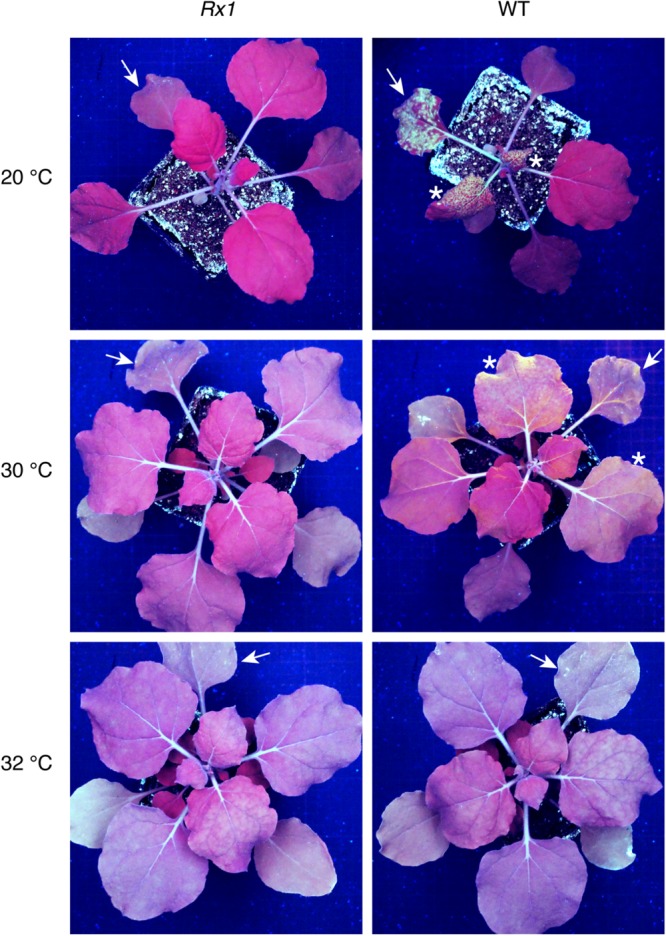
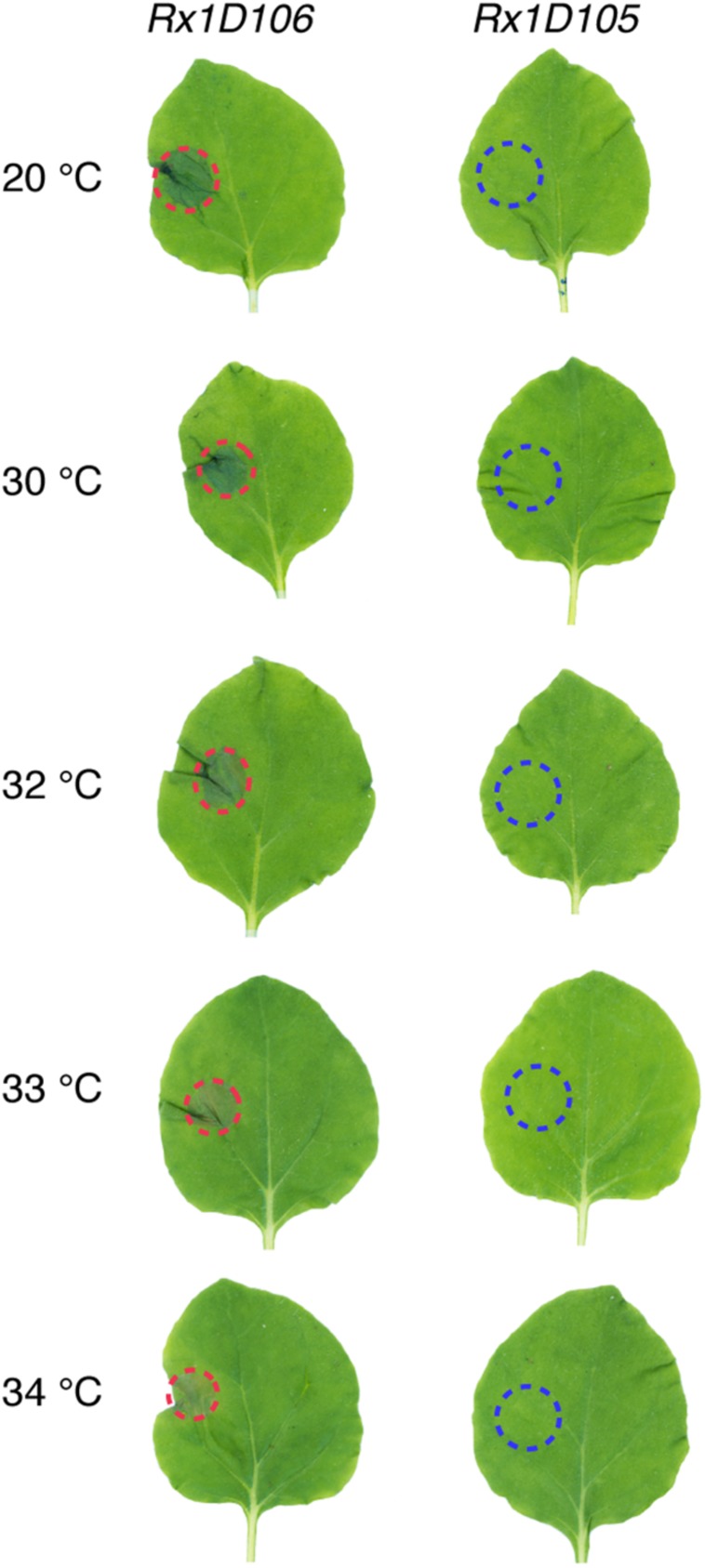
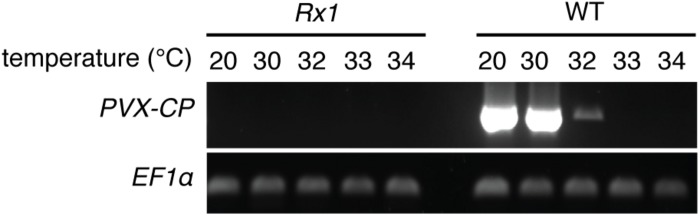
Specificity in the plant immune system is mediated by Resistance (R) proteins. Most R genes encode intracellular NLR-type immune receptors and these pathogen sensors require helper NLRs to activate immune signaling upon pathogen perception. Resistance conferred by many R genes is temperature sensitive and compromised above 28°C. Many Solanaceae R genes, including the potato NLR Rx1 conferring resistance to Potato Virus X (PVX), have been reported to be temperature labile. Rx1 activity, like many Solanaceae NLRs, depends on helper-NLRs called NRC's. In this study, we investigated Rx1 resistance at elevated temperatures in potato and in plants stably expressing upon rub-inoculation with GFP-expressing PVX particles. In parallel, we used susceptible plants as a control to assess infectiousness of PVX at a range of different temperatures. Surprisingly, we found that Rx1 confers virus resistance in up to 32°C, a temperature at which the PVX::GFP lost infectiousness. Furthermore, at 34°C, an Rx1-mediated hypersensitive response could still be triggered in upon PVX Coat-Protein overexpression. As the Rx1-immune signaling pathway is not temperature compromised, this implies that at least one helper NRC and its downstream signaling components are temperature tolerant. This finding suggests that the temperature sensitivity for Solanaceous resistances is likely attributable to the sensor NLR and not to its downstream signaling components.
植物免疫系统的特异性由抗性(R)蛋白介导。大多数R基因编码细胞内NLR型免疫受体,这些病原体传感器需要辅助NLR在感知病原体时激活免疫信号。许多R基因赋予的抗性对温度敏感,在28°C以上会受到影响。据报道,包括赋予马铃薯X病毒(PVX)抗性的马铃薯NLR Rx1在内的许多茄科R基因对温度不稳定。与许多茄科NLR一样,Rx1的活性依赖于称为NRC的辅助NLR。在本研究中,我们研究了马铃薯以及通过摩擦接种表达绿色荧光蛋白的PVX颗粒而稳定表达的植物在高温下的Rx1抗性。同时,我们使用易感植物作为对照,评估PVX在一系列不同温度下的感染性。令人惊讶的是,我们发现Rx1在高达32°C时赋予病毒抗性,在这个温度下PVX::GFP失去感染性。此外,在34°C时,通过PVX外壳蛋白过表达仍可在植物中触发Rx1介导的过敏反应。由于Rx1免疫信号通路不受温度影响,这意味着至少一种植物辅助NRC及其下游信号成分对温度具有耐受性。这一发现表明,茄科抗性的温度敏感性可能归因于传感NLR,而不是其下游信号成分。