Abdalla Pedro Pugliesi, Carvalho Andesron Dos Santos, Dos Santos André Pereira, Venturini Ana Claudia Rossini, Alves Thiago Cândido, Mota Jorge, Machado Dalmo Roberto Lopes
1College of Nursing of the University of Sao Paulo at Ribeirao Preto (EERP/USP), Avenida dos Bandeirantes, 3900, Ribeirão Preto, SP 14040-902 Brazil.
2Paulista University, Physical Education, Avenida Presidente Juscelino Kubitschek de Oliveira, w/ no, São José do Rio Preto, 15092-415 SP Brazil.
BMC Sports Sci Med Rehabil. 2020 May 6;12:29. doi: 10.1186/s13102-020-00178-9. eCollection 2020.
Dynamic knee extensor muscle strength is a valid measure among healthy older adults but has not been tested in the sarcopenia condition. This study's objective was to test the validity of a one-repetition submaximal strength protocol to measure dynamic knee extension strength in older adults with and without sarcopenia.
Ninety-four physically independent older adults (female: = 64, 60 to 85 years; male: = 29, 60 to 85 years) participated in this study in Brazil during 2016-2017. Sarcopenia was classified and isokinetic unilateral knee extension strength was measured at 60°/s. Bilateral dynamic knee extension strength was estimated with an extensor chair using one-repetition submaximal protocol. Validity was determined using Spearman's correlation with isokinetic muscle strength.
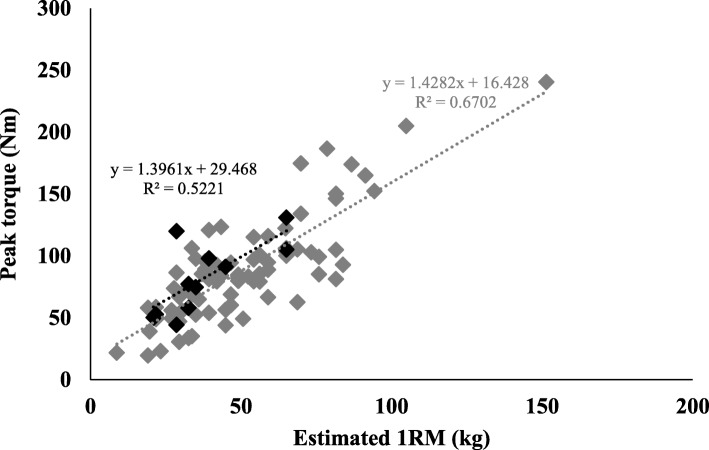
The frequency of sarcopenia was 11.7%. Sarcopenic individuals presented lower body mass, body mass index and skeletal muscle index. Only chronological age was higher among the sarcopenic individuals. A high correlation was found between isokinetic unilateral knee extension strength and bilateral estimated one-repetition with submaximal protocol (r = 0.74; < 0.001), when the presence (r = 0.71; = 0.014) and absence of sarcopenia (r = 0.74; p < 0.001) were considered. The validity of the one-repetition submaximal protocol for bilateral knee extension was confirmed.
The estimated measure of bilateral knee extension muscle strength can be used to monitor adaptations promoted by physical exercise for older adults with and without sarcopenia. The validation enable studies that will propose cutoff points to identify sarcopenia with this submaximal protocol. This will enable early diagnosis and better management of sarcopenia, a disease with adverse impacts for older adults.
动态伸膝肌力量在健康老年人中是一种有效的测量指标,但尚未在肌肉减少症患者中进行测试。本研究的目的是测试一次重复次最大力量方案在测量有或无肌肉减少症的老年人动态伸膝力量方面的有效性。
2016年至2017年期间,94名身体独立的老年人(女性=64名,年龄60至85岁;男性=29名,年龄60至85岁)在巴西参与了本研究。对肌肉减少症进行分类,并以60°/秒的速度测量等速单侧伸膝力量。使用伸肌椅通过一次重复次最大方案估计双侧动态伸膝力量。通过与等速肌肉力量的Spearman相关性确定有效性。
肌肉减少症的发生率为11.7%。肌肉减少症患者的体重、体重指数和骨骼肌指数较低。只有年龄在肌肉减少症患者中较高。当考虑存在(r=0.71;p=0.014)和不存在肌肉减少症(r=0.74;p<0.001)时,等速单侧伸膝力量与双侧估计的一次重复次最大方案之间存在高度相关性(r=0.74;p<0.001)。一次重复次最大方案用于双侧伸膝的有效性得到证实。
双侧伸膝肌力量的估计测量可用于监测有或无肌肉减少症的老年人体育锻炼所促进的适应性变化。该验证使得能够开展研究,提出使用此亚最大方案识别肌肉减少症的临界点。这将有助于早期诊断和更好地管理肌肉减少症,这是一种对老年人有不利影响的疾病。