School of Kinesiology, Shanghai University of Sport, Shanghai, 200438, China.
Department of Rehabilitation, Xinhua Hospital Chongming Branch, Shanghai, China.
Trials. 2021 Aug 4;22(1):518. doi: 10.1186/s13063-021-05495-z.
Sarcopenia is accompanied by a decline in muscle mass, muscle strength, and muscle function. Resistance training is the most potential training method for the prevention and treatment of sarcopenia. However, the conventional high-load resistance training (CRT) recommended by the American College of Sports Medicine is a challenge for older people with sarcopenia. As a novel training method, low-load resistance training combined with blood flow restriction (LRT-BFR) may elicit similar muscle mass and muscle strength gains as CRT but with less effort. The objectives of this study are to assess and compare the efficacy and safety of 12-week LRT-BFR and CRT on muscle strength, muscle performance, body composition, pulmonary function, blood biomarkers, CVD risk factors, and quality of life in community-dwelling older Chinese people with sarcopenia.
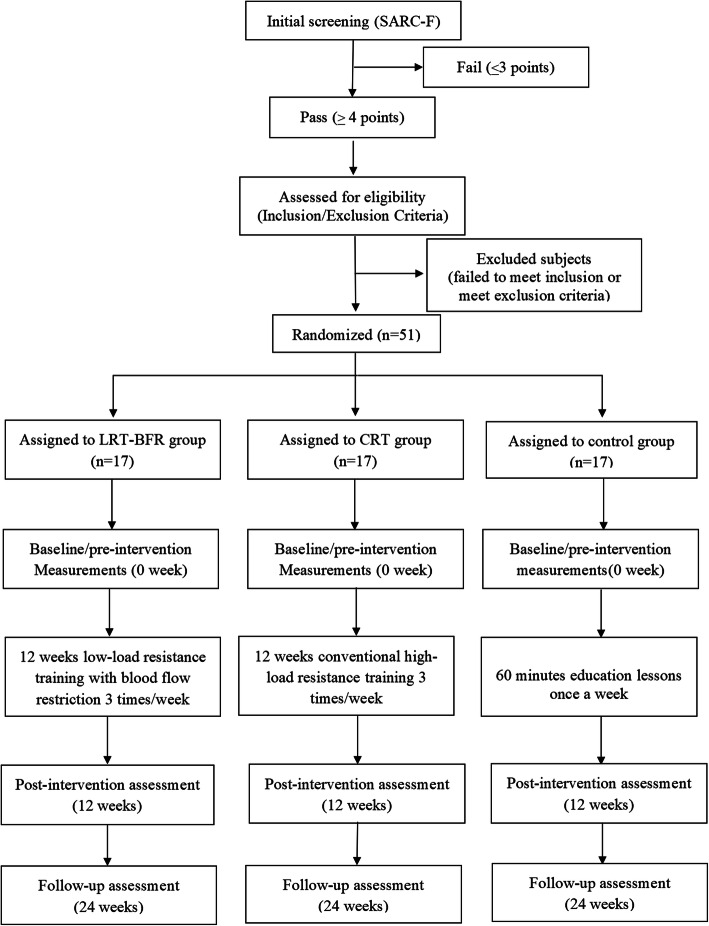
This is a 12-week, assessor-blinded, 3-arm randomized controlled trial with a non-exercise control group. Community-dwelling people over 65 years will be screened for sarcopenia according to the diagnostic criteria of the Asian Working Group for Sarcopenia (AWGS). Fifty-one subjects will be randomized into a LRT-BFR group (n = 17), a CRT group (n = 17), and a no-strength training control group (n = 17). The primary outcome is lower limb muscle strength. The secondary outcomes are body composition, upper limb muscle strength, pulmonary function, blood biomarkers, CVD risk factors, and quality of life. Post-intervention follow-up will be performed for 12 weeks. These indicators will be assessed at baseline (0 week), after the 12-week intervention (12 weeks), and at follow-up (24 weeks). The adverse events will also be reported. Data will be analyzed for all participants in an intent-to-treat plan.
This study is the first RCT that will systematically measure and compare the efficacy and safety of LRT-BFR and CRT in older people with sarcopenia on muscle strength, body composition, pulmonary function, blood biomarkers (inflammatory biomarkers, hormone, and growth factors), CVD risk factors, and quality of life. This study can provide an efficient and safe method to prevent the progression of sarcopenia in older people.
Chinese Clinical Trial Registry ChiCTR2100042803 . Registered on 28 January 2021.
肌少症伴随着肌肉质量、肌肉力量和肌肉功能的下降。阻力训练是预防和治疗肌少症最有潜力的训练方法。然而,美国运动医学学院推荐的传统高负荷阻力训练(CRT)对患有肌少症的老年人来说是一个挑战。作为一种新的训练方法,低负荷阻力训练结合血流限制(LRT-BFR)可能会产生与 CRT 相似的肌肉质量和肌肉力量增加,但难度较小。本研究的目的是评估和比较 12 周 LRT-BFR 和 CRT 对肌肉力量、肌肉表现、身体成分、肺功能、血液生物标志物、心血管疾病危险因素和生活质量的疗效和安全性,比较社区居住的中国老年人肌少症患者。
这是一项 12 周、评估者盲法、3 臂随机对照试验,设有非运动对照组。根据亚洲肌少症工作组(AWGS)的诊断标准,对 65 岁以上的社区居民进行肌少症筛查。51 名受试者将被随机分为 LRT-BFR 组(n = 17)、CRT 组(n = 17)和无力量训练对照组(n = 17)。主要结局是下肢肌肉力量。次要结局是身体成分、上肢肌肉力量、肺功能、血液生物标志物、心血管疾病危险因素和生活质量。干预后随访 12 周。这些指标将在基线(0 周)、12 周干预后(12 周)和随访(24 周)时进行评估。还将报告不良事件。将按照意向治疗计划对所有参与者进行数据分析。
这是第一项 RCT,将系统地测量和比较 LRT-BFR 和 CRT 在肌肉力量、身体成分、肺功能、血液生物标志物(炎症生物标志物、激素和生长因子)、心血管疾病危险因素和生活质量方面对肌少症老年人的疗效和安全性。这项研究可以为预防老年人肌少症的进展提供一种有效和安全的方法。
中国临床试验注册中心 ChiCTR2100042803 。于 2021 年 1 月 28 日注册。