Pan Elizabeth, Bogumil David, Cortessis Victoria, Yu Sherrie, Nieva Jorge
Department of Medical Oncology, Norris Comprehensive Cancer Center, Los Angeles, CA, United States.
Department of Epidemiology, University of Southern California, Los Angeles, CA, United States.
Front Oncol. 2020 Apr 23;10:591. doi: 10.3389/fonc.2020.00591. eCollection 2020.
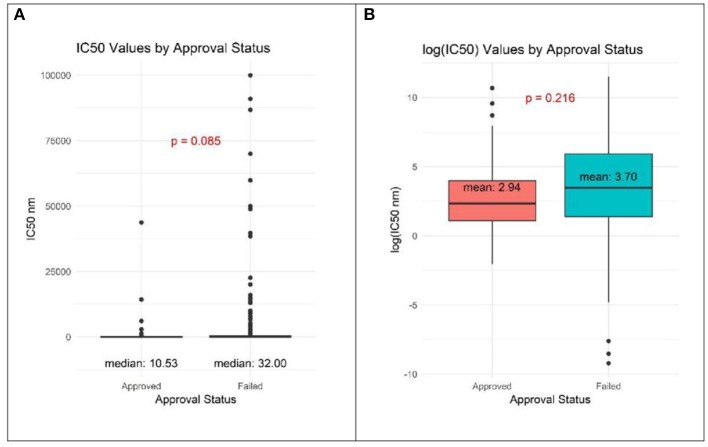
Preclinical cell models are the mainstay in the early stages of drug development. We sought to explore the preclinical data that differentiated successful from failed therapeutic agents in lung cancer. One hundred thirty-four failed lung cancer drugs and twenty seven successful lung cancer drugs were identified. Preclinical data were evaluated. The independent variable for cell model experiments was the half maximal inhibitory concentration (IC50), and for murine model experiments was tumor growth inhibition (TGI). A logistic regression was performed on quartiles (Q) of IC50s and TGIs. We compared odds of approval among drugs defined by IC50 and TGI quartile. Compared to drugs with preclinical cell experiments in highest IC50 quartile (Q4, IC50 345.01-100,000 nM), those in Q3 differed little, but those in the lower two quartiles had better odds of being approved. However, there was no significant monotonic trend identified (P-trend 0.4). For preclinical murine models, TGI values ranged from -0.3119 to 1.0000, with a tendency for approved drugs to demonstrate poorer inhibition than failed drugs. Analyses comparing success of drugs according to TGI quartile produced interval estimates too wide to be statistically meaningful, although all point estimates accord with drugs in Q2-Q4 (TGI 0.5576-0.7600, 0.7601-0.9364, 0.9365-1.0000) having lower odds of success than those in Q1 (-0.3119-0.5575). There does not appear to be a significant linear trend between preclinical success and drug approval, and therefore published preclinical data does not predict success of therapeutics in lung cancer. Newer models with predictive power would be beneficial to drug development efforts.
临床前细胞模型是药物研发早期阶段的主要支柱。我们试图探索能区分肺癌治疗药物成功与失败的临床前数据。确定了134种失败的肺癌药物和27种成功的肺癌药物。对临床前数据进行了评估。细胞模型实验的自变量是半数最大抑制浓度(IC50),小鼠模型实验的自变量是肿瘤生长抑制(TGI)。对IC50和TGI的四分位数进行了逻辑回归分析。我们比较了由IC50和TGI四分位数定义的药物获批几率。与临床前细胞实验中IC50处于最高四分位数(Q4,IC50为345.01 - 100,000 nM)的药物相比,Q3中的药物差异不大,但较低两个四分位数中的药物获批几率更高。然而,未发现显著的单调趋势(P趋势为0.4)。对于临床前小鼠模型,TGI值范围为 - 0.3119至1.0000,获批药物的抑制作用往往比失败药物更差。根据TGI四分位数比较药物成功情况的分析产生的区间估计太宽,无统计学意义,尽管所有点估计都表明Q2 - Q4(TGI为0.5576 - 0.7600、0.7601 - 0.9364、0.9365 - 1.0000)中的药物成功几率低于Q1( - 0.3119 - 0.5575)中的药物。临床前成功与药物获批之间似乎不存在显著的线性趋势,因此已发表的临床前数据无法预测肺癌治疗药物的成功。具有预测能力的新型模型将有助于药物研发工作。