Wiedemann Christoph, Kumar Amit, Lang Andras, Ohlenschläger Oliver
Institute of Biochemistry and Biotechnology, Martin Luther University Halle-Wittenberg, Halle, Germany.
Leibniz Institute on Aging - Fritz Lipmann Institute, Jena, Germany.
Front Chem. 2020 Apr 23;8:280. doi: 10.3389/fchem.2020.00280. eCollection 2020.
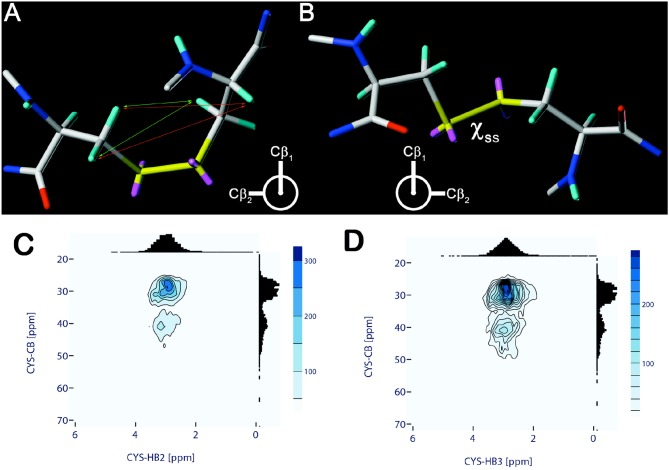
Disulfide bridges establish a fundamental element in the molecular architecture of proteins and peptides which are involved e.g., in basic biological processes or acting as toxins. NMR spectroscopy is one method to characterize the structure of bioactive compounds including cystine-containing molecules. Although the disulfide bridge itself is invisible in NMR, constraints obtained via the neighboring NMR-active nuclei allow to define the underlying conformation and thereby to resolve their functional background. In this mini-review we present shortly the impact of cysteine and disulfide bonds in the proteasome from different domains of life and give a condensed overview of recent NMR applications for the characterization of disulfide-bond containing biomolecules including advantages and limitations of the different approaches.
二硫键是蛋白质和肽分子结构中的一个基本元素,这些蛋白质和肽参与例如基本的生物过程或作为毒素发挥作用。核磁共振光谱法是表征包括含胱氨酸分子在内的生物活性化合物结构的一种方法。尽管二硫键本身在核磁共振中不可见,但通过相邻的具有核磁共振活性的原子核获得的限制条件有助于确定其潜在构象,从而解析其功能背景。在本综述中,我们简要介绍了来自不同生命域的蛋白酶体中半胱氨酸和二硫键的影响,并简要概述了最近用于表征含二硫键生物分子的核磁共振应用,包括不同方法的优缺点。