Hoda Shanu, Gupta Lovely, Shankar Jata, Gupta Alok Kumar, Vijayaraghavan Pooja
Antimycotic and Drug Susceptibility Laboratory, J3 Block, Amity Institute of Biotechnology, Sector-125, Amity University Uttar Pradesh, Noida 201301, India.
Genomic Laboratory, Department of Biotechnology and Bioinformatics, Jaypee University of Information Technology, Solan 173212, Himachal Pradesh, India.
ACS Omega. 2020 Apr 21;5(17):10077-10088. doi: 10.1021/acsomega.0c00615. eCollection 2020 May 5.
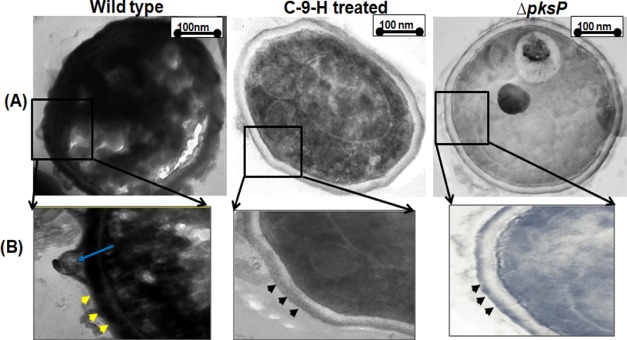
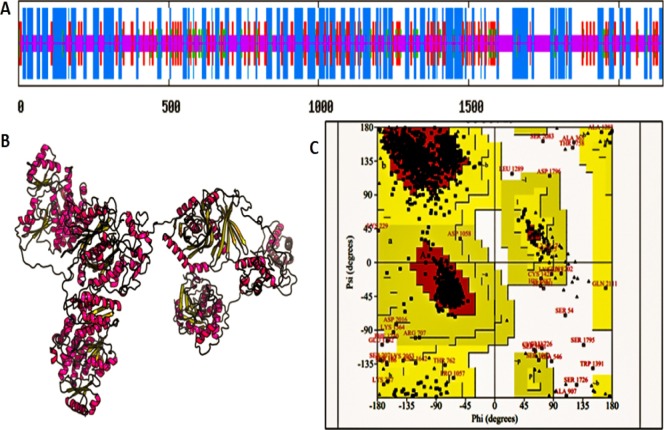
causes several nosocomial pulmonary infections and accounts for high morbidity and mortality rate globally. Among various virulence factors, 1,8-dihydroxynaphthalene-melanin plays an important role in the survival during unfavorable conditions both and , masks various molecular patterns associated with and protects it from the host immune system. In the present study, we aim to understand the potential of -9-hexadecenal as an antimelanogenic compound and its role in modulating other associated virulence factors in . -9-Hexadecenal is a bioactive compound that belongs to C mono-unsaturated fatty-aldehyde groups. Minimum effective concentration of -9-hexadecenal affecting melanin biosynthesis was determined using broth microdilution method. The spectrophotometric analysis revealed reduced melanin content (91%) and hydrophobicity (59%) at 0.293 mM of -9-hexadecenal. Cell surface organizational changes using electron microscopy showed altered demelanized smooth conidial surface without any protrusions after -9-hexadecenal treatment. The transcript analysis of polyketide synthase (PKS) / gene was quantified through qRT-PCR which revealed an upregulated expression. Total proteome profiling conducted through LC-MS-MS showed upregulated PKS enzyme but other downstream proteins involved in the 1,8-dihydroxynaphthalene-melanin biosynthesis pathway were absent. The homology modeling of PKS using Expasy's web server predicted that PKS is stable at varied conditions and is hydrophilic in nature. The Ramachandran plot by PROCHECK confirmed the 3-D structure of PKS to be reliable. Docking analysis using AutoDock-4.2.6 predicted the binding of -9-hexadecenal and PKS at Thr-264 and Ser-171 residue via hydrogen bonding at a low binding energy of -4.95 kcal/mol.
会引发多种医院内肺部感染,在全球范围内导致高发病率和死亡率。在各种毒力因子中,1,8 - 二羟基萘黑色素在不利条件下的生存中起着重要作用,既能掩盖与[具体内容缺失]相关的各种分子模式,又能保护其免受宿主免疫系统的攻击。在本研究中,我们旨在了解反 - 9 - 十六碳烯醛作为一种抗黑色素生成化合物的潜力及其在调节[具体内容缺失]中其他相关毒力因子方面的作用。反 - 9 - 十六碳烯醛是一种生物活性化合物,属于C单不饱和脂肪醛类。使用肉汤微量稀释法测定了影响[具体内容缺失]黑色素生物合成的反 - 9 - 十六碳烯醛的最低有效浓度。分光光度分析显示,在0.293 mM的反 - 9 - 十六碳烯醛作用下,黑色素含量降低了91%,疏水性降低了59%。使用电子显微镜进行的细胞表面组织变化分析表明,反 - 9 - 十六碳烯醛处理后,脱黑色素的光滑分生孢子表面发生改变,没有任何突起。通过qRT - PCR对聚酮合酶(PKS)/[基因名称缺失]基因进行转录分析,结果显示表达上调。通过LC - MS - MS进行的总蛋白质组分析显示PKS酶上调,但参与1,8 - 二羟基萘黑色素生物合成途径的其他下游蛋白质缺失。使用Expasy的网络服务器对PKS进行同源建模预测,PKS在不同条件下稳定,本质上是亲水性的。PROCHECK的拉氏图证实PKS的三维结构可靠。使用AutoDock - 4.2.6进行的对接分析预测,反 - 9 - 十六碳烯醛与PKS在Thr - 264和Ser - 171残基处通过氢键结合,结合能低至 - 4.95 kcal/mol。