Ragon Institute of MGH, MIT and Harvard, Cambridge, Massachusetts, United States of America.
Department of Virology, Harvard Medical School, Boston, Massachusetts, United States of America.
PLoS Pathog. 2020 May 11;16(5):e1008577. doi: 10.1371/journal.ppat.1008577. eCollection 2020 May.
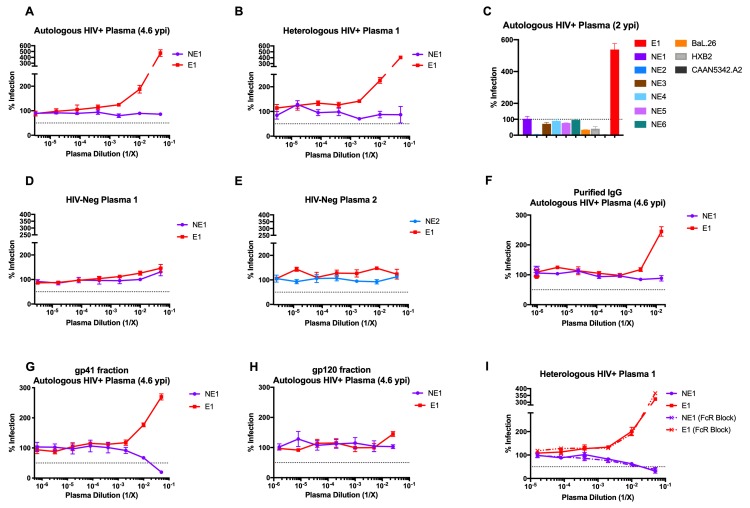
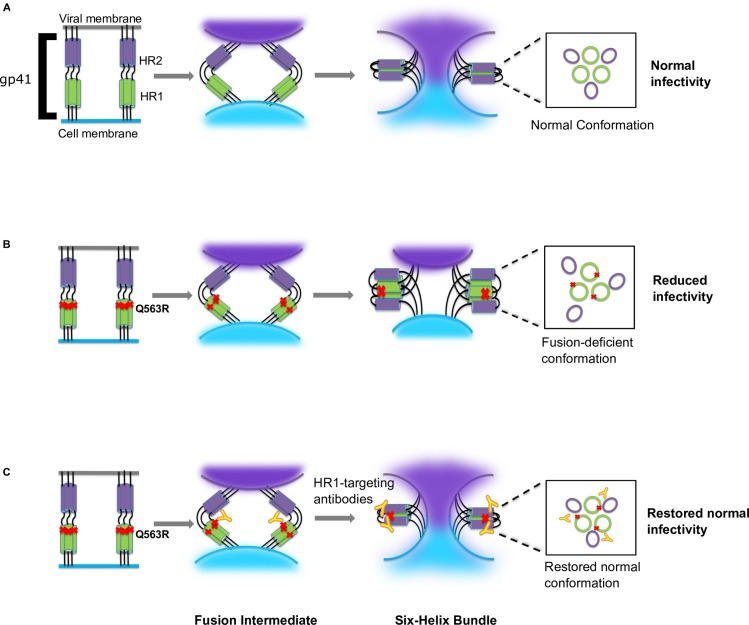
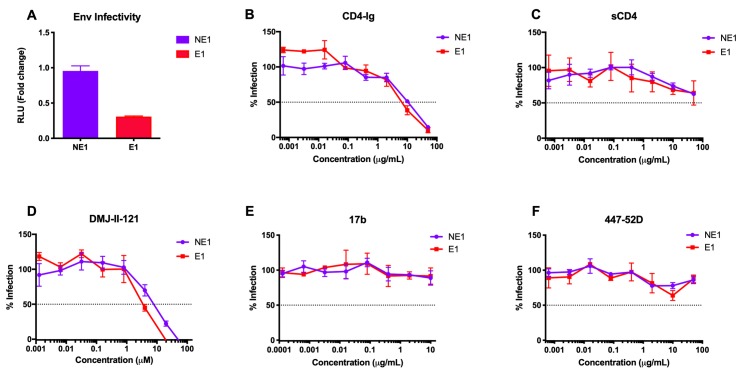
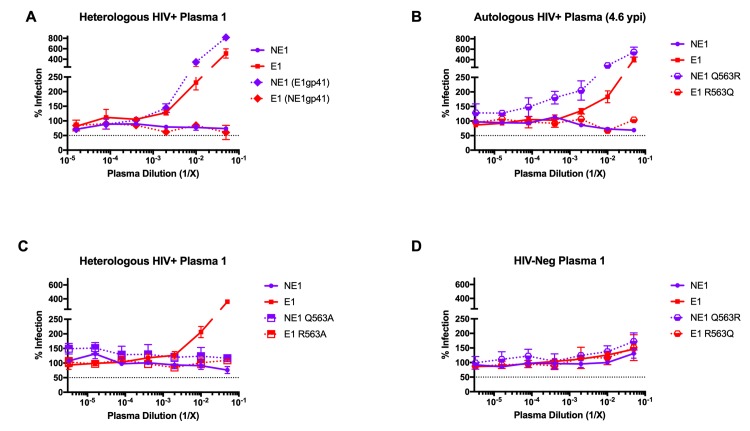
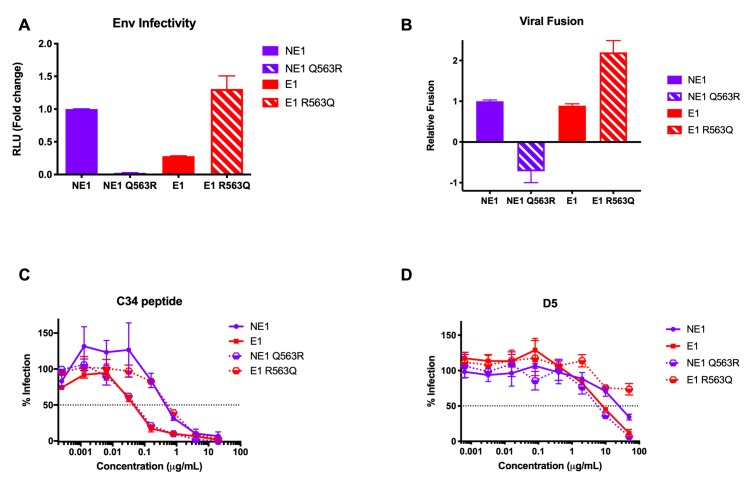
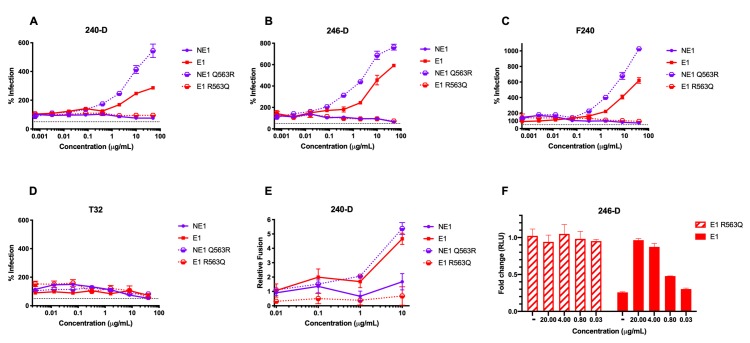
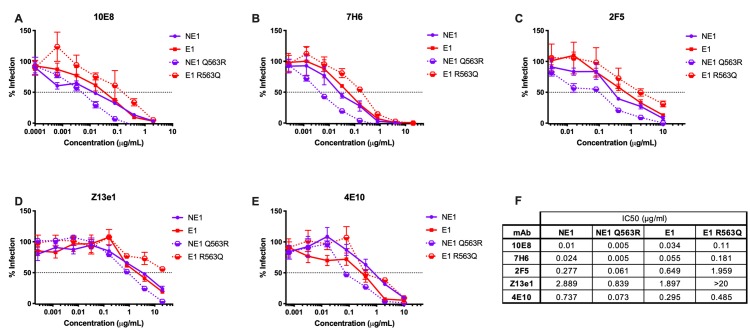
The HIV-1 envelope glycoprotein (Env) mediates viral entry via conformational changes associated with binding the cell surface receptor (CD4) and coreceptor (CCR5/CXCR4), resulting in subsequent fusion of the viral and cellular membranes. While the gp120 Env surface subunit has been extensively studied for its role in viral entry and evasion of the host immune response, the gp41 transmembrane glycoprotein and its role in natural infection are less well characterized. Here, we identified a primary HIV-1 Env variant that consistently supports >300% increased viral infectivity in the presence of autologous or heterologous HIV-positive plasma. However, in the absence of HIV-positive plasma, viruses with this Env exhibited reduced infectivity that was not due to decreased CD4 binding. Using Env chimeras and sequence analysis, we mapped this phenotype to a change Q563R, in the gp41 heptad repeat 1 (HR1) region. We demonstrate that Q563R reduces viral infection by disrupting formation of the gp41 six-helix bundle required for virus-cell membrane fusion. Intriguingly, antibodies that bind cluster I epitopes on gp41 overcome this inhibitory effect, restoring infectivity to wild-type levels. We further demonstrate that the Q563R change increases HIV-1 sensitivity to broadly neutralizing antibodies (bNAbs) targeting the gp41 membrane-proximal external region (MPER). In summary, we identify an HIV-1 Env variant with impaired infectivity whose Env functionality is restored through the binding of host antibodies. These data contribute to our understanding of gp41 residues involved in membrane fusion and identify a mechanism by which host factors can alleviate a viral defect.
HIV-1 包膜糖蛋白(Env)通过与细胞表面受体(CD4)和共受体(CCR5/CXCR4)结合相关的构象变化介导病毒进入,导致病毒和细胞膜随后融合。虽然 gp120 Env 表面亚基因其在病毒进入和逃避宿主免疫反应中的作用而得到广泛研究,但 gp41 跨膜糖蛋白及其在自然感染中的作用的了解较少。在这里,我们鉴定了一种主要的 HIV-1 Env 变体,它在存在同源或异源 HIV 阳性血浆的情况下始终支持超过 300%的病毒感染力增加。然而,在没有 HIV 阳性血浆的情况下,具有这种 Env 的病毒表现出降低的感染力,这不是由于 CD4 结合减少引起的。使用 Env 嵌合体和序列分析,我们将这种表型映射到 gp41 七螺旋重复 1(HR1)区域的 Q563R 变化上。我们证明,Q563R 通过破坏形成 gp41 六螺旋束的形成来减少病毒感染,该六螺旋束对于病毒-细胞膜融合是必需的。有趣的是,结合 gp41 簇 I 表位的抗体克服了这种抑制作用,将感染性恢复到野生型水平。我们进一步证明,Q563R 变化增加了 HIV-1 对靶向 gp41 膜近端外部区域(MPER)的广泛中和抗体(bNAb)的敏感性。总之,我们鉴定了一种具有受损感染力的 HIV-1 Env 变体,其 Env 功能通过宿主抗体的结合得到恢复。这些数据有助于我们了解参与膜融合的 gp41 残基,并确定宿主因子可以减轻病毒缺陷的机制。