Children's Health Policy Centre, Faculty of Health Sciences, Simon Fraser University, Room 2431, 515 West Hastings Street, Vancouver, BC, V6B 5K3, Canada.
School of Nursing, Faculty of Human and Social Development, University of Victoria, Victoria, BC, Canada.
Trials. 2020 May 11;21(1):393. doi: 10.1186/s13063-020-04328-9.
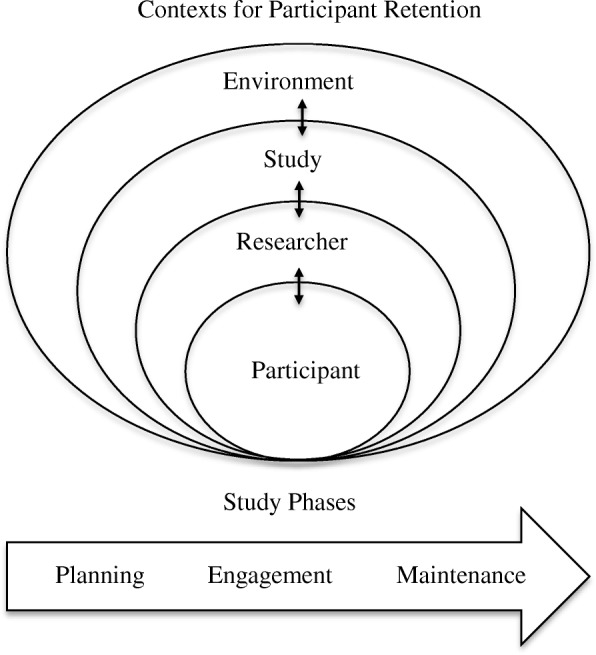
Effective strategies for participant retention are critical in health research to ensure validity, generalizability and efficient use of resources. Yet standardized guidelines for planning and reporting on retention efforts have been lacking. As with randomized controlled trial (RCT) and systematic review (SR) protocols, retention protocols are an opportunity to improve transparency and rigor. An RCT being conducted in British Columbia (BC), Canada provides a case example for developing a priori retention frameworks for use in protocol planning and reporting.
The BC Healthy Connections Project RCT is examining the effectiveness of a nurse home-visiting program in improving child and maternal outcomes compared with existing services. Participants (N = 739) were girls and young women preparing to parent for the first time and experiencing socioeconomic disadvantage. Quantitative data were collected upon trial entry during pregnancy and during five follow-up interviews until participants' children reached age 2 years. A framework was developed to guide retention of this study population throughout the RCT. We reviewed relevant literature and mapped essential retention activities across the study planning, recruitment and maintenance phases. Interview completion rates were tracked.
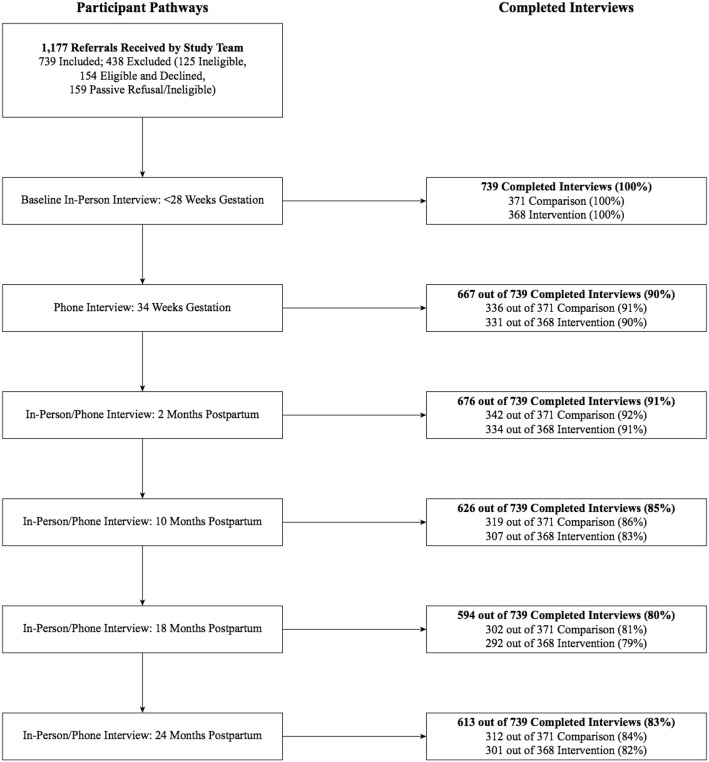
Results from 3302 follow-up interviews (in-person/telephone) conducted over 4 years indicate high completion rates: 90% (n = 667) at 34 weeks gestation; and 91% (n = 676), 85% (n = 626), 80% (n = 594) and 83% (n = 613) at 2, 10, 18 and 24 months postpartum, respectively. Almost all participants (99%, n = 732) provided ongoing consent to access administrative health data. These results provide preliminary data on the success of the framework.
Our retention results are encouraging given that participants were experiencing considerable socioeconomic disadvantage. Standardized retention planning and reporting may therefore be feasible for health research in general, using the framework we have developed. Use of standardized retention protocols should be encouraged in research to promote consistency across diverse studies, as now happens with RCT and SR protocols. Beyond this, successful retention approaches may help inform health policy-makers and practitioners who also need to better reach, engage and retain underserved populations.
ClinicalTrials.gov, NCT01672060. Registered on 24 August 2012.
在健康研究中,有效的参与者保留策略对于确保有效性、可推广性和资源的有效利用至关重要。然而,缺乏规划和报告保留工作的标准化指南。与随机对照试验(RCT)和系统评价(SR)方案一样,保留方案是提高透明度和严谨性的机会。正在加拿大不列颠哥伦比亚省(BC)进行的一项 RCT 为制定用于方案规划和报告的预先保留框架提供了一个案例研究。
BC 健康连接项目 RCT 正在研究护士家访计划在改善儿童和产妇结局方面的有效性,与现有服务相比。参与者(N=739)是首次准备为人父母且处于社会经济劣势的女孩和年轻女性。在妊娠期间和五次随访访谈期间收集了定量数据,直到参与者的孩子达到 2 岁。制定了一个框架来指导整个 RCT 期间对该研究人群的保留。我们回顾了相关文献,并绘制了研究规划、招募和维持阶段的基本保留活动图。跟踪了访谈完成率。
在 4 年期间进行的 3302 次随访访谈(面对面/电话)的结果表明,完成率很高:妊娠 34 周时为 90%(n=667);产后 2、10、18 和 24 个月时分别为 91%(n=676)、85%(n=626)、80%(n=594)和 83%(n=613)。几乎所有参与者(99%,n=732)都同意继续访问行政健康数据。这些结果提供了该框架成功的初步数据。
鉴于参与者经历了相当大的社会经济劣势,我们的保留结果令人鼓舞。因此,标准化的保留规划和报告对于一般的健康研究可能是可行的,可以使用我们开发的框架。应该鼓励在研究中使用标准化的保留协议,以促进不同研究之间的一致性,就像现在对 RCT 和 SR 协议所做的那样。除此之外,成功的保留方法可能有助于为卫生政策制定者和从业者提供信息,他们也需要更好地接触、参与和保留服务不足的人群。
ClinicalTrials.gov,NCT01672060。于 2012 年 8 月 24 日注册。