Department of Translational Research in Psychiatry, Max Planck Institute of Psychiatry, Kraepelinstr. 2-10, 80804, Munich, Germany.
Max Planck Institute of Psychiatry, Munich, Germany.
BMC Psychiatry. 2020 May 11;20(1):213. doi: 10.1186/s12888-020-02541-z.
A major research finding in the field of Biological Psychiatry is that symptom-based categories of mental disorders map poorly onto dysfunctions in brain circuits or neurobiological pathways. Many of the identified (neuro) biological dysfunctions are "transdiagnostic", meaning that they do not reflect diagnostic boundaries but are shared by different ICD/DSM diagnoses. The compromised biological validity of the current classification system for mental disorders impedes rather than supports the development of treatments that not only target symptoms but also the underlying pathophysiological mechanisms. The Biological Classification of Mental Disorders (BeCOME) study aims to identify biology-based classes of mental disorders that improve the translation of novel biomedical findings into tailored clinical applications.
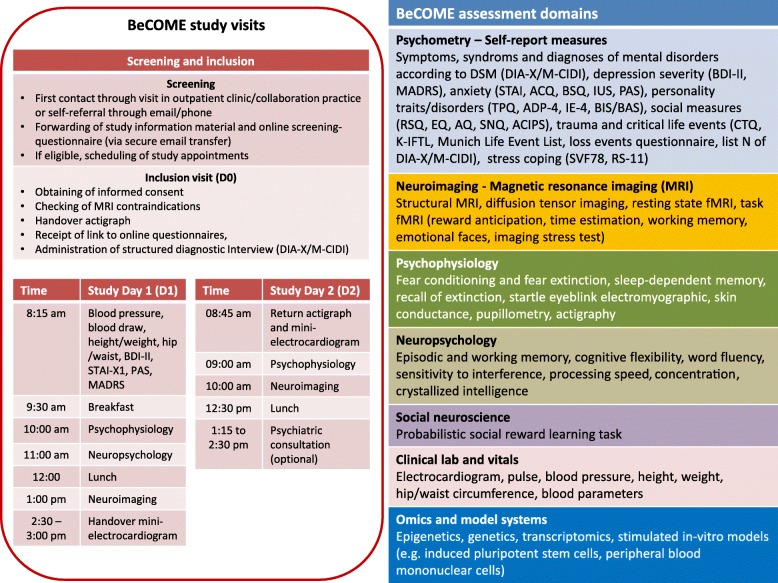
BeCOME intends to include at least 1000 individuals with a broad spectrum of affective, anxiety and stress-related mental disorders as well as 500 individuals unaffected by mental disorders. After a screening visit, all participants undergo in-depth phenotyping procedures and omics assessments on two consecutive days. Several validated paradigms (e.g., fear conditioning, reward anticipation, imaging stress test, social reward learning task) are applied to stimulate a response in a basic system of human functioning (e.g., acute threat response, reward processing, stress response or social reward learning) that plays a key role in the development of affective, anxiety and stress-related mental disorders. The response to this stimulation is then read out across multiple levels. Assessments comprise genetic, molecular, cellular, physiological, neuroimaging, neurocognitive, psychophysiological and psychometric measurements. The multilevel information collected in BeCOME will be used to identify data-driven biologically-informed categories of mental disorders using cluster analytical techniques.
The novelty of BeCOME lies in the dynamic in-depth phenotyping and omics characterization of individuals with mental disorders from the depression and anxiety spectrum of varying severity. We believe that such biology-based subclasses of mental disorders will serve as better treatment targets than purely symptom-based disease entities, and help in tailoring the right treatment to the individual patient suffering from a mental disorder. BeCOME has the potential to contribute to a novel taxonomy of mental disorders that integrates the underlying pathomechanisms into diagnoses.
Retrospectively registered on June 12, 2019 on ClinicalTrials.gov (TRN: NCT03984084).
生物精神病学领域的一项重要研究发现是,基于症状的精神障碍类别与大脑回路或神经生物学途径的功能障碍相关性较差。许多已确定的(神经)生物学功能障碍是“跨诊断”的,这意味着它们不反映诊断边界,而是由不同的 ICD/DSM 诊断所共有。当前精神障碍分类系统的生物学有效性受到限制,而不是支持开发不仅针对症状,而且针对潜在病理生理机制的治疗方法。生物精神障碍分类(BeCOME)研究旨在确定基于生物学的精神障碍类别,以提高新的生物医学发现转化为针对性临床应用的能力。
BeCOME 计划纳入至少 1000 名患有广泛的情感、焦虑和应激相关精神障碍的个体,以及 500 名未受精神障碍影响的个体。在筛查就诊后,所有参与者都要在连续两天内接受深入的表型和组学评估。应用多个已验证的范式(例如,恐惧条件反射、奖励预期、影像应激测试、社会奖励学习任务)来刺激人类基本功能系统的反应(例如,急性威胁反应、奖励处理、应激反应或社会奖励学习),该系统在情感、焦虑和应激相关精神障碍的发展中起着关键作用。然后在多个层面上读取对这种刺激的反应。评估包括遗传、分子、细胞、生理、神经影像学、神经认知、心理生理学和心理计量学测量。BeCOME 中收集的多层次信息将用于使用聚类分析技术确定数据驱动的、基于生物学的精神障碍类别。
BeCOME 的新颖之处在于对不同严重程度的抑郁和焦虑谱系的精神障碍患者进行动态深入的表型和组学特征描述。我们相信,这种基于生物学的精神障碍亚类将作为比单纯基于症状的疾病实体更好的治疗靶点,并有助于为患有精神障碍的个体量身定制合适的治疗方法。BeCOME 有可能为一种新的精神障碍分类学做出贡献,将潜在的病理机制纳入诊断。
于 2019 年 6 月 12 日在 ClinicalTrials.gov(TRN:NCT03984084)上进行了回顾性注册。