Carrillo-Larco Rodrigo M, Tudor Car Lorainne, Pearson-Stuttard Jonathan, Panch Trishan, Miranda J Jaime, Atun Rifat
Department of Epidemiology and Biostatistics, School of Public Health, Imperial College London, London, UK
CRONICAS Centre of Excellence in Chronic Diseases, Universidad Peruana Cayetano Heredia, Lima, Peru.
BMJ Open. 2020 May 10;10(5):e035983. doi: 10.1136/bmjopen-2019-035983.
Machine learning (ML) has been used in bio-medical research, and recently in clinical and public health research. However, much of the available evidence comes from high-income countries, where different health profiles challenge the application of this research to low/middle-income countries (LMICs). It is largely unknown what ML applications are available for LMICs that can support and advance clinical medicine and public health. We aim to address this gap by conducting a scoping review of health-related ML applications in LMICs.
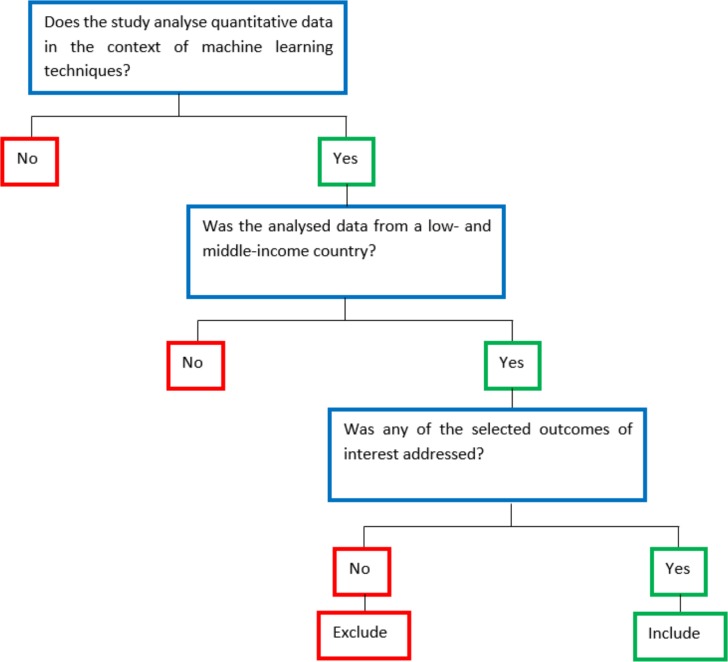
This scoping review will follow the methodology proposed by Levac . The search strategy is informed by recent systematic reviews of ML health-related applications. We will search Embase, Medline and Global Health (through Ovid), Cochrane and Google Scholar; we will present the date of our searches in the final review. Titles and abstracts will be screened by two reviewers independently; selected reports will be studied by two reviewers independently. Reports will be included if they are primary research where data have been analysed, ML techniques have been used on data from LMICs and they aimed to improve health-related outcomes. We will synthesise the information following evidence mapping recommendations.
The review will provide a comprehensive list of health-related ML applications in LMICs. The results will be disseminated through scientific publications. We also plan to launch a website where ML models can be hosted so that researchers, policymakers and the general public can readily access them.
机器学习(ML)已应用于生物医学研究,最近也应用于临床和公共卫生研究。然而,现有证据大多来自高收入国家,这些国家不同的健康状况对将此类研究应用于低收入/中等收入国家(LMICs)构成挑战。对于低收入/中等收入国家可用于支持和推进临床医学与公共卫生的机器学习应用,目前很大程度上尚不清楚。我们旨在通过对低收入/中等收入国家与健康相关的机器学习应用进行范围审查来填补这一空白。
本范围审查将遵循Levac提出的方法。搜索策略参考了近期对与机器学习健康相关应用的系统评价。我们将检索Embase、Medline和全球卫生数据库(通过Ovid)、Cochrane和谷歌学术;我们将在最终审查中列出搜索日期。标题和摘要将由两名评审员独立筛选;选定的报告将由两名评审员独立研究。如果报告是对数据进行了分析的原始研究,在低收入/中等收入国家的数据上使用了机器学习技术且旨在改善与健康相关的结果,则将其纳入。我们将按照证据映射建议综合信息。
该审查将提供一份低收入/中等收入国家与健康相关的机器学习应用的综合清单。结果将通过科学出版物传播。我们还计划推出一个可托管机器学习模型的网站,以便研究人员、政策制定者和公众能够方便地访问它们。