Translational Medicine Research Center (TMRC), School of Pharmaceutical Science, Xiamen University, Xiamen, Fujian, China.
Department of oncology, Xiamen Fifth hospital, Xiamen, China.
J Cell Mol Med. 2020 Jun;24(12):6869-6882. doi: 10.1111/jcmm.15344. Epub 2020 May 12.
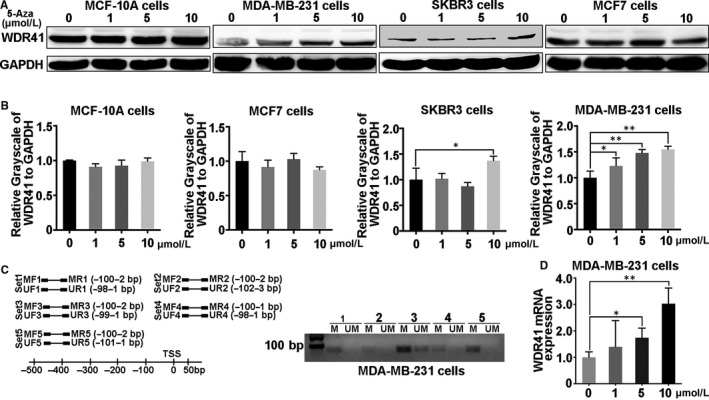
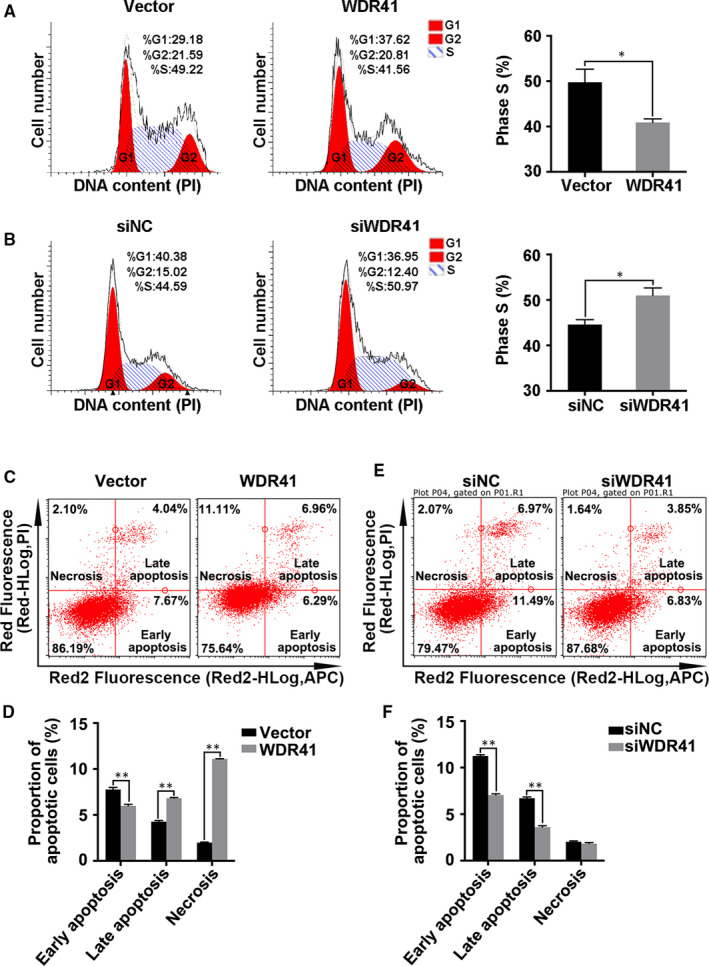
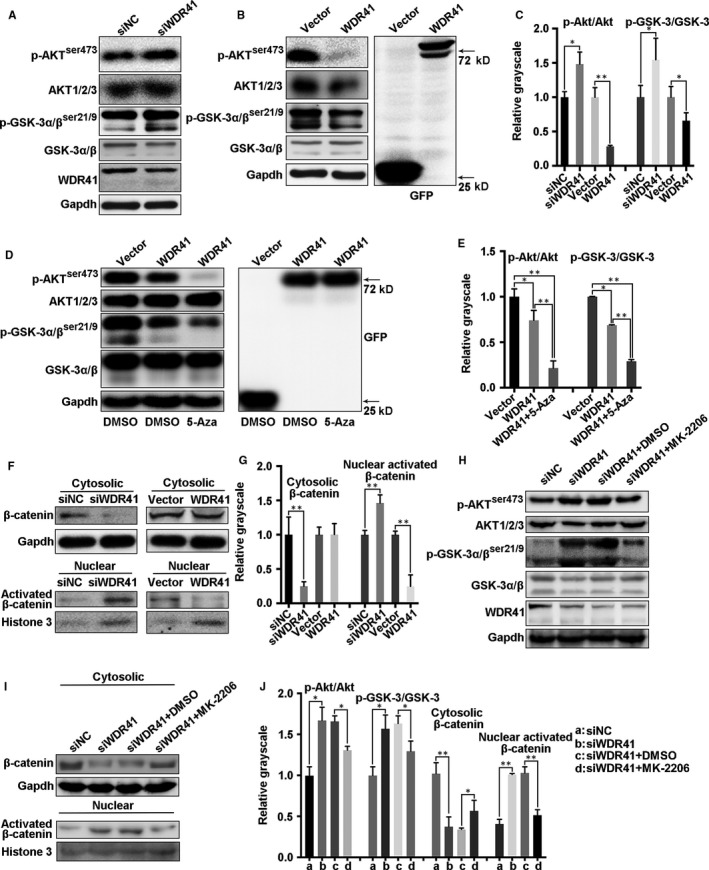
WD-repeat proteins are implicated in a variety of biological functions, most recently in oncogenesis. However, the underlying function of WD-repeat protein 41 (WDR41) in tumorigenesis remains elusive. The present study was aimed to explore the role of WDR41 in breast cancer. Combined with Western blotting and immunohistochemistry, the results showed that WDR41 was expressed at low levels in breast cancer, especially in triple-negative breast cancer (TNBC). Using methylation-specific PCR (MSP), we observed that WDR41 presented hypermethylation in MDA-MB-231 cells. Methylation inhibitor 5-aza-2'-deoxycytidine (5-aza-dC) management increased the expression of WDR41 in MDA-MB-231 cells, but not in MCF-10A (normal mammary epithelial cells) or oestrogen receptor-positive MCF-7 breast cancer cells. WDR41-down-regulation promoted, while WDR41-up-regulation inhibited the tumour characteristics of TNBC cells including cell viability, cell cycle and migration. Further, WDR41-up-regulation dramatically suppressed tumour growth in vivo. Mechanistically, WDR41 protein ablation activated, while WDR41-up-regulation repressed the AKT/GSK-3β pathway and the subsequent nuclear activation of β-catenin in MDA-MB-231 cells, and 5-aza-dC treatment enhanced this effect. After treatment with the AKT inhibitor MK-2206, WDR41-down-regulation-mediated activation of the GSK-3β/β-catenin signalling was robustly abolished. Collectively, methylated WDR41 in MDA-MB-231 cells promotes tumorigenesis through positively regulating the AKT/GSK-3β/β-catenin pathway, thus providing an important foundation for treating TNBC.
WD 重复蛋白参与多种生物学功能,最近在肿瘤发生中也有涉及。然而,WD 重复蛋白 41(WDR41)在肿瘤发生中的潜在功能仍不清楚。本研究旨在探讨 WDR41 在乳腺癌中的作用。通过 Western blot 和免疫组织化学结合的方法,结果表明 WDR41 在乳腺癌中表达水平较低,特别是在三阴性乳腺癌(TNBC)中。通过甲基化特异性 PCR(MSP),我们观察到 WDR41 在 MDA-MB-231 细胞中呈高甲基化状态。甲基化抑制剂 5-氮杂-2'-脱氧胞苷(5-aza-dC)处理增加了 MDA-MB-231 细胞中 WDR41 的表达,但对 MCF-10A(正常乳腺上皮细胞)或雌激素受体阳性 MCF-7 乳腺癌细胞没有影响。WDR41 下调促进了 TNBC 细胞的肿瘤特征,包括细胞活力、细胞周期和迁移,而 WDR41 上调则抑制了这些特征。此外,WDR41 上调显著抑制了体内 TNBC 细胞的肿瘤生长。在机制上,WDR41 蛋白缺失激活了 AKT/GSK-3β 通路,随后核内β-catenin 激活,而 WDR41 上调则抑制了 MDA-MB-231 细胞中的这一通路,5-aza-dC 处理增强了这一效应。在用 AKT 抑制剂 MK-2206 处理后,WDR41 下调介导的 GSK-3β/β-catenin 信号通路的激活被显著阻断。综上所述,MDA-MB-231 细胞中甲基化的 WDR41 通过正向调节 AKT/GSK-3β/β-catenin 信号通路促进肿瘤发生,为治疗 TNBC 提供了重要基础。