Kelly Brian, Black Jason, Stoltzfus Jill, Stankewicz Holly A
Department of Emergency Medicine, St. Luke's University Health Network, Bethlehem, PA, USA.
Department of Emergency Medicine, Abrazo Healthcare System, Pheonix, AZ, USA.
J Emerg Trauma Shock. 2020 Jan-Mar;13(1):54-57. doi: 10.4103/JETS.JETS_4_19. Epub 2020 Mar 19.
The most common form of measurement of breath alcohol content (BrAC) is through the use of a diode catheter. This study aims to test the accuracy of breath alcohol analysis through different manipulations.
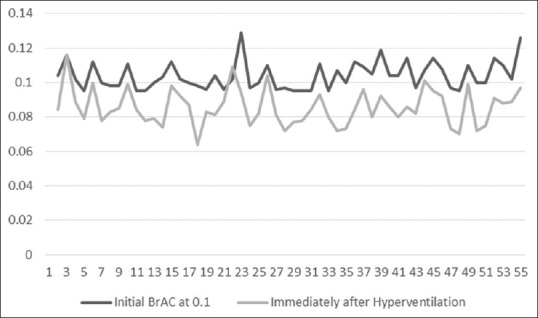
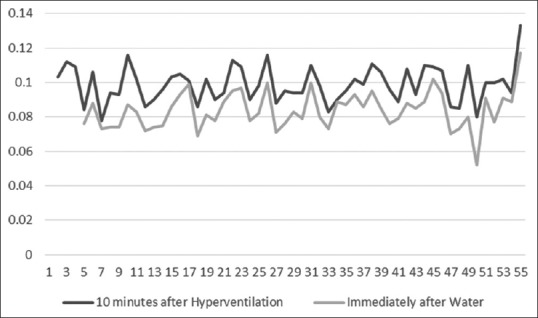
BrAC was measured after individuals consumed each standardized beer until they reached a 0.1 BrAC. Then, the individuals were breath analyzed while not providing full effort, using the side of their mouths, immediately after hyperventilating, 5 and 10 min after hyperventilation, immediately after a sip of water, and 5 min after that water.
There were 54 individuals. Two baselines were used as the controls. The first baseline was a mean BrAC of. 104 with standard deviation of +0.008 for poor effort, side of mouth, and hyperventilating. The second baseline used for drinking water manipulations was a BrAC of 0.099 + 0.11. Poor effort (mean + standard deviation: 0.099 ± 0.10, < 0.0001), immediately after hyperventilating (0.086 ± 0.011, < 0.0001), 5 min after hyperventilating (0.099 ± 0.009, < 0.0001), and 10 min after hyperventilating (0.099 ± 0.011, < 0.0001) were all found to be statistically significant in their ability to lower BrAC. Both immediately after water (0.084 ± 0.011, < 0001) and 5 min after drinking water (0.096 ± 0.13, < 0.0001) were found to have significantly altered the BrAC.
Our research shows that manipulations can alter BrAC readings significantly. Breath analyzer operators should be cognizant of these methods that may lead to falsely lower BrAC readings.
测量呼气酒精含量(BrAC)最常见的形式是使用二极管导管。本研究旨在通过不同的操作来测试呼气酒精分析的准确性。
个体饮用每瓶标准啤酒后测量BrAC,直至达到0.1的BrAC。然后,在个体未全力呼气、使用嘴角呼气、过度换气后立即、过度换气后5分钟和10分钟、喝一小口水后立即以及喝水后5分钟时对其进行呼气分析。
共有54名个体。使用两个基线作为对照。第一个基线是在未全力呼气、使用嘴角呼气和过度换气情况下,平均BrAC为0.104,标准差为+0.008。用于饮水操作的第二个基线BrAC为0.099±0.11。未全力呼气(平均值±标准差:0.099±0.10,P<0.0001)、过度换气后立即(0.086±0.011,P<0.0001)、过度换气后5分钟(0.099±0.009,P<0.0001)以及过度换气后10分钟(0.099±0.011,P<0.0001),在降低BrAC的能力方面均具有统计学意义。喝水后立即(0.084±0.011,P<0.0001)和喝水后5分钟(0.096±0.13,P<0.0001)均被发现显著改变了BrAC。
我们的研究表明,这些操作可显著改变BrAC读数。呼气分析仪操作人员应了解这些可能导致BrAC读数被错误降低的方法。