Assouline Sarit, Li Shen, Gisselbrecht Christian, Fogarty Patrick, Hay Annette, van den Neste Eric, Shepherd Lois E, Schmitz Norbert, Baetz Tara, Keating Armand, Robinson Sue, Seftel Matthew, Stelitano Caterina, Djurfeldt Marina S, Meyer Ralph, Chen Bingshu E, Crump Michael
Lady Davis Institute, Jewish General Hospital, McGill University, Montreal, QC, Canada.
Hospital Saint Louis, Paris, France.
Blood Adv. 2020 May 12;4(9):2011-2017. doi: 10.1182/bloodadvances.2020001646.
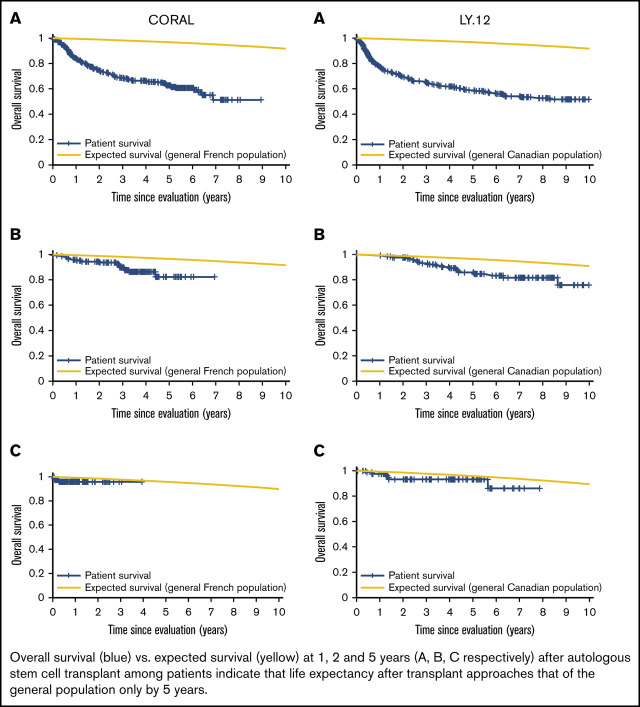
The conditional survival of patients after frontline therapy for diffuse large B-cell lymphoma (DLBCL) approaches that of the general population once patients have survived disease free for 2 years. We sought to determine the conditional survival of patients among patients with relapsed de novo DLBCL successfully undergoing an autologous stem-cell transplant (ASCT) after first relapse. A total of 478 patients with de novo DLBCL, relapsed after 1 treatment from the Collaborative Trial in Relapsed Aggressive Lymphoma (CORAL) and LY.12, were included. Patients were followed prospectively after ASCT for a median of 5.3 and 8.2 years, respectively. Individual patient data were analyzed for event-free survival (EFS) and overall survival. Standardized mortality ratios (SMRs) were estimated using French and Canadian life tables. The EFS estimates declined with each year of follow-up after ASCT and were 50.1% (95% confidence interval [CI]: 43.7% to 56.3%) and 43.4% (95% CI: 36.7% to 49.9%) at 5 years in CORAL and LY.12, respectively. The rate of death stabilized once patients achieved at least 4 years of EFS. Compared with the age- and sex-matched population, the SMR was significantly higher until 5 years after ASCT, when values were no longer statistically significant. Patients undergoing ASCT for relapsed DLBCL continue to have a higher rate of death at least until they have survived event free for 5 years. These observations can help to determine endpoints for future clinical trials in this population and for patient counseling. This trial was registered at www.clinicaltrials.gov as #NCT00078949.
弥漫性大B细胞淋巴瘤(DLBCL)患者一线治疗后的条件性生存情况,在患者无病生存2年后接近普通人群。我们试图确定初治复发的DLBCL患者首次复发后成功接受自体干细胞移植(ASCT)后的条件性生存情况。纳入了478例来自复发性侵袭性淋巴瘤协作试验(CORAL)和LY.12的初治DLBCL患者,这些患者在接受1次治疗后复发。ASCT后分别对患者进行了中位时间为5.3年和8.2年的前瞻性随访。分析了个体患者数据的无事件生存期(EFS)和总生存期。使用法国和加拿大生命表估计标准化死亡比(SMR)。ASCT后每年的EFS估计值均下降,CORAL和LY.12研究中5年时的EFS分别为50.1%(95%置信区间[CI]:43.7%至56.3%)和43.4%(95%CI:36.7%至49.9%)。一旦患者达到至少4年的EFS,死亡率就会稳定下来。与年龄和性别匹配的人群相比,ASCT后5年内SMR显著更高,之后数值不再具有统计学意义。复发DLBCL患者接受ASCT后至少在无事件生存5年之前死亡率持续较高。这些观察结果有助于确定该人群未来临床试验的终点以及用于患者咨询。该试验已在www.clinicaltrials.gov注册,编号为#NCT00078949。