Skalt Daniela, Moertl Bernhard, von Bergwelt-Baildon Michael, Schmidt Christian, Schoel Wolfgang, Bücklein Veit, Weiglein Tobias, Dreyling Martin, Berger Karin
Institute for Medical Information Processing, Biometry, and Epidemiology-IBE, Ludwig-Maximilian University, Munich, Germany.
Pettenkofer School of Public Health, Munich, Germany.
Hemasphere. 2022 Jul 4;6(7):e736. doi: 10.1097/HS9.0000000000000736. eCollection 2022 Jul.
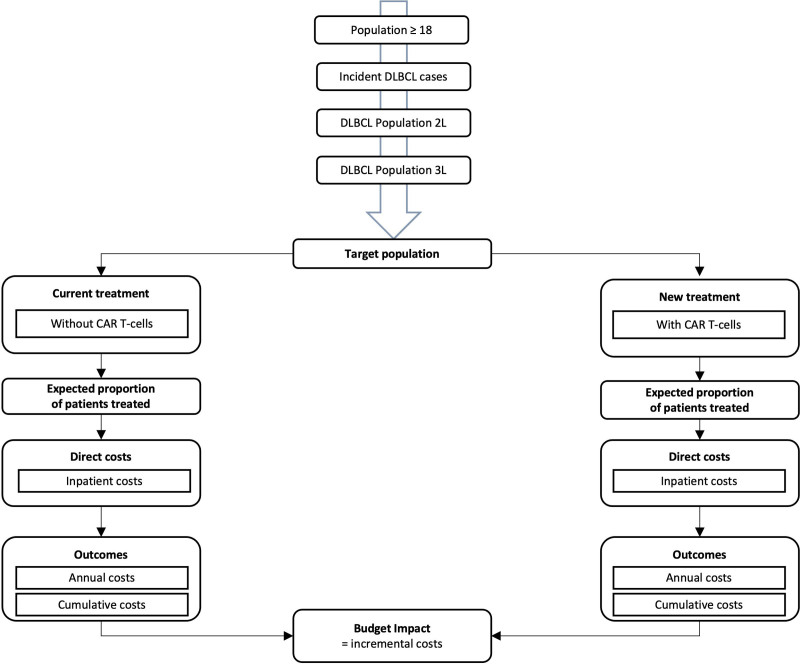
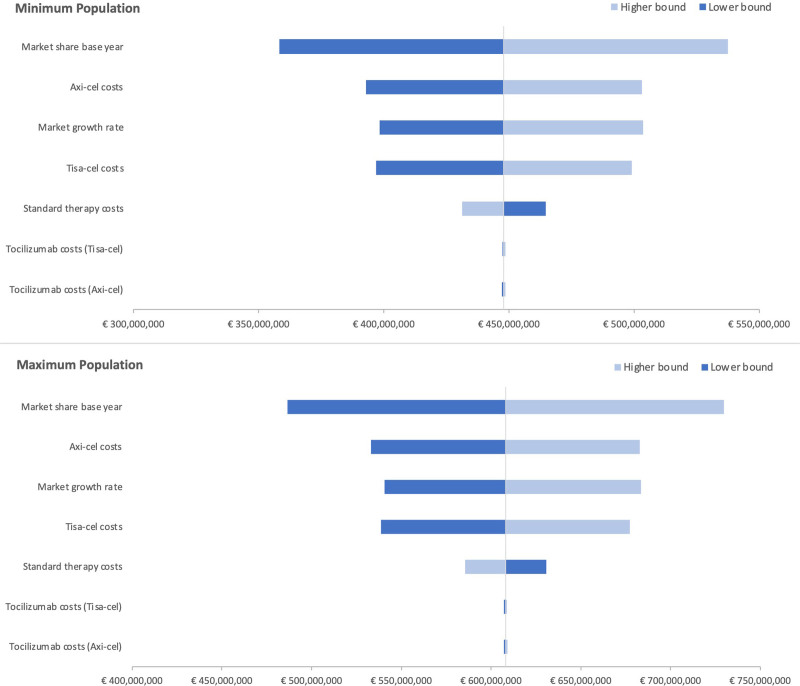
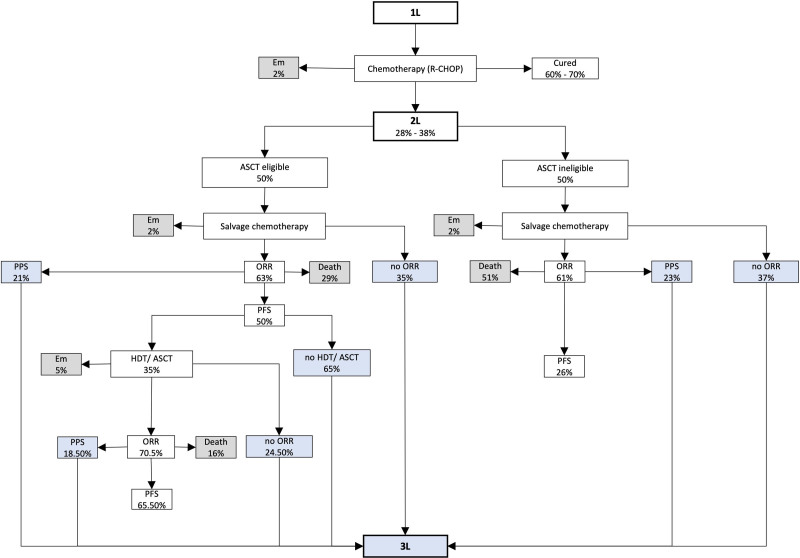
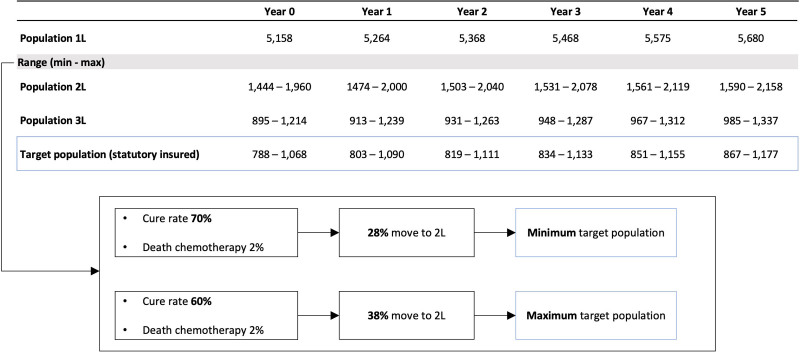
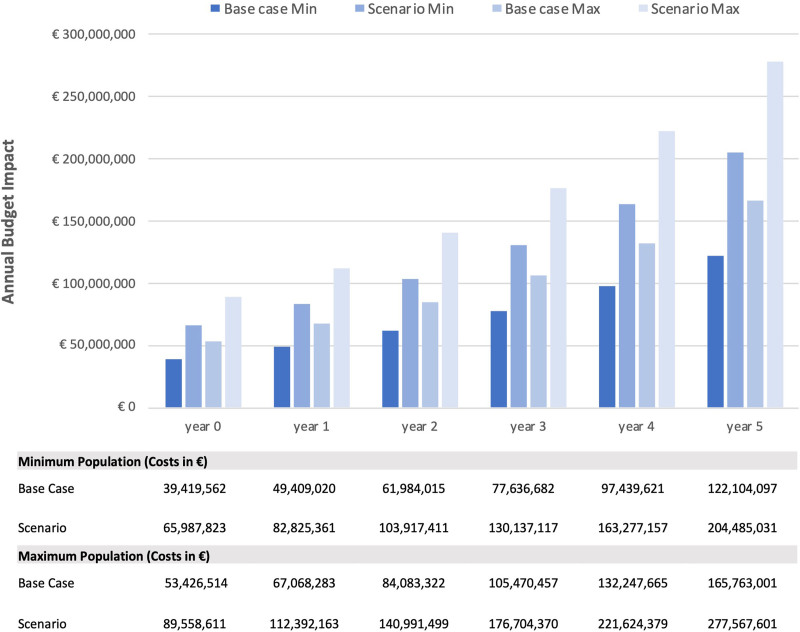
The aim was to assess the incremental costs of chimeric antigen receptor (CAR) T-cell therapy (axicabtagene ciloleucel, tisagenlecleucel) compared with standard of care in adult patients with relapsed or refractory diffuse large B-cell lymphoma (r/r DLBCL) from the German third-party payer perspective. A budget impact model was established over a 6-year period. Estimation of the third-line population: partitioned survival model based on outcome data from peer-reviewed literature, a top-down approach based on population forecasts, and age-standardized incidences. Cost data were derived from the controlling department of a tertiary hospital and a German cost-of-illness study. In the scenario analysis, the budget impact of treating second-line DLBCL patients was calculated. One-way deterministic sensitivity analyses were conducted to test the robustness of the model. For the period 2021-2026, 788-867 (minimum population, min) and 1,068-1,177 (maximum population, max) adult third-line r/r DLBCL patients were estimated. The budget impact ranged from €39,419,562; €53,426,514 (min; max) in year 0 to €122,104,097; €165,763,001 (min; max) in year 5. The scenario analysis resulted in a budget impact of €65,987,823; €89,558,611 (min; max) and €204,485,031; €277,567,601 (min; max) for years 0 and 5, respectively. This budget impact analysis showed a significant but reasonable financial burden associated with CAR T-cell therapy for a limited number of patients requiring individualized care. Further, this study presents challenges and future needs in data acquisition associated with cost analysis in personalized medicine. For comprehensive economic discussions, complementary cost-effectiveness analyses are required to determine the value of innovative therapies for r/r DLBCL.
本研究旨在从德国第三方支付方的角度,评估嵌合抗原受体(CAR)T细胞疗法(阿基仑赛注射液、替雷利珠单抗)相较于复发或难治性弥漫性大B细胞淋巴瘤(r/r DLBCL)成年患者标准治疗的增量成本。建立了一个为期6年的预算影响模型。三线患者群体的估计:基于同行评审文献的结果数据的分区生存模型、基于人口预测的自上而下方法以及年龄标准化发病率。成本数据来自一家三级医院的控制部门和一项德国疾病成本研究。在情景分析中,计算了治疗二线DLBCL患者的预算影响。进行了单向确定性敏感性分析以检验模型的稳健性。对于2021 - 2026年期间,估计有788 - 867名(最小群体,min)和1,068 - 1,177名(最大群体,max)成年三线r/r DLBCL患者。预算影响范围从第0年的39,419,562欧元;53,426,514欧元(min;max)到第5年的122,104,097欧元;165,763,001欧元(min;max)。情景分析得出第0年和第5年的预算影响分别为65,987,823欧元;89,558,611欧元(min;max)和204,485,031欧元;277,567,601欧元(min;max)。这项预算影响分析表明,对于有限数量需要个体化治疗的患者,CAR T细胞疗法带来了显著但合理的财务负担。此外,本研究提出了个性化医疗中与成本分析相关的数据获取方面的挑战和未来需求。为了进行全面的经济讨论,需要进行补充性成本效益分析以确定r/r DLBCL创新疗法的价值。