Division of Hematology and Oncology, Department of Medicine, College of Medicine, University of Florida, Gainesville, FL 32610, USA.
Int J Mol Sci. 2020 May 8;21(9):3323. doi: 10.3390/ijms21093323.
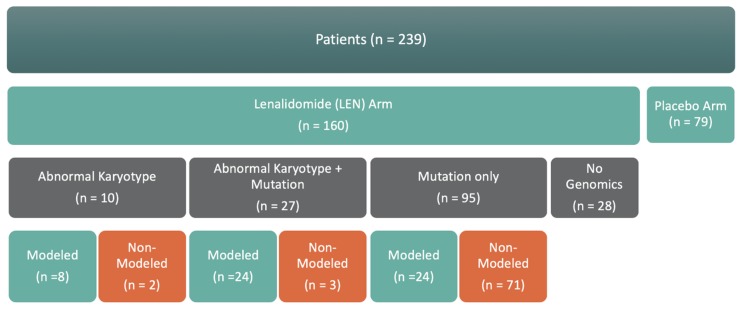
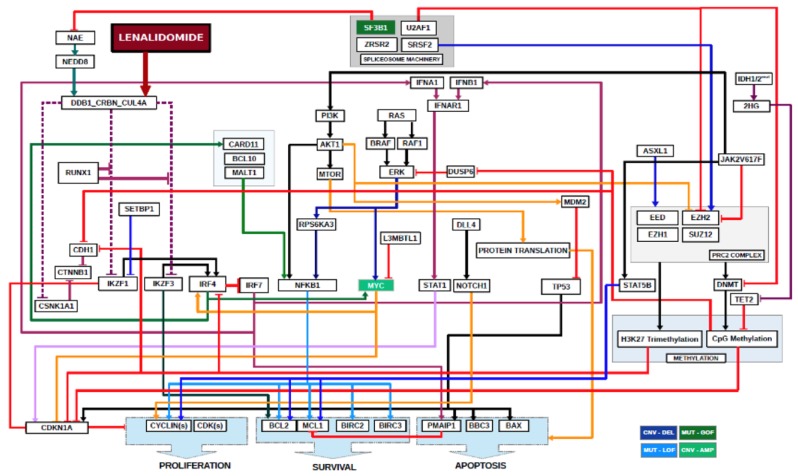
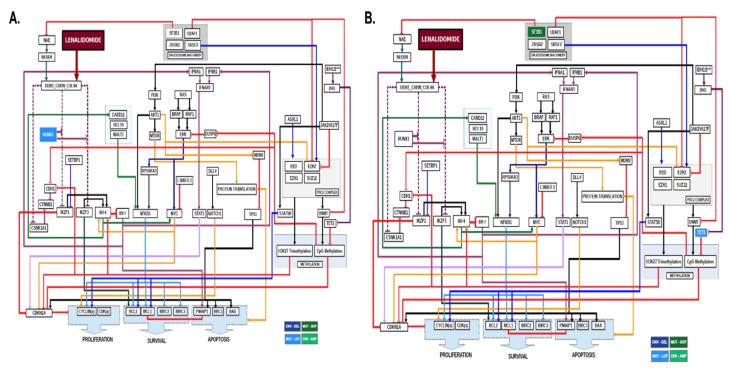
Whereas lenalidomide is an effective therapy for del(5q) MDS patients, a minority of non-del(5q) MDS patients achieve hematologic improvement with lenalidomide. We used computational biology modeling and digital drug simulation to examine genomic data from 56 non-del(5q) MDS patients treated with lenalidomide, and then matched treatment response with molecular pathways. The computer inferred genomic abnormalities associating with lenalidomide treatment response in non-del(5q) MDS to include trisomy 8, del(20q), or loss of function mutations. Genomic abnormalities associating with lenalidomide resistance in non-del(5q) MDS patients included mutations in , , amplification, amplification, and/or amplification. These results may inform protocols for determining appropriateness of lenalidomide in non-del(5q) MDS.
虽然来那度胺是治疗 del(5q) MDS 患者的有效疗法,但少数非 del(5q) MDS 患者使用来那度胺可获得血液学改善。我们使用计算生物学模型和数字药物模拟方法,分析了 56 例接受来那度胺治疗的非 del(5q) MDS 患者的基因组数据,并将治疗反应与分子途径相匹配。计算机推断出与非 del(5q) MDS 中来那度胺治疗反应相关的基因组异常包括 8 三体、20q 缺失或功能丧失突变。与非 del(5q) MDS 患者中来那度胺耐药相关的基因组异常包括 、 、 扩增、 扩增和/或 扩增的突变。这些结果可能为确定非 del(5q) MDS 患者中来那度胺的适用性提供依据。