Wang Shichao, Li Zhiyue, Gao Shaobing
The Fifth Affiliated Hospital of Zhengzhou University, No. 3 Kangfu Front Street, 450052, Zhengzhou, China.
The Affiliated Cancer Hospital of Zhengzhou University, Henan Cancer Hospital, 127 Dongming Road, Zhengzhou, 450008, China.
Biomark Res. 2021 Jun 5;9(1):43. doi: 10.1186/s40364-021-00297-6.
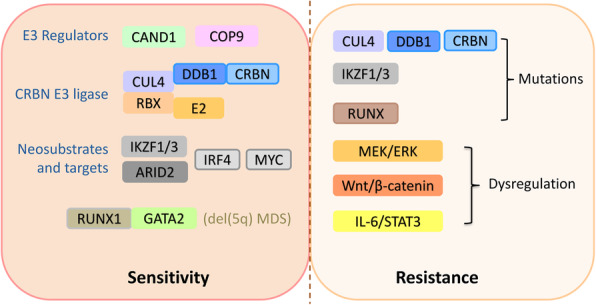
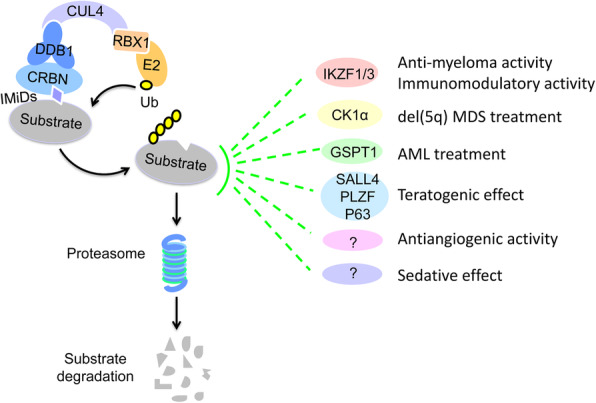
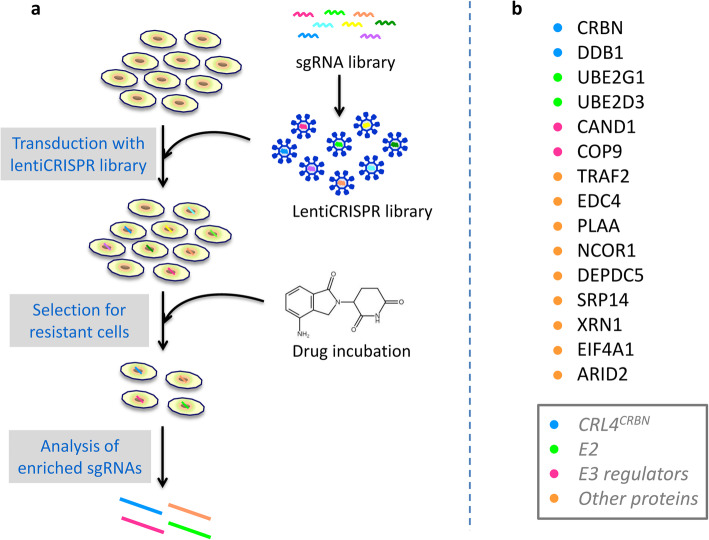
Immunomodulatory drugs (IMiDs) include thalidomide, lenalidomide, and pomalidomide, which have shown significant efficacy in the treatment of multiple myeloma (MM), myelodysplastic syndrome (MDS) with deletion of chromosome 5q (del(5q)) and other hematological malignancies. IMiDs hijack the CRL4 ubiquitin ligase to target cellular proteins for ubiquitination and degradation, which is responsible for their clinical activity in MM and MDS with del(5q). However, intrinsic and acquired resistance frequently limit the efficacy of IMiDs. Recently, many efforts have been made to explore key regulators of IMiD sensitivity, resulting in great advances in the understanding of the regulatory networks related to this class of drugs. In this review, we describe the mechanism of IMiDs in cancer treatment and summarize the key regulators of IMiD sensitivity. Furthermore, we introduce genome-wide CRISPR-Cas9 screenings, through which the regulatory networks of IMiD sensitivity could be identified.
免疫调节药物(IMiDs)包括沙利度胺、来那度胺和泊马度胺,这些药物在治疗多发性骨髓瘤(MM)、伴有5号染色体缺失(del(5q))的骨髓增生异常综合征(MDS)及其他血液系统恶性肿瘤方面已显示出显著疗效。IMiDs利用CRL4泛素连接酶将细胞蛋白靶向泛素化和降解,这是它们在MM和伴有del(5q)的MDS中发挥临床活性的原因。然而,内在和获得性耐药常常限制了IMiDs的疗效。最近,人们为探索IMiD敏感性的关键调节因子付出了诸多努力,在理解与这类药物相关的调控网络方面取得了重大进展。在本综述中,我们描述了IMiDs在癌症治疗中的机制,并总结了IMiD敏感性的关键调节因子。此外,我们介绍了全基因组CRISPR-Cas9筛选,通过这种筛选可以确定IMiD敏感性的调控网络。