Peerzade Saquib Ahmed M A, Makarova Nadezda, Sokolov Igor
Department of Biomedical Engineering, Tufts University, Medford, MA 02155, USA.
Department of Mechanical Engineering, Tufts University, Medford, MA 02155, USA.
Nanomaterials (Basel). 2020 May 8;10(5):905. doi: 10.3390/nano10050905.
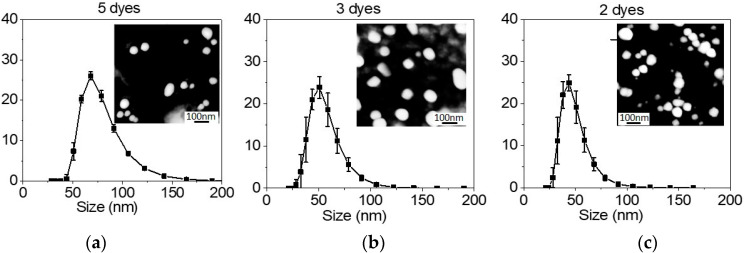
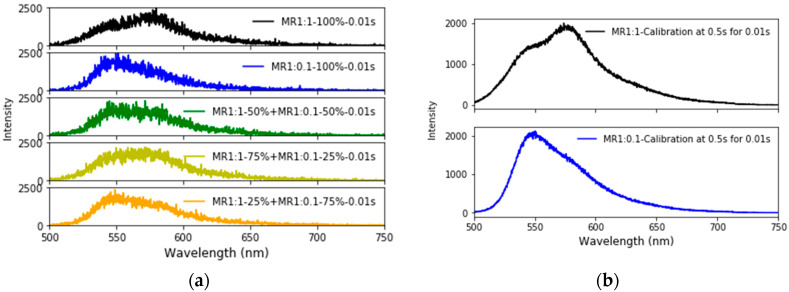
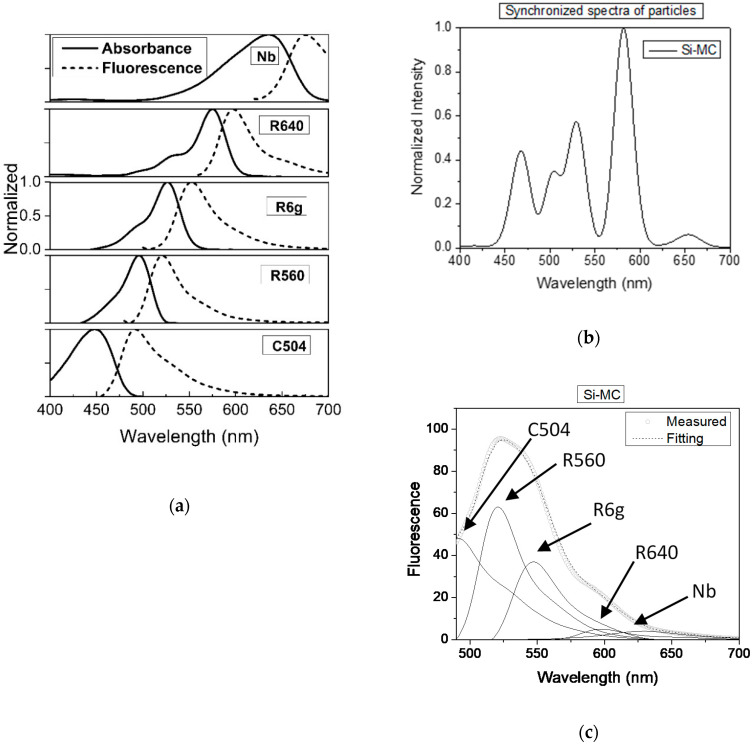
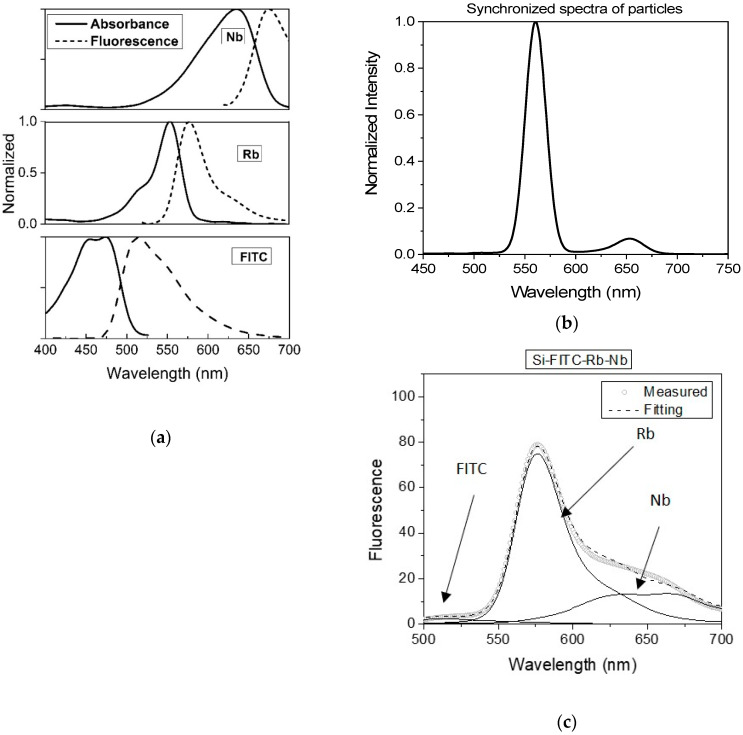
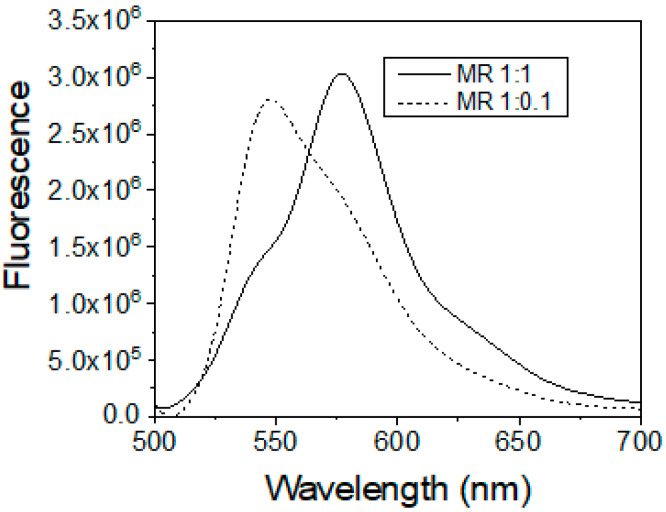
Fluorescent tagging is a popular method in biomedical research. Using multiple taggants of different but resolvable fluorescent spectra simultaneously (multiplexing), it is possible to obtain more comprehensive and faster information about various biochemical reactions and diseases, for example, in the method of flow cytometry. Here we report on a first demonstration of the synthesis of ultrabright fluorescent silica nanoporous nanoparticles (Star-dots), which have a large number of complex fluorescence spectra suitable for multiplexed applications. The spectra are obtained via simple physical mixing of different commercially available fluorescent dyes in a synthesizing bath. The resulting particles contain dye molecules encapsulated inside of cylindrical nanochannels of the silica matrix. The distance between the dye molecules is sufficiently small to attain Forster resonance energy transfer (FRET) coupling within a portion of the encapsulated dye molecules. As a result, one can have particles of multiple spectra that can be excited with just one wavelength. We show this for the mixing of five, three, and two dyes. Furthermore, the dyes can be mixed inside of particles in different proportions. This brings another dimension in the complexity of the obtained spectra and makes the number of different resolvable spectra practically unlimited. We demonstrate that the spectra obtained by different mixing of just two dyes inside of each particle can be easily distinguished by using a linear decomposition method. As a practical example, the errors of demultiplexing are measured when sets of a hundred particles are used for tagging.
荧光标记是生物医学研究中的一种常用方法。通过同时使用具有不同但可分辨荧光光谱的多种标记物(多路复用),有可能获得关于各种生化反应和疾病的更全面、更快速的信息,例如在流式细胞术方法中。在此,我们首次报道了超亮荧光二氧化硅纳米多孔纳米颗粒(星点)的合成,其具有大量适用于多路复用应用的复杂荧光光谱。这些光谱是通过在合成浴中简单物理混合不同的市售荧光染料获得的。所得颗粒包含封装在二氧化硅基质圆柱形纳米通道内的染料分子。染料分子之间的距离足够小,以在一部分封装的染料分子内实现福斯特共振能量转移(FRET)耦合。结果,可以得到仅用一个波长就能激发的具有多种光谱的颗粒。我们展示了五种、三种和两种染料混合的情况。此外,染料可以以不同比例在颗粒内部混合。这为所获得光谱的复杂性带来了另一个维度,并使不同可分辨光谱的数量实际上不受限制。我们证明,通过使用线性分解方法,可以轻松区分每个颗粒内部仅两种染料不同混合方式所获得的光谱。作为一个实际例子,当使用一百个颗粒的集合进行标记时,测量了多路分解的误差。