Sun Qing-Lei, Zhang Jian, Wang Min-Xiao, Cao Lei, Du Zeng-Feng, Sun Yuan-Yuan, Liu Shi-Qi, Li Chao-Lun, Sun Li
CAS Key Laboratory of Experimental Marine Biology, CAS Center for Ocean Mega-Science, Institute of Oceanology, Chinese Academy of Sciences, Qingdao 266071, China.
Laboratory for Marine Biology and Biotechnology, Qingdao National Laboratory for Marine Science and Technology, Qingdao 266071, China.
Microorganisms. 2020 May 8;8(5):687. doi: 10.3390/microorganisms8050687.
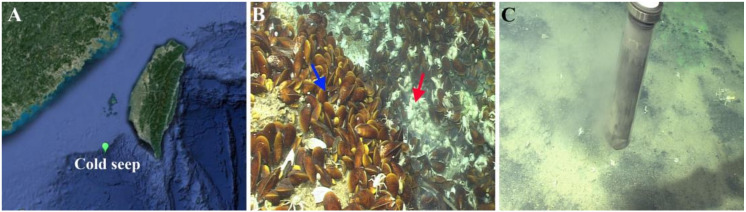
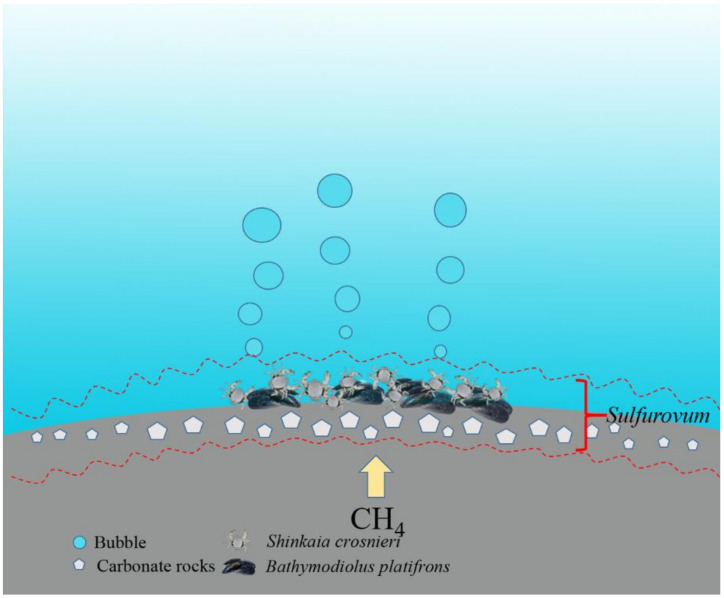
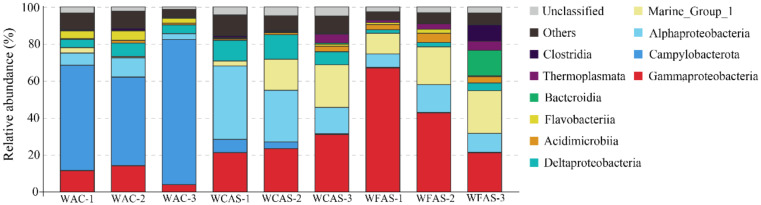
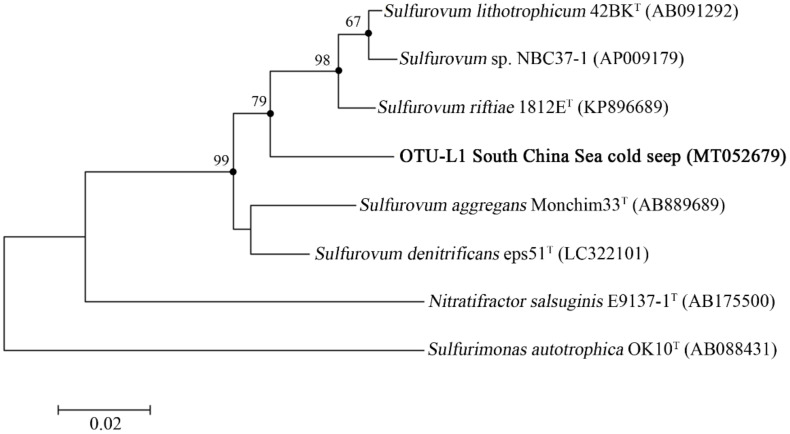
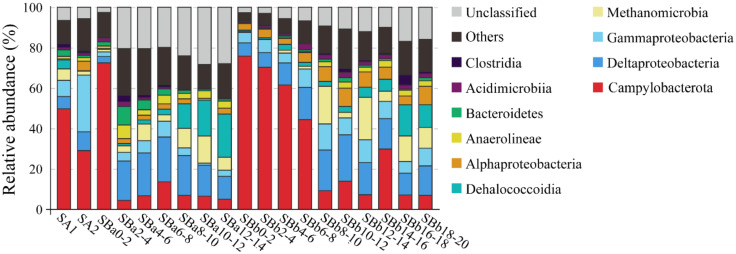
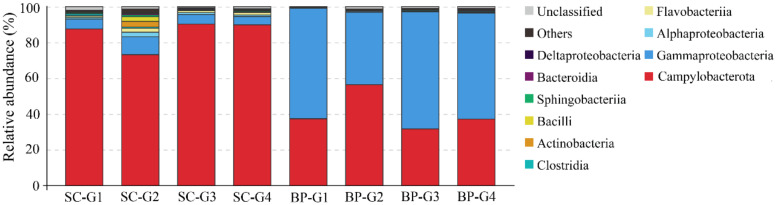
In the Formosa cold seep of the South China Sea (SCS), large amounts of methane and sulfide hydrogen are released from the subseafloor. In this study, we systematically investigated the microbial communities in the seawater-sediment interface of Formosa cold seep using high-throughput sequencing techniques including amplicon sequencing based on next-generation sequencing and Pacbio amplicon sequencing platforms, and metagenomics. We found that dominated the microbial communities in the sediment-seawater interface, including the seawater close to the seepage, the surface sediments, and the gills of the dominant animal inhabitant (). A nearly complete 16S rRNA gene sequence of the dominant operational taxonomic units (OTUs) was obtained from the Pacbio sequencing platforms and classified as OTU-L1, which belonged to . This OTU was potentially novel as it shared relatively low similarity percentages (<97%) of the gene sequence with its close phylogenetic species. Further, a draft genome of was assembled using the binning technique based on metagenomic data. Genome analysis suggested that sp. in this region may fix carbon by the reductive tricarboxylic acid (rTCA) pathway, obtain energy by oxidizing reduced sulfur through sulfur oxidizing (Sox) pathway, and utilize nitrate as electron acceptors. These results demonstrated that probably plays an important role in the carbon, sulfur, and nitrogen cycles of the Formosa cold seep of the SCS. This study improves our understanding of the diversity, distribution, and function of sulfur-oxidizing bacteria in deep-sea cold seep.
在南海福尔摩沙冷泉中,大量甲烷和硫化氢从海底释放出来。在本研究中,我们使用高通量测序技术,包括基于新一代测序和Pacbio扩增子测序平台的扩增子测序以及宏基因组学,系统地研究了福尔摩沙冷泉海水 - 沉积物界面中的微生物群落。我们发现, 在沉积物 - 海水界面的微生物群落中占主导地位,包括靠近渗漏处的海水、表层沉积物以及优势动物居民( )的鳃。从Pacbio测序平台获得了优势操作分类单元(OTU)的近乎完整的16S rRNA基因序列,并将其分类为OTU - L1,其属于 。该OTU可能是新的,因为它与其近缘系统发育物种的基因序列相似性百分比相对较低(<97%)。此外,使用基于宏基因组数据的分箱技术组装了 的基因组草图。基因组分析表明,该区域的 菌株可能通过还原性三羧酸(rTCA)途径固定碳,通过硫氧化(Sox)途径氧化还原态硫获取能量,并利用硝酸盐作为电子受体。这些结果表明, 可能在南海福尔摩沙冷泉的碳、硫和氮循环中发挥重要作用。本研究增进了我们对深海冷泉中硫氧化细菌的多样性、分布和功能的理解。