The George Institute for Global Health, The University of New South Wales, Sydney, NSW 2006, Australia.
Nutrients. 2020 May 8;12(5):1346. doi: 10.3390/nu12051346.
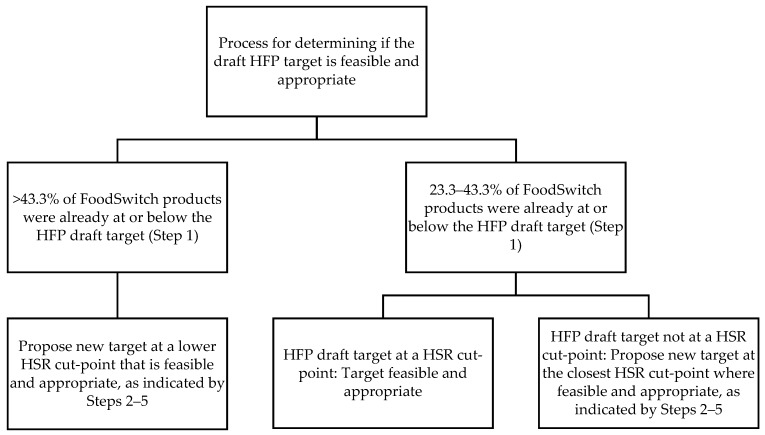
Non-communicable diseases (NCDs) are the leading cause of mortality and morbidity worldwide. Unhealthy diets are one of four main behavioral risk factors contributing to the majority of NCDs. To promote healthy eating and reduce dietary risks, the Australian Commonwealth Government established the Healthy Food Partnership (HFP). In 2018, the HFP consulted on proposed nutrient reformulation targets for 36 food categories to improve the overall quality of the food supply. This study assessed whether the proposed targets were feasible and appropriate. The HFP used a five-step approach to inform the proposed targets. We replicated and extended this approach using a different nutrient composition database (FoodSwitch). Products in FoodSwitch were mapped to the proposed HFP targets. The proportion of products meeting each target was calculated and the FoodSwitch data were compared with HFP data to determine whether the proposed target nutrient levels were appropriate or whether a more stringent target was feasible. Products from the FoodSwitch database (10,599) were mapped against the proposed HFP categories: 8434 products across 30 categories for sodium, 2875 products across seven categories for sugar, and 612 products across five categories for saturated fat. The analyses revealed that 14 of 30 proposed HFP targets for sodium, one of seven targets for sugar, and one of five targets for saturated fat were feasible and appropriate. For the remaining 26 reformulation targets, the results indicate that these target levels could be more stringent and alternative targets are proposed. The draft HFP targets are feasible but the majority are too conservative. If Australia is to meet its commitment to a 30 per cent reduction in the average population salt intake by 2025, these targets could be implemented as interim targets to be reached within two years. However, the opportunity exists to improve the food supply and strengthen the HFP's population health impact by adopting more ambitious and incremental targets. Reformulation programs should be prioritized and closely monitored as part of a coordinated, multi-faceted national food and nutrition strategy.
非传染性疾病(NCDs)是全球死亡和发病的主要原因。不健康的饮食是导致大多数 NCDs 的四个主要行为风险因素之一。为了促进健康饮食和减少饮食风险,澳大利亚联邦政府成立了健康食品伙伴关系(HFP)。2018 年,HFP 就 36 种食品类别的营养素配方目标进行了咨询,以提高食品供应的整体质量。本研究评估了拟议目标的可行性和适当性。HFP 使用五步方法为拟议目标提供信息。我们使用不同的营养成分数据库(FoodSwitch)复制和扩展了这种方法。FoodSwitch 中的产品与拟议的 HFP 目标进行了匹配。计算了符合每个目标的产品比例,并将 FoodSwitch 数据与 HFP 数据进行比较,以确定拟议目标营养水平是否适当,或者是否可以实现更严格的目标。FoodSwitch 数据库中的产品(10599 种)与拟议的 HFP 类别进行了匹配:30 个类别中的 8434 种产品涉及钠,7 个类别中的 2875 种产品涉及糖,5 个类别中的 612 种产品涉及饱和脂肪。分析结果显示,拟议的 HFP 钠目标中有 14 个、糖目标中有 1 个、饱和脂肪目标中有 1 个是可行和适当的。对于其余 26 个配方目标,结果表明这些目标水平可以更加严格,并提出了替代目标。HFP 草案目标是可行的,但大多数目标过于保守。如果澳大利亚要实现到 2025 年将平均人口盐摄入量减少 30%的承诺,这些目标可以作为两年内达到的临时目标。然而,通过采用更具雄心和渐进性的目标,有机会改善食品供应并增强 HFP 对人口健康的影响。作为协调、多方面的国家食品和营养战略的一部分,应优先考虑和密切监测配方调整计划。