Department of Biosystems Machinery Engineering, College of Agricultural and Life Science, Chungnam National University, 99 Daehak-ro, Yuseong-gu, Daejeon 341-34, Korea.
Environmental Microbial and Food Safety Laboratory, Agricultural Research Service, U.S. Department of Agriculture, Powder Mill Rd. Bldg. 303, BARC-East, Beltsville, MD 20705, USA.
Sensors (Basel). 2020 May 8;20(9):2690. doi: 10.3390/s20092690.
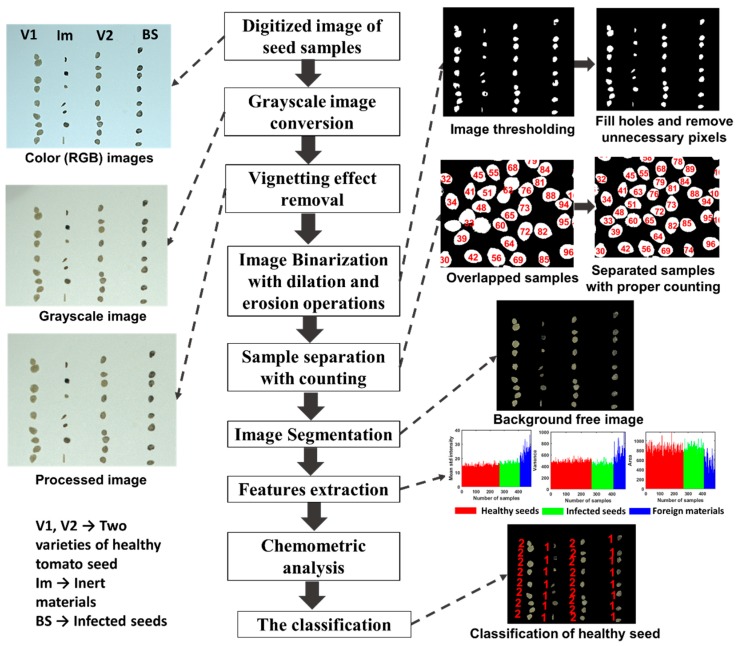
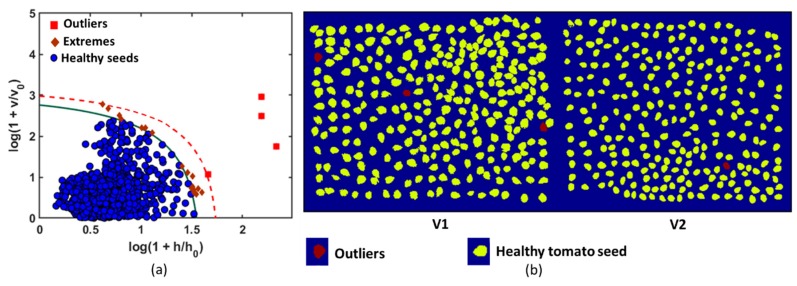
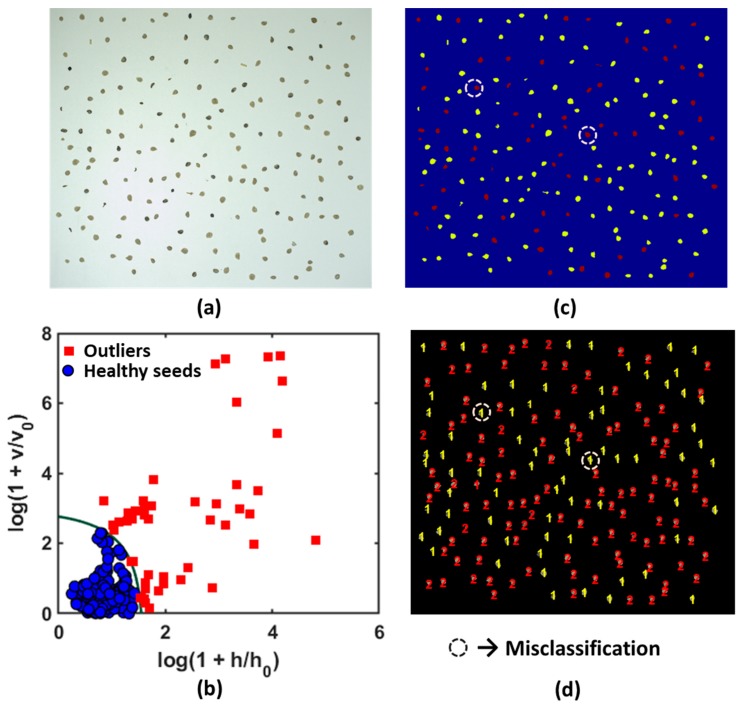
The feasibility of a color machine vision technique with the one-class classification method was investigated for the quality assessment of tomato seeds. The health of seeds is an important quality factor that affects their germination rate, which may be affected by seed contamination. Hence, segregation of healthy seeds from diseased and infected seeds, along with foreign materials and broken seeds, is important to improve the final yield. In this study, a custom-built machine vision system containing a color camera with a white light emitting diode (LED) light source was adopted for image acquisition. The one-class classification method was used to identify healthy seeds after extracting the features of the samples. A significant difference was observed between the features of healthy and infected seeds, and foreign materials, implying a certain threshold. The results indicated that tomato seeds can be classified with an accuracy exceeding 97%. The infected tomato seeds indicated a lower germination rate (<10%) compared to healthy seeds, as confirmed by the organic growing media germination test. Thus, identification through image analysis and rapid measurement were observed as useful in discriminating between the quality of tomato seeds in real time.
采用基于单类分类法的彩色机器视觉技术对番茄种子的质量评估进行了可行性研究。种子的健康状况是影响其发芽率的一个重要质量因素,而种子的污染可能会影响其健康状况。因此,将健康种子与患病、感染的种子以及异物和破碎的种子分离开来,对于提高最终产量是很重要的。在本研究中,采用了一个定制的机器视觉系统,该系统包含一个带有白色发光二极管(LED)光源的彩色摄像机,用于图像采集。采用单类分类法提取样本特征后,对健康种子进行识别。健康种子和感染种子以及异物的特征存在显著差异,这意味着存在一定的阈值。结果表明,番茄种子的分类准确率超过 97%。感染的番茄种子的发芽率(<10%)明显低于健康种子,这与有机生长介质发芽试验的结果一致。因此,通过图像分析和快速测量进行的识别被观察到可实时区分番茄种子的质量。