Department of Psychiatry & Mental Health Institute of the Second Xiangya Hospital, Central South University, National Clinical Research Centre on Mental Disorders (Xiangya), Hunan Medical Center for Mental Health, Changsha, 410011, Hunan, China.
Division of Psychology, Faculty of Health and Life Sciences, De Montfort University, Leicester, UK.
BMC Public Health. 2020 May 12;20(1):669. doi: 10.1186/s12889-020-08834-y.
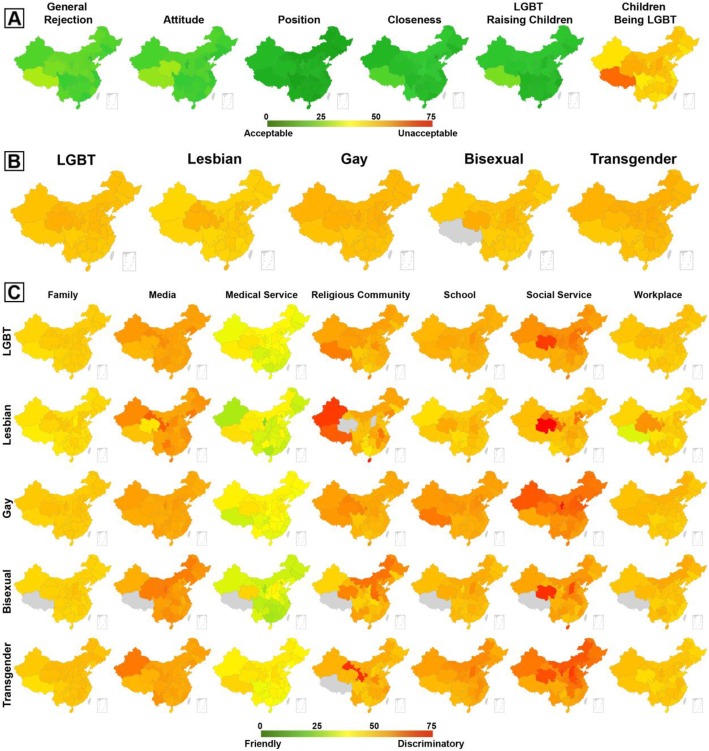
China has the world's largest lesbian, gay, bisexual, and transgender (LGBT) population. This study assessed the discrimination experienced by LGBT individuals in China in a comprehensive way, covering discrimination perpetrated by family, media, medical services, religious communities, schools, social services, and in the workplace.
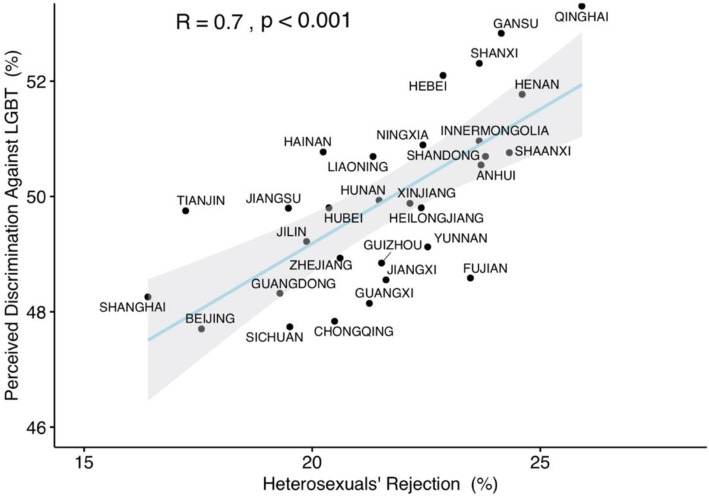
The current study involved a national survey of 31 provinces and autonomous regions. Discrimination was measured both in terms of heterosexual participants' attitudes towards LGBT individuals, and LGBT participants' self-perceived discrimination. Pearson correlation analysis was performed to examine the difference between heterosexual participants' attitudes towards LGBT individuals and LGBT participants' self-perceived discrimination. Linear regression was used to investigate the association between gross domestic product per capita and discrimination.
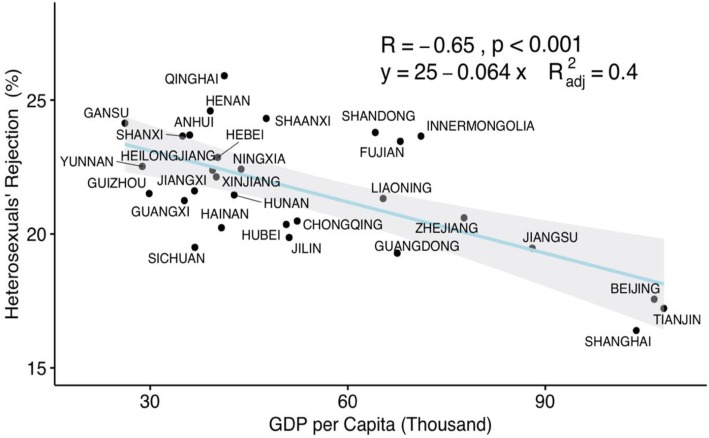
Among 29,125 participants, 2066 (7.1%) identified as lesbian, 9491 (32.6%) as gay, 3441 (11.8%) as bisexual, 3195 (11.0%) as transgender, and 10,932 (37.5%) as heterosexual. Heterosexual people were generally friendly towards the LGBT community with a mean score of 21.9 (SD = 2.7, total scale score = 100) and the grand averaged score of self-perceived discrimination by LGBT participants was 49.9 (SD = 2.5). Self-perceived discrimination from family and social services is particularly severe. We created a series of provincial level choropleth maps showing heterosexual participants' acceptance towards the LGBT community, and self-perceived discrimination reported by members of the LGBT community. We found that a higher level of economic development in provinces was associated with a decrease in discrimination, and we identified that every 100 thousand RMB increase in per capita GDP lead to a 6.4% decrease in discriminatory events perpetrated by heterosexuals.
Chinese LGBT groups consistently experience discrimination in various aspects of their daily lives. The prevalence of this discrimination is associated with the economic development of the province in which it occurs. In order to reduce discrimination, it is important for future studies to discover the underlying reasons for discrimination against LGBT individuals in China.
中国拥有全球最大的同性恋、双性恋和跨性别(LGBT)人群。本研究全面评估了中国 LGBT 群体所遭受的歧视,涵盖了来自家庭、媒体、医疗服务、宗教团体、学校、社会服务和工作场所等方面的歧视。
本研究涉及对全国 31 个省、自治区的一项全国性调查。通过异性恋参与者对 LGBT 群体的态度以及 LGBT 参与者自我感知的歧视程度来衡量歧视。采用皮尔逊相关分析来检验异性恋参与者对 LGBT 群体的态度与 LGBT 参与者自我感知的歧视之间的差异。采用线性回归来研究人均国内生产总值与歧视之间的关联。
在 29125 名参与者中,2066 人(7.1%)自认为是女同性恋者,9491 人(32.6%)自认为是男同性恋者,3441 人(11.8%)是双性恋者,3195 人(11.0%)是跨性别者,10932 人(37.5%)是异性恋者。异性恋者对 LGBT 群体普遍友好,平均得分为 21.9(SD=2.7,总分 100),而 LGBT 参与者自我感知的歧视平均得分为 49.9(SD=2.5)。来自家庭和社会服务的自我感知歧视尤为严重。我们制作了一系列省级层面的等值线图,展示了异性恋者对 LGBT 群体的接受程度,以及 LGBT 群体成员自我感知的歧视程度。我们发现,省份经济发展水平越高,歧视程度越低,人均 GDP 每增加 10 万元,异性恋者实施的歧视事件就会减少 6.4%。
中国的 LGBT 群体在日常生活的各个方面都持续遭遇歧视。这种歧视的普遍程度与发生歧视的省份的经济发展水平有关。为了减少歧视,未来的研究有必要探索中国 LGBT 群体遭受歧视的根本原因。