College of Agronomy, Henan Agricultural University, Zhengzhou, 450002, China.
College of Life Sciences, Synergetic Innovation Center of Henan Grain Crops and National Key Laboratory of Wheat and Maize Crop Science, Henan Agricultural University, Zhengzhou, 450002, China.
BMC Genomics. 2020 May 12;21(1):357. doi: 10.1186/s12864-020-6733-7.
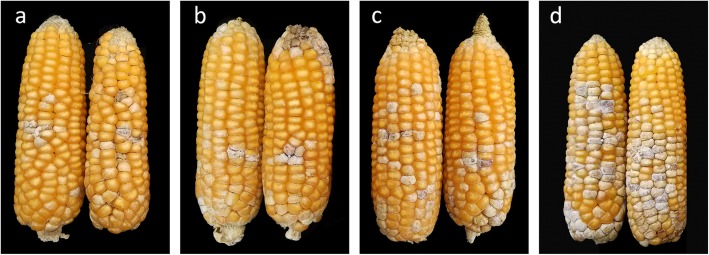
Fusarium ear rot (FER) caused by Fusarium verticillioides is a major disease of maize that reduces grain yield and quality globally. However, there have been few reports of major loci for FER were verified and cloned.
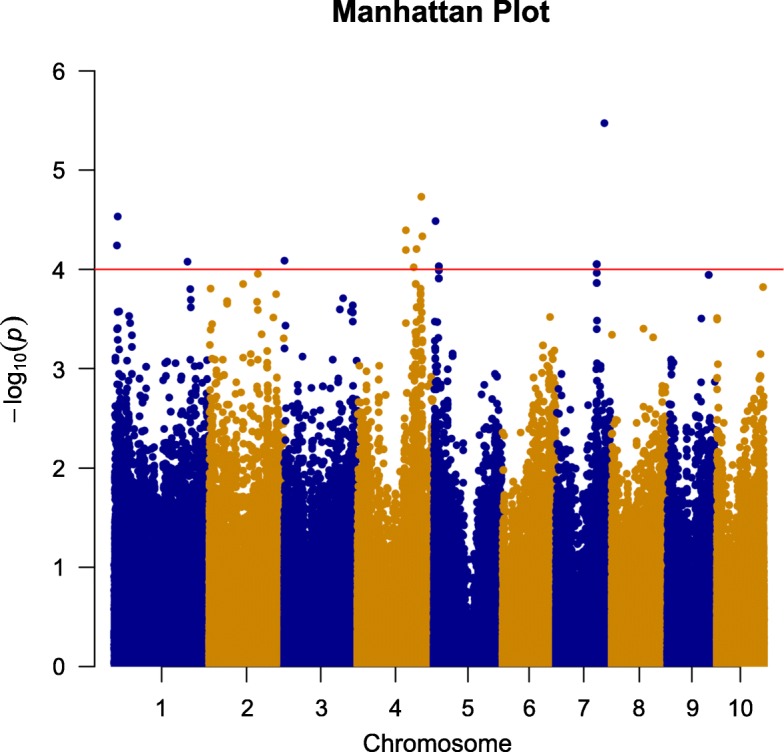
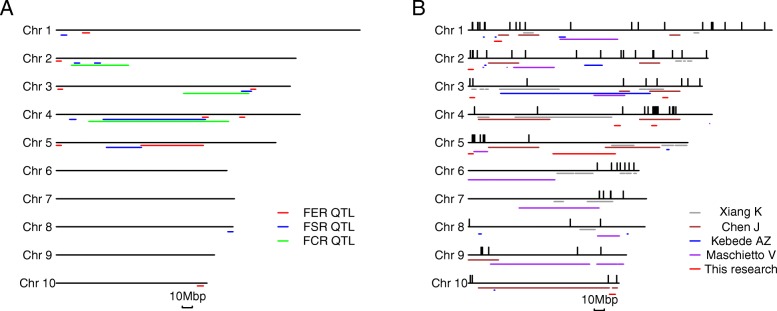
To gain a comprehensive understanding of the genetic basis of natural variation in FER resistance, a recombinant inbred lines (RIL) population and one panel of inbred lines were used to map quantitative trait loci (QTL) for resistance. As a result, a total of 10 QTL were identified by linkage mapping under four environments, which were located on six chromosomes and explained 1.0-7.1% of the phenotypic variation. Epistatic mapping detected four pairs of QTL that showed significant epistasis effects, explaining 2.1-3.0% of the phenotypic variation. Additionally, 18 single nucleotide polymorphisms (SNPs) were identified across the whole genome by genome-wide association study (GWAS) under five environments. Compared linkage and association mapping revealed five common intervals located on chromosomes 3, 4, and 5 associated with FER resistance, four of which were verified in different near-isogenic lines (NILs) populations. GWAS identified three candidate genes in these consistent intervals, which belonged to the Glutaredoxin protein family, actin-depolymerizing factors (ADFs), and AMP-binding proteins. In addition, two verified FER QTL regions were found consistent with Fusarium cob rot (FCR) and Fusarium seed rot (FSR).
These results revealed that multi pathways were involved in FER resistance, which was a complex trait that was controlled by multiple genes with minor effects, and provided important QTL and genes, which could be used in molecular breeding for resistance.
由串珠镰刀菌(Fusarium verticillioides)引起的镰刀菌穗腐病(FER)是一种全球性的玉米主要病害,它降低了谷物的产量和质量。然而,目前关于 FER 主要基因座的验证和克隆的报道很少。
为了全面了解 FER 抗性的自然变异的遗传基础,使用重组自交系(RIL)群体和一组自交系来定位抗 FER 的数量性状基因座(QTL)。结果,通过在四个环境下的连锁作图共鉴定出 10 个 QTL,这些 QTL 位于六个染色体上,解释了 1.0-7.1%的表型变异。上位性作图检测到四对具有显著上位性效应的 QTL,解释了 2.1-3.0%的表型变异。此外,通过全基因组关联研究(GWAS)在五个环境下共鉴定出全基因组 18 个单核苷酸多态性(SNP)。比较连锁和关联作图揭示了五个位于染色体 3、4 和 5 上与 FER 抗性相关的共同区间,其中四个在不同的近等基因系(NIL)群体中得到了验证。GWAS 在这些一致区间中鉴定出三个候选基因,它们属于谷氧还蛋白家族、肌动蛋白解聚因子(ADFs)和 AMP 结合蛋白。此外,还发现两个经过验证的 FER QTL 区域与镰刀菌穗腐病(FCR)和镰刀菌种子腐病(FSR)一致。
这些结果表明,FER 抗性涉及多种途径,是一个由多个微效基因控制的复杂性状,为分子抗性育种提供了重要的 QTL 和基因。