Department of Epidemiology, Gillings School of Global Public Health, University of North Carolina at Chapel Hill, Chapel Hill, NC, USA.
Early Oncology, Discover ICA, AstraZeneca, Gaithersburg, MD, USA.
J Expo Sci Environ Epidemiol. 2020 Sep;30(5):824-834. doi: 10.1038/s41370-020-0226-2. Epub 2020 May 12.
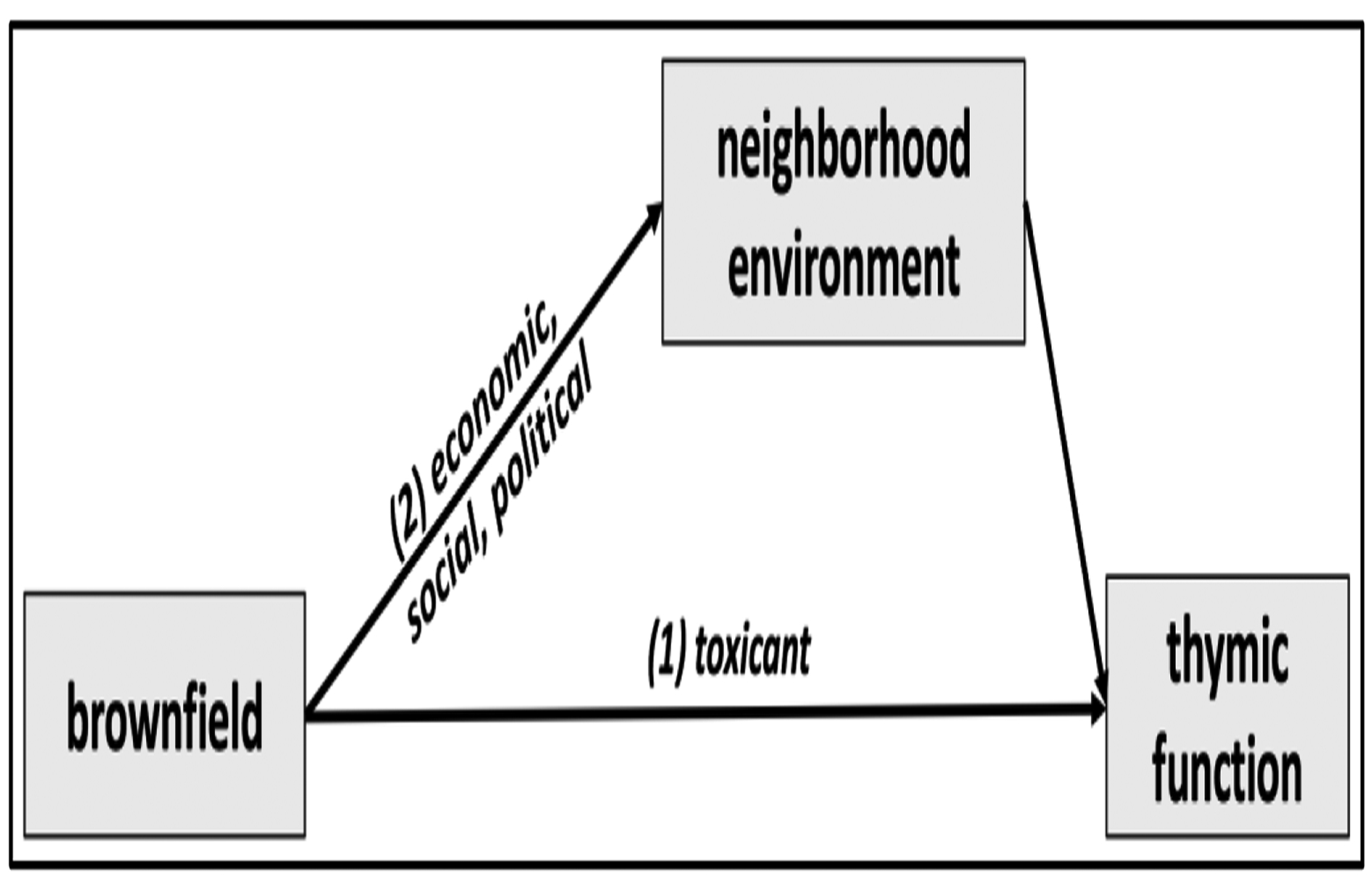
The mechanisms by which neighborhood environmental exposures influence health are poorly understood, although immune system dysregulation represents a potential biological pathway. While many neighborhood exposures have been investigated, there is little research on residential proximity to brownfield waste. Using biomarker data from 262 participants in the Detroit Neighborhood Health Study, we estimated the association between proximity to brownfields and heavy traffic and signal joint T-cell receptor excision circles (sjTRECs, a measure of naive T-cell production), C-reactive protein (CRP, a measure of systemic inflammation), and interleukin-6 (IL-6, a pro-inflammatory cytokine). We assessed residential proximity ≤200 m from brownfields and highways on all three biomarkers using multivariate regression. We demonstrated that living ≤200 m from a brownfield site was associated with a 0.30 (95% CI = 0.59, 0.02, p = 0.04) log-unit decrease in sjTRECs per million whole blood cells, as well as non-significantly elevated levels of CRP and IL-6. Heavy traffic was not associated with any biomarker. Persons living in close proximity to brownfield sites had significantly lower naive T-cell production, suggesting accelerated immune aging. Decreased T-cell production associated with brownfield proximity may be caused by toxicant exposure in brownfield sites, or may serve as a marker of other neighborhood stressors.
尽管免疫系统失调是一个潜在的生物学途径,但邻里环境暴露影响健康的机制仍不清楚。虽然已经研究了许多邻里暴露因素,但对住宅与棕地废物的接近程度的研究甚少。利用底特律邻里健康研究中 262 名参与者的生物标志物数据,我们估计了与棕地和交通繁忙地区的接近程度与 T 细胞受体切除环(sjTRECs,衡量幼稚 T 细胞生成的指标)、C 反应蛋白(CRP,衡量全身炎症的指标)和白细胞介素-6(IL-6,一种促炎细胞因子)之间的关联。我们使用多元回归评估了居住在距棕地和高速公路 200 米以内的所有三种生物标志物的情况。我们表明,居住在距棕地地点 200 米以内与每百万全血细胞中的 sjTRECs 减少 0.30(95%CI=0.59, 0.02,p=0.04)对数单位有关,并且 CRP 和 IL-6 的水平也略有升高。交通繁忙与任何生物标志物均无关联。居住在棕地附近的人明显幼稚 T 细胞生成减少,表明免疫加速衰老。与棕地接近相关的 T 细胞生成减少可能是由于棕地中的有毒物质暴露引起的,也可能是其他邻里压力源的标志物。