Kim Seon Hee, Lee Jihye, Jang Yun Jung, Lee Kang-Bong, Lee Yeonhee
Advanced Analysis Center, Korea Institute of Science & Technology, Seoul 02792, Republic of Korea.
Department of Materials Science and Engineering, Korea University, Seoul 02841, Republic of Korea.
J Anal Methods Chem. 2020 Jan 22;2020:6134627. doi: 10.1155/2020/6134627. eCollection 2020.
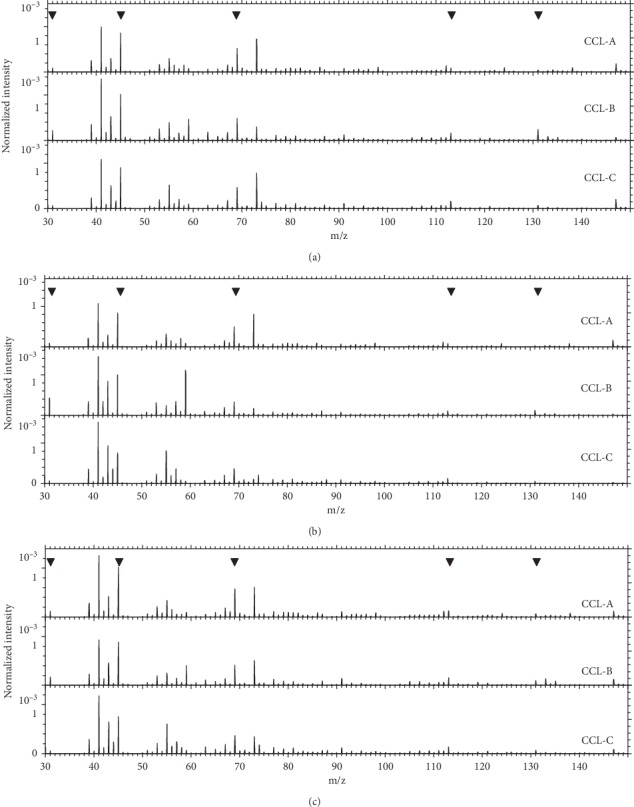
Over the years, soft contact lenses for vision correction and cosmetic and therapeutic purposes have been greatly improved. For cosmetic contact lenses, the pigments need to be nontoxic, and the position of the pigment layer is particularly important because of the risks posed by pigment elution and the roughness of the lens surface. In this paper, we characterized the properties of brown cosmetic contact lenses made by three different manufacturers using surface analytical techniques. The surface topographies of the noncolored and colored parts were obtained by atomic force microscopy (AFM), and the position and composition of the pigment layer were determined by analyzing the cross section of the contact lenses using scanning electron microscopy with energy-dispersive X-ray spectroscopy (SEM-EDX). The influence of pigment location on surface roughness was also examined. In addition, to find the method of the evaluation for the risk of surface elution of the pigments in the colored parts, the mass spectra and ion images of the surfaces were obtained by time-of-flight secondary ion mass spectrometry (ToF-SIMS) with a new sample preparation. From the ToF-SIMS spectra, we observed specific fragment ions of the poly(hydroxyethyl methacrylate) (PHEMA) polymer and found differences in the composition of the pigment layer depending on the manufacturers. The cross-sectioned image and 3D chemical characterizations of metallic and specific ions in the brown cosmetic contact lenses clearly indicated the spatial distribution and location of the pigment layer that can be used for the evaluation of pigment elution.
多年来,用于视力矫正、美容和治疗目的的软性隐形眼镜有了很大改进。对于美容隐形眼镜,色素必须无毒,而且由于色素洗脱和镜片表面粗糙度带来的风险,色素层的位置尤为重要。在本文中,我们使用表面分析技术对三家不同制造商生产的棕色美容隐形眼镜的特性进行了表征。通过原子力显微镜(AFM)获得无色和有色部分的表面形貌,并使用扫描电子显微镜与能量色散X射线光谱仪(SEM-EDX)分析隐形眼镜的横截面,以确定色素层的位置和组成。还研究了色素位置对表面粗糙度的影响。此外,为了找到评估有色部分色素表面洗脱风险的方法,采用新的样品制备方法,通过飞行时间二次离子质谱(ToF-SIMS)获得了表面的质谱图和离子图像。从ToF-SIMS光谱中,我们观察到聚甲基丙烯酸羟乙酯(PHEMA)聚合物的特定碎片离子,并发现不同制造商生产的色素层组成存在差异。棕色美容隐形眼镜中金属和特定离子的横截面图像和三维化学表征清楚地表明了色素层的空间分布和位置,可用于评估色素洗脱情况。