Thai Red Cross Emerging Infectious Diseases Health Science Centre, World Health Organization Collaborating Centre for Research and Training on Viral Zoonoses, King Chulalongkorn Memorial Hospital, Faculty of Medicine, Chulalongkorn University, Bangkok, Thailand.
Division of Infectious Diseases, Department of Medicine, Faculty of Medicine, Thai Red Cross Emerging Infectious Diseases Clinical Centre, King Chulalongkorn Memorial Hospital, Chulalongkorn University, Bangkok, Thailand.
J Med Virol. 2020 Oct;92(10):2193-2199. doi: 10.1002/jmv.26005. Epub 2020 Jul 21.
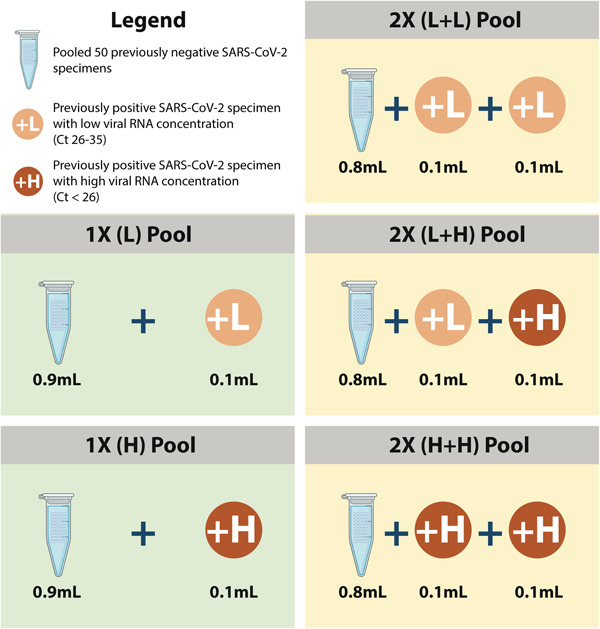
In the age of a pandemic, such as the ongoing one caused by severe acute respiratory syndrome coronavirus 2 (SARS-CoV-2), the world faces a limited supply of tests, personal protective equipment, and factories and supply chains are struggling to meet the growing demands. This study aimed to evaluate the efficacy of specimen pooling for testing of SARS-CoV-2 virus, to determine whether costs and resource savings could be achieved without impacting the sensitivity of the testing. Ten previously tested nasopharyngeal and throat swab specimens by real-time polymerase chain reaction (PCR), were pooled for testing, containing either one or two known positive specimens of varying viral concentrations. Specimen pooling did not affect the sensitivity of detecting SARS-CoV-2 when the PCR cycle threshold (Ct) of original specimen was lower than 35. In specimens with low viral load (Ct > 35), 2 of 15 pools (13.3%) were false negative. Pooling specimens to test for Coronavirus Disease 2019 infection in low prevalence (≤1%) areas or in low risk populations can dramatically decrease the resource burden on laboratory operations by up to 80%. This paves the way for large-scale population screening, allowing for assured policy decisions by governmental bodies to ease lockdown restrictions in areas with a low incidence of infection, or with lower-risk populations.
在大流行时期,例如当前由严重急性呼吸综合征冠状病毒 2 (SARS-CoV-2) 引起的大流行时期,全球面临着测试、个人防护设备以及工厂和供应链供应有限的问题,难以满足不断增长的需求。本研究旨在评估 SARS-CoV-2 病毒检测中样本混合的效果,以确定在不影响检测灵敏度的情况下,是否可以节省成本和资源。我们将之前通过实时聚合酶链反应 (PCR) 检测的 10 份鼻咽和咽喉拭子标本混合进行检测,其中包含 1 或 2 份已知浓度不同的阳性标本。当原始标本的 PCR 循环阈值 (Ct) 低于 35 时,样本混合不会影响 SARS-CoV-2 的检测灵敏度。在病毒载量低 (Ct>35) 的标本中,15 个混合标本中有 2 个 (13.3%) 为假阴性。在低流行率 (≤1%) 地区或低风险人群中混合检测样本以检测 2019 年冠状病毒病,可以将实验室操作的资源负担减少高达 80%。这为大规模人群筛查铺平了道路,使政府机构能够做出有保证的决策,在感染率低或风险较低的地区放宽封锁限制。