Faculty of Infectious Diseases, London School of Hygiene and Tropical Medicine, United Kingdom.
Faculty of Infectious Diseases, London School of Hygiene and Tropical Medicine, United Kingdom; PHE Malaria Reference Laboratory, London School of Hygiene & Tropical Medicine, United Kingdom.
EBioMedicine. 2020 May;55:102757. doi: 10.1016/j.ebiom.2020.102757. Epub 2020 May 8.
Many health facilities in malaria endemic countries are dependent on Rapid diagnostic tests (RDTs) for diagnosis and some National Health Service (NHS) hospitals without expert microscopists rely on them for diagnosis out of hours. The emergence of P. falciparum lacking the gene encoding histidine-rich protein 2 and 3 (HRP2 and HRP3) and escaping RDT detection threatens progress in malaria control and elimination. Currently, confirmation of RDT negative due to the deletion of pfhrp2 and pfhrp3, which encodes a cross-reactive protein isoform, requires a series of PCR assays. These tests have different limits of detection and many laboratories have reported difficulty in confirming the absence of the deletions with certainty.
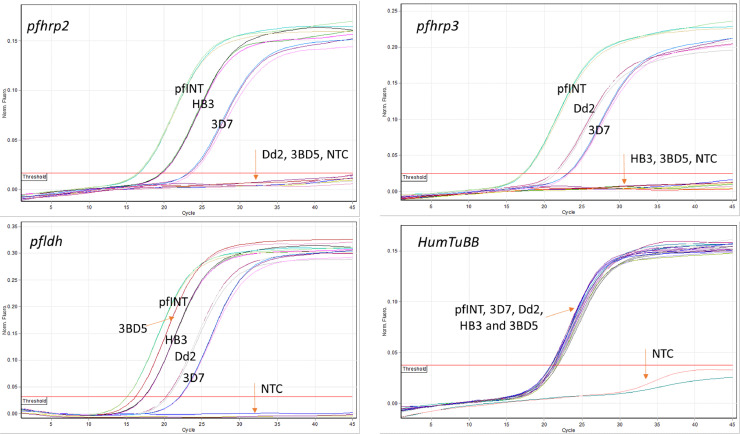
We developed and validated a novel and rapid multiplex real time quantitative (qPCR) assay to detect pfhrp2, pfhrp3, confirmatory parasite and human reference genes simultaneously. We also applied the assay to detect pfhrp2 and pfhrp3 deletion in 462 field samples from different endemic countries and UK travellers.
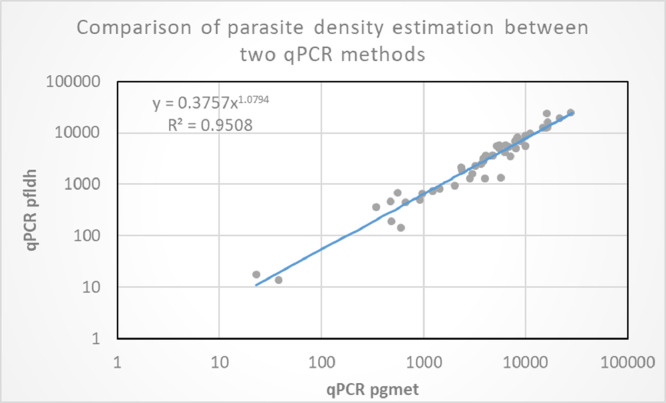
The qPCR assay demonstrated diagnostic sensitivity of 100% (n = 19, 95% CI= (82.3%; 100%)) and diagnostic specificity of 100% (n = 31; 95% CI= (88.8%; 100%)) in detecting pfhrp2 and pfhrp3 deletions. In addition, the assay estimates P. falciparum parasite density and accurately detects pfhrp2 and pfhrp3 deletions masked in polyclonal infections. We report pfhrp2 and pfhrp3 deletions in parasite isolates from Kenya, Tanzania and in UK travellers.
The new qPCR is easily scalable to routine surveillance studies in countries where P. falciparum parasites lacking pfhrp2 and pfhrp3 are a threat to malaria control.
许多疟疾流行国家的卫生机构依赖于快速诊断检测(RDT)进行诊断,一些国家卫生服务(NHS)医院由于缺乏专家级别的显微镜检验师,在非工作时间也依赖 RDT 进行诊断。恶性疟原虫缺乏编码组氨酸丰富蛋白 2 和 3(HRP2 和 HRP3)的基因,并逃避 RDT 检测,这威胁到疟疾控制和消除工作的进展。目前,由于 pfhrp2 和 pfhrp3 缺失,即编码交叉反应蛋白同工型的基因缺失,导致 RDT 检测呈阴性,需要进行一系列 PCR 检测。这些检测方法的检测限不同,许多实验室报告称,难以确定是否确实存在缺失。
我们开发并验证了一种新的快速多重实时定量(qPCR)检测方法,用于同时检测 pfhrp2、pfhrp3、确认的寄生虫和人类参考基因。我们还应用该方法检测了来自不同流行国家和英国旅行者的 462 个现场样本中 pfhrp2 和 pfhrp3 的缺失情况。
qPCR 检测方法在检测 pfhrp2 和 pfhrp3 缺失方面表现出 100%的诊断灵敏度(n=19,95%CI=(82.3%;100%))和 100%的诊断特异性(n=31,95%CI=(88.8%;100%))。此外,该方法还可以估计恶性疟原虫寄生虫密度,并准确检测多克隆感染中隐藏的 pfhrp2 和 pfhrp3 缺失。我们报告了肯尼亚、坦桑尼亚寄生虫分离株以及英国旅行者中 pfhrp2 和 pfhrp3 缺失的情况。
新的 qPCR 方法易于扩展到恶性疟原虫缺乏 pfhrp2 和 pfhrp3 的国家进行常规监测研究,这对疟疾控制构成了威胁。