London School of Hygiene and Tropical Medicine, Keppel Street, London, WC1E 7HT, United Kingdom.
Laboratory of Entomology, Wageningen University & Research, 6708 PB, Wageningen, The Netherlands.
Sci Rep. 2019 Mar 25;9(1):5107. doi: 10.1038/s41598-019-41438-0.
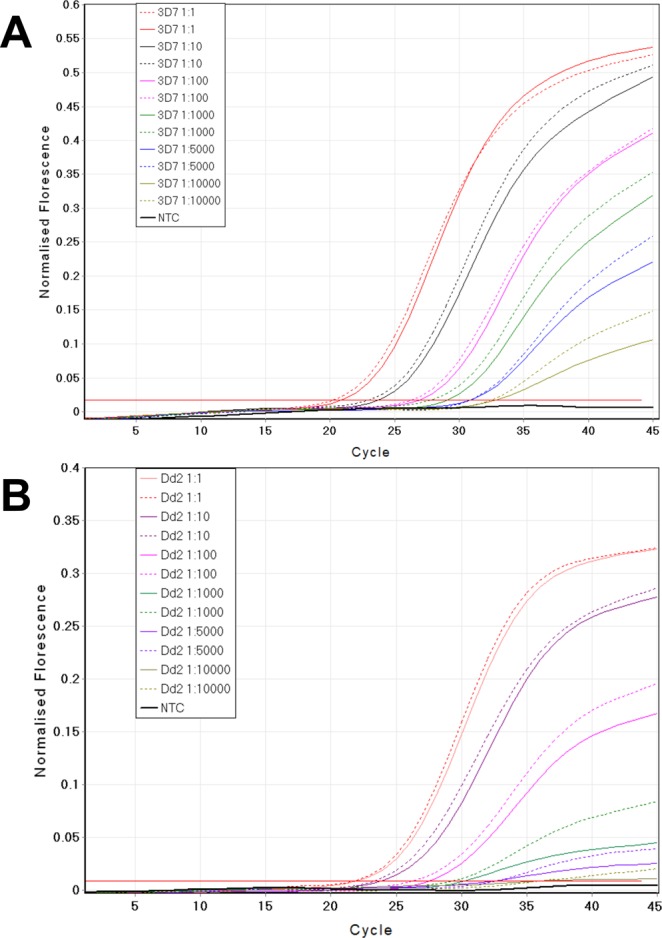
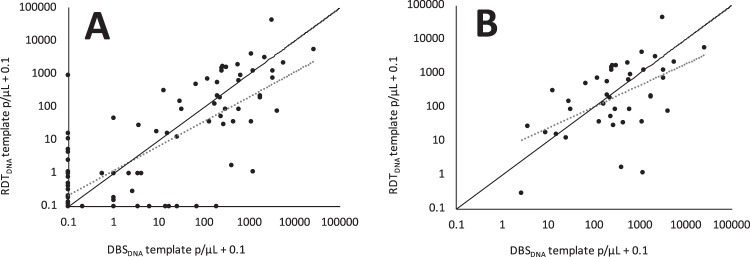
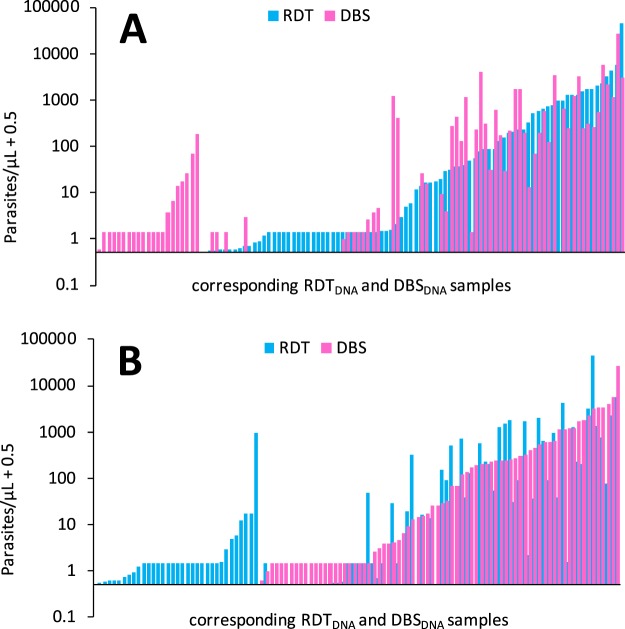
Most malaria-endemic countries are heavily reliant upon rapid diagnostic tests (RDT) for malaria case identification and treatment. RDT previously used for malaria diagnosis can subsequently be used for molecular assays, including qualitative assessment of parasite species present or the carriage of resistance markers, because parasite DNA can be extracted from the blood inside the RDT which remains preserved on the internal components. However, the quantification of parasite density has not previously been possible from used RDT. In this study, blood samples were collected from school-age children in Western Kenya, in the form of both dried blood spots on Whatman filter paper, and the blood spot that is dropped into rapid diagnostic tests during use. Having first validated a robotic DNA extraction method, the parasite density was determined from both types of sample by duplex qPCR, and across a range of densities. The methods showed good agreement. The preservation of both parasite and human DNA on the nitrocellulose membrane inside the RDT was stable even after more than one year's storage. This presents a useful opportunity for researchers or clinicians wishing to gain greater information about the parasite populations that are being studied, without significant investment of resources.
大多数疟疾流行国家严重依赖快速诊断检测(RDT)来识别和治疗疟疾病例。先前用于疟疾诊断的 RDT 随后可用于分子检测,包括定性评估存在的寄生虫种类或携带的耐药标志物,因为寄生虫 DNA 可以从 RDT 内部保存的血液中提取出来。然而,以前无法从使用过的 RDT 中定量寄生虫密度。在这项研究中,从肯尼亚西部的学龄儿童中采集了血液样本,形式包括滤纸制成的干血斑和在使用时滴入快速诊断检测的血斑。在首次验证了一种机器人 DNA 提取方法后,通过双荧光定量 PCR 从两种类型的样本中确定了寄生虫密度,并在一系列密度范围内进行了检测。这两种方法的结果吻合度较好。即使在储存一年多后,RDT 内硝酸纤维素膜上的寄生虫和人类 DNA 的保存仍然稳定。这为希望在不大量投入资源的情况下,从研究中获得更多有关寄生虫种群信息的研究人员或临床医生提供了一个有用的机会。