Midwifery Department, Ahvaz Jundishapur University of Medical Sciences, Ahvaz, Iran.
Midwifery Department, Menopause Andropause Research Center, Ahvaz Jundishapur University of Medical Sciences, Ahvaz, Iran.
BMC Pregnancy Childbirth. 2020 May 13;20(1):291. doi: 10.1186/s12884-020-2832-3.
The objective of this systematic review and meta-analysis was to assess the effectiveness of hyoscine n-butylbromide in labor progress.
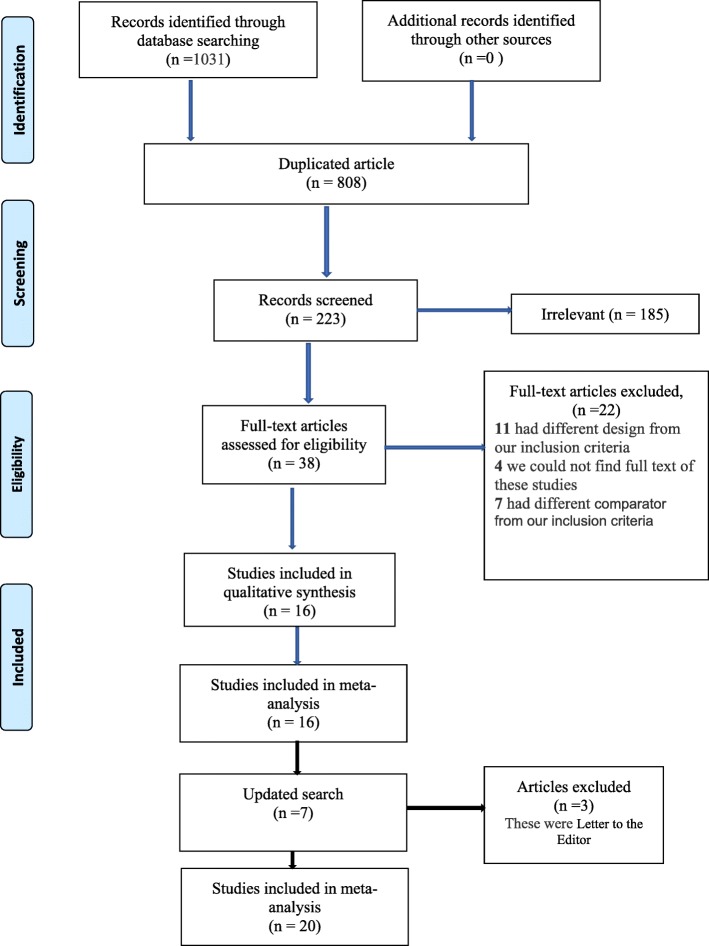
The databases including PubMed, the Cochrane Library, Science-Direct, Scopus and Web of Science were searched for studies published up to December 2019. Articles that published as randomized controlled trials (RCTs), and full-text articles published in English or other languages were included and participants were primi or multigravida women who were in active phase of labor. The intervention included HBB compared to placebo (normal saline) that was used during active phase of labor. Pooled estimates were measured using the fixed or random effect model, while the overall effect was reported in a mean difference (MD). All data were analyzed using Review Manager 5.3.
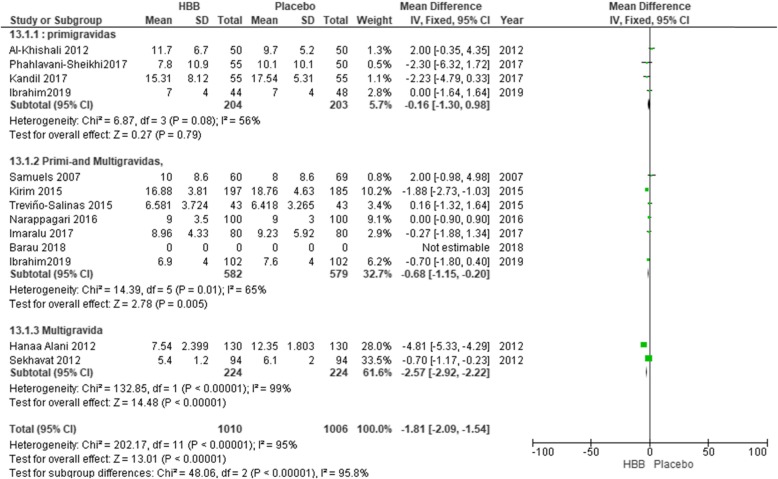
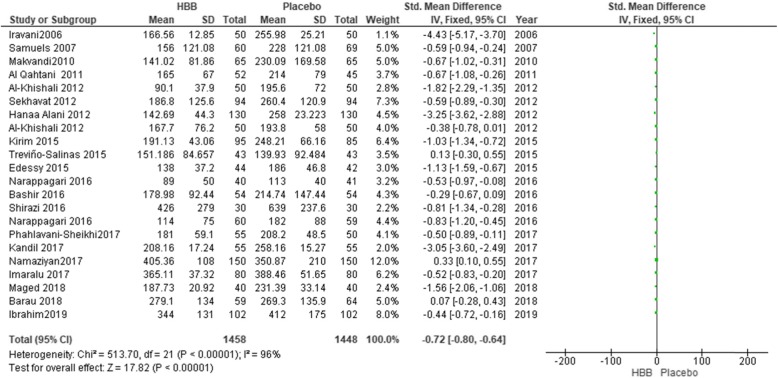
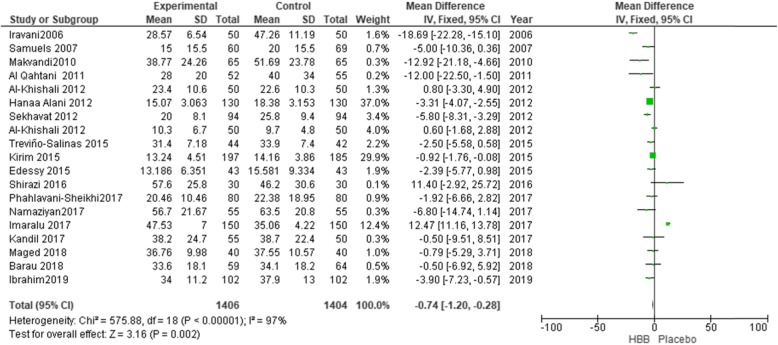
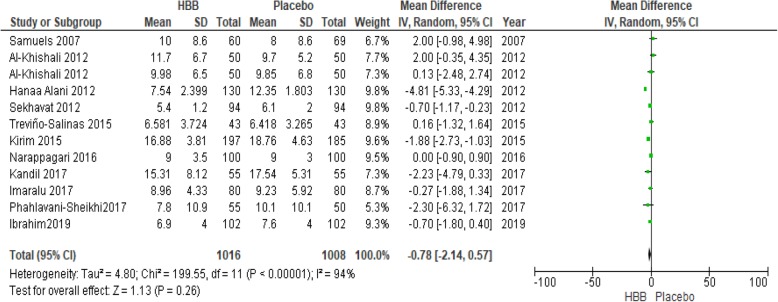
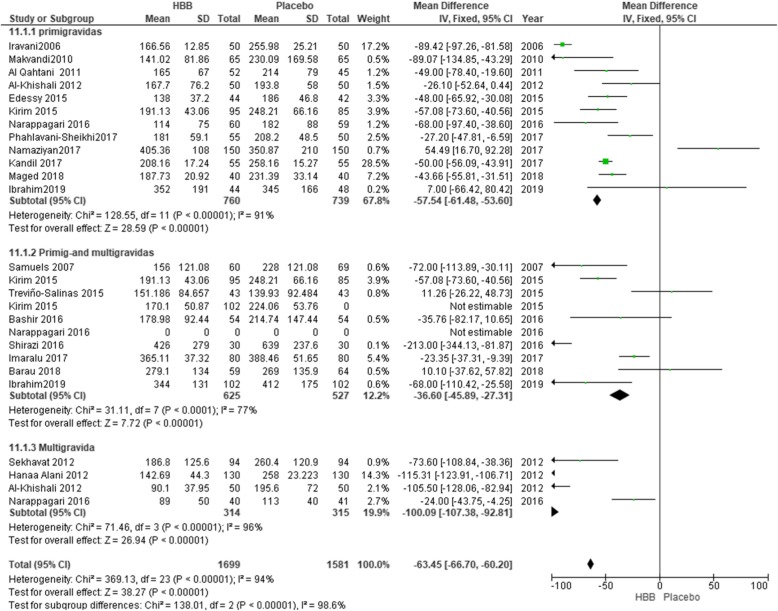
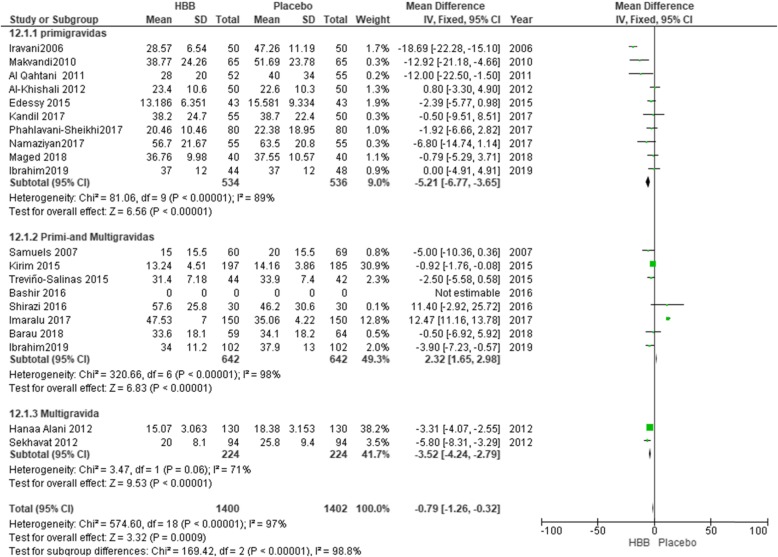
Twenty studies involving 3108 women were included in meta-analysis. Based on subgroup analysis by parity, use of HBB significantly reduced the duration of the first stage of labor in primigravida women (MD = - 57.73; 95% CI: [- 61.48, - 53.60]) and in multigravida women (MD = - 90.74; 95% CI: [- 97.24, - 84.24]). Administering HBB could reduce the second stages of labor in primigravidas and multigravidas about 6 min and 4 min respectively. Also, HBB reduced the duration of the third stage of labor in multigravidas about 3 min. APGAR score at one and 5 min after birth was not affected. The main maternal adverse effect was tachycardia and dry mouth. Labor duration in studies in which the participants were primi-and multigravida was not presented based on separate parities except for four papers, and the route of HBB administration was not the same across all studies.
Although, the effect of HBB was minimal when multigravidas and primigravidas women were considered together, the HBB was clinically effective in primigravida and multigravida women for shortening the first and the second stages of labor. Also, HBB could reduce the length of the third stage of labor in multigravidas.
本系统评价和荟萃分析的目的是评估氢溴酸东莨菪碱在产程中的有效性。
检索了包括 PubMed、Cochrane 图书馆、Science-Direct、Scopus 和 Web of Science 在内的数据库,以获取截至 2019 年 12 月发表的研究。纳入的文章为随机对照试验(RCT),并包括发表在英文或其他语言的全文文章,参与者为处于活跃分娩期的初产妇或经产妇。干预措施包括氢溴酸东莨菪碱与安慰剂(生理盐水)的比较,均在活跃分娩期使用。使用固定或随机效应模型测量汇总估计值,以均数差(MD)报告总体效果。使用 Review Manager 5.3 分析所有数据。
荟萃分析纳入了 20 项研究,共 3108 名女性。根据产次的亚组分析,氢溴酸东莨菪碱可显著缩短初产妇的第一产程(MD = -57.73;95% CI:[-61.48,-53.60])和经产妇的第一产程(MD = -90.74;95% CI:[-97.24,-84.24])。给予氢溴酸东莨菪碱可分别缩短初产妇和经产妇的第二产程约 6 分钟和 4 分钟。此外,氢溴酸东莨菪碱还可缩短经产妇的第三产程约 3 分钟。产后 1 分钟和 5 分钟的 APGAR 评分不受影响。主要的母体不良效应是心动过速和口干。除了 4 篇论文外,未按单独的产次分别呈现研究中初产妇和经产妇的产程,并且所有研究中氢溴酸东莨菪碱的给药途径也不相同。
虽然氢溴酸东莨菪碱对初产妇和经产妇的影响不大,但氢溴酸东莨菪碱对初产妇和经产妇缩短第一产程和第二产程是有效的。此外,氢溴酸东莨菪碱还可以缩短经产妇的第三产程。