Complex Care and Recovery Program, Centre for Addiction and Mental Health, 1001 Queen Street West, Toronto, Ontario, M6J 1H4, Canada.
Department of Psychiatry, University of Toronto, Toronto, Canada.
BMC Psychiatry. 2020 May 13;20(1):230. doi: 10.1186/s12888-020-02629-6.
The risk and recovery paradigms are the dominant frameworks informing forensic mental health services and have been the focus of increasing research interest. Despite this, there are significant gaps in our understanding of the nature of mental health recovery in forensic settings (i.e., 'secure recovery'), and specifically, the key elements of recovery as perceived by forensic patients and their treatment providers. Importantly, we know little about how patients perceive the forensic mental health system, to what extent they see it as fair and legitimate, and how these perceptions impact upon treatment engagement, risk for adversity, and progress in recovery.
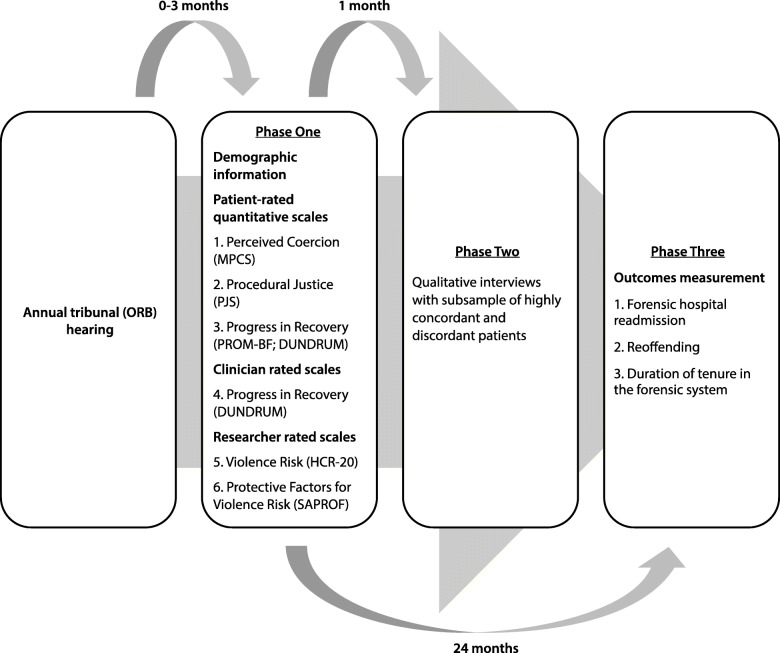
In this prospective, mixed-methods study, we investigate patient perceptions of procedural justice and coercion within the context of the forensic mental health system in Ontario, Canada (final N = 120 forensic patients and their primary care providers). We elicit patient self-assessments of risk and progress in recovery, and assess the degree of concordance with clinician-rated estimates of these constructs. Both qualitative and quantitative methods are used to assess the degree to which patient perceptions of coercion, fairness and legitimacy impact upon their level of treatment engagement, risk for adversity and progress in recovery. A prospective, two-year follow-up will investigate the impact of patient and clinician perspectives on outcomes in the domains of forensic hospital readmission, criminal reoffending, and rate of progress through the forensic system.
Results from this mixed-methods study will yield a rich and detailed account of patient perceptions of the forensic mental health system, and specifically whether perceptions of procedural fairness, justice and legitimacy, as well as perceived coercion, systematically influence patients' risk for adversity, their ability to progress in their recovery, and ultimately, advance through the forensic system towards successful community living. Findings will provide conceptual clarity to the key elements of secure recovery, and illuminate areas of similarity and divergence with respect to how patients and clinicians assess risk and recovery needs. In doing so, knowledge from this study will provide a deep understanding of factors that promote patient safety and recovery, and provide a foundation for optimizing the forensic mental health system to improve patient outcomes.
风险与恢复范式是指导法医心理健康服务的主要框架,也是越来越多研究关注的焦点。尽管如此,我们对法医环境中心理健康恢复的本质(即“安全恢复”),尤其是法医患者及其治疗提供者所感知的恢复的关键要素,仍存在很大的理解差距。重要的是,我们对患者如何看待法医心理健康系统知之甚少,他们在多大程度上认为该系统公平合法,以及这些看法如何影响治疗参与、逆境风险和恢复进展。
在这项前瞻性的混合方法研究中,我们调查了加拿大安大略省法医心理健康系统中患者对程序公正和强制治疗的看法(最终 N=120 名法医患者及其主要治疗提供者)。我们通过自我评估来评估患者的风险和恢复进展,并评估这些评估与临床医生对这些评估的评估的一致性程度。我们使用定性和定量方法来评估患者对强制治疗、公平性和合法性的看法对其治疗参与度、逆境风险和恢复进展的影响程度。一项为期两年的前瞻性随访将调查患者和临床医生观点对法医医院再入院、刑事再犯罪和通过法医系统的进展速度等领域的结果的影响。
这项混合方法研究的结果将详细描述患者对法医心理健康系统的看法,特别是程序公平、正义和合法性的看法,以及感知到的强制治疗是否会系统地影响患者的逆境风险、恢复进展能力,以及最终成功融入社区生活的能力。研究结果将为安全恢复的关键要素提供概念上的清晰认识,并阐明患者和临床医生如何评估风险和恢复需求的相似之处和差异。通过这样做,这项研究的知识将深入了解促进患者安全和恢复的因素,并为优化法医心理健康系统以改善患者结果提供基础。