Center for the Study of Equity and Governance in Health Systems (CEGSS), 11 calle 0-48 Zona 10, Edificio Diamond, oficina 504, Ciudad de Guatemala, Guatemala.
Division of Epidemiology and Global Health, Umeå University, Umeå, Sweden.
BMC Health Serv Res. 2020 May 13;20(1):416. doi: 10.1186/s12913-020-05259-6.
Citizen-led accountability initiatives are a critical strategy for redressing the causes of health inequalities and promoting better health system governance. A growing body of evidence points to the need for putting power relations at the forefront of understanding and operationalizing citizen-led accountability, rather than technical tools and best practices. In this study, we apply a network lens to the question of how initiatives build collective power to redress health system failures affecting marginalized communities in three municipalities in Guatemala.
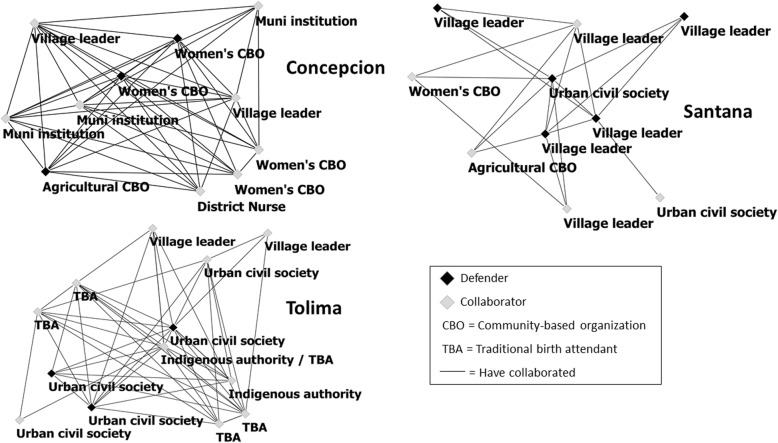
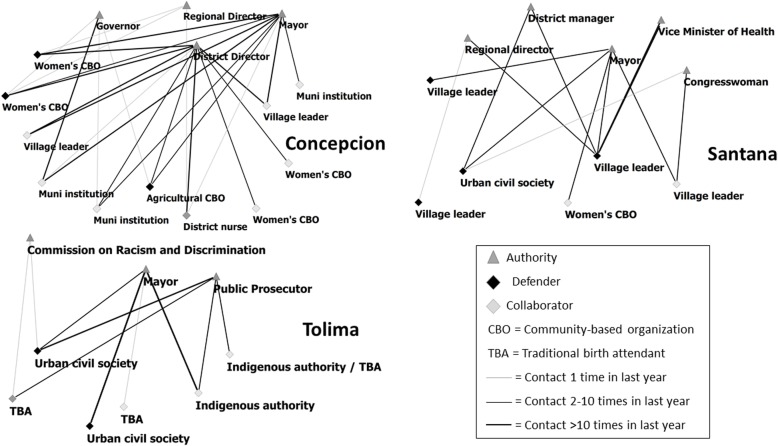
Network mapping and interpretive discussions were used to examine relational qualities of citizen-led initiatives' networks and explore the resources they offer for mobilizing action and influencing health accountability. Participants in the municipal-level initiatives responded to a social network analysis questionnaire focused on their ties of communication and collaboration with other initiative participants and their interactions with authorities regarding health system problems. Discussions with participants about the maps generated enriched our view of what the ties represented and their history of collective action and also provided space for planning action to strengthen their networks.
Our findings indicate that network qualities like cohesiveness and centralization reflected the initiative participants' agency in adapting to their sociopolitical context, and participants' social positions were a key resource in providing connection to a broad base of support for mobilizing collective action to document health service deficiencies and advocate for solutions. Their legitimacy as "representatives of the people" enabled them to engage with authorities from a bolstered position of power, and their iterative interactions with authorities further contributed to develop their advocacy capabilities and resulted in accountability gains.
Our study provided evidence to counter the tendency to underestimate the assets and capabilities that marginalized citizens have for building power, and affirmed the idea that best-fit, with-the-grain approaches are well-suited for highly unequal settings characterized by weak governance. Efforts to support and understand change processes in citizen-led initiatives should include focus on adaptive network building to enable contextually-embedded approaches that leverage the collective power of the users of health services and grassroots leaders on the frontlines of accountability.
公民主导的问责倡议是纠正健康不平等根源和促进更好的卫生系统治理的关键策略。越来越多的证据表明,需要将权力关系置于理解和实施公民主导的问责制的前沿,而不是技术工具和最佳实践。在这项研究中,我们应用网络视角来研究倡议如何建立集体权力,以纠正影响危地马拉三个城市中边缘化社区的卫生系统失败问题。
网络映射和解释性讨论用于检查公民主导的倡议网络的关系质量,并探讨它们为动员行动和影响卫生问责制提供的资源。参与市级倡议的人员对一项社会网络分析问卷做出了回应,该问卷侧重于他们与其他倡议参与者的沟通和协作关系,以及他们与当局就卫生系统问题进行的互动。与参与者就生成的地图进行讨论丰富了我们对关系的看法,以及他们集体行动的历史,也为加强网络的行动规划提供了空间。
我们的研究结果表明,网络质量如内聚性和集中性反映了倡议参与者在适应社会政治背景方面的能动性,参与者的社会地位是为动员集体行动提供广泛支持的关键资源,以记录卫生服务缺陷并倡导解决方案。他们作为“人民代表”的合法性使他们能够从增强的权力地位与当局接触,他们与当局的迭代互动进一步有助于发展他们的倡导能力,并导致问责制的收益。
我们的研究提供了证据,以反驳低估边缘化公民建立权力的资产和能力的倾向,并肯定了最佳适合、符合实际的方法非常适合治理薄弱、高度不平等的环境。支持和理解公民主导的倡议中的变革过程的努力应包括关注适应性网络建设,以实现利用卫生服务用户和基层领导者的集体权力的嵌入式方法。