Lincoln International Institute for Rural Health, University of Lincoln, Lincoln, United Kingdom.
School of Psychology, University of Lincoln, Lincoln, United Kingdom.
PLoS One. 2020 May 14;15(5):e0232958. doi: 10.1371/journal.pone.0232958. eCollection 2020.
Previous evidence has shown significant effects of exercise, cognitive and dual-task training for improving cognition in healthy cohorts. The effects of these types of interventions in type 2 diabetes mellitus is unclear. The aim of this research was to systematically review evidence, and estimate the effect, of exercise, cognitive, and dual-task interventions on cognition in type 2 diabetes mellitus.
Electronic databases including PubMed, EMBASE, CINAHL, PsycINFO, SPORTDiscus, and MEDLINE were searched for ongoing and completed interventional trials investigating the effect of either an exercise, cognitive or dual-task intervention on cognition in type 2 diabetes mellitus.
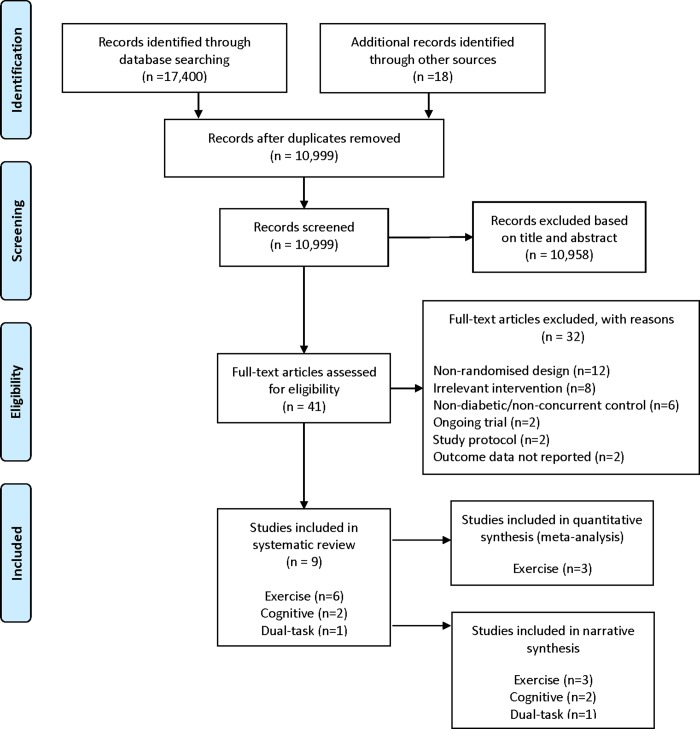
Nine trials met the inclusion criteria-one dual-task, two cognitive, and six exercise. Meta-analyses of exercise trials showed no significant effects of exercise on measures of executive function (Stroop task, SMD = -0.31, 95% CI -0.71-0.09, P = 0.13, trail making test part A SMD = 0.28, 95% CI -0.20-0.77 P = 0.25, trail making test part B SMD = -0.15, 95% CI -0.64-0.34 P = 0.54, digit symbol SMD = 0.09, 95% CI -0.39-0.57 P = 0.72), and memory (immediate memory SMD = 0.20, 95% CI -0.28-0.69, P = 0.41 and delayed memory SMD = -0.06, 95% CI -0.55-0.42, P = 0.80). A meta-analysis could not be conducted using cognitive or dual-task data, but individual trials did report a favourable effect of interventions on cognition. Risk of bias was considered moderate to high for the majority of included trials.
Meta-analyses of exercise trials identified a small effect size (0.31), which whilst not significant warrants further investigation. Larger and more robust trials are needed that report evidence using appropriate reporting guidelines (e.g. CONSORT) to increase confidence in the validity of results.
Protocol was registered (CRD42017058526) on the International Prospective Register of Systematic Reviews (http://www.crd.york.ac.uk/PROSPERO).
先前的证据表明,运动、认知和双重任务训练对改善健康人群的认知有显著影响。这些干预措施在 2 型糖尿病中的效果尚不清楚。本研究的目的是系统地回顾证据,并估计运动、认知和双重任务干预对 2 型糖尿病患者认知的影响。
电子数据库包括 PubMed、EMBASE、CINAHL、PsycINFO、SPORTDiscus 和 MEDLINE,用于搜索正在进行和已完成的干预试验,以调查运动、认知或双重任务干预对 2 型糖尿病患者认知的影响。
有 9 项试验符合纳入标准,其中 1 项为双重任务,2 项为认知,6 项为运动。运动试验的荟萃分析显示,运动对执行功能(Stroop 任务,SMD=-0.31,95%CI-0.71-0.09,P=0.13,连线测试 A 部分 SMD=0.28,95%CI-0.20-0.77,P=0.25,连线测试 B 部分 SMD=-0.15,95%CI-0.64-0.34,P=0.54,数字符号 SMD=0.09,95%CI-0.39-0.57,P=0.72)和记忆(即刻记忆 SMD=0.20,95%CI-0.28-0.69,P=0.41,延迟记忆 SMD=-0.06,95%CI-0.55-0.42,P=0.80)无显著影响。由于认知或双重任务数据,无法进行荟萃分析,但个别试验报告干预对认知有有利影响。大多数纳入的试验的偏倚风险被认为是中度到高度。
运动试验的荟萃分析确定了一个较小的效应大小(0.31),虽然没有统计学意义,但值得进一步研究。需要更大和更稳健的试验,并使用适当的报告指南(例如 CONSORT)报告证据,以提高结果有效性的信心。
方案在国际前瞻性系统评价注册库(http://www.crd.york.ac.uk/PROSPERO)中注册(CRD42017058526)。