Beijing Rehabilitation Medicine Academy, Capital Medical University, Beijing, China 100144.
Department of Neurological Rehabilitation, Beijing Rehabilitation Hospital, Capital Medical University, Beijing, China 100144.
Biomed Res Int. 2021 Nov 17;2021:4558279. doi: 10.1155/2021/4558279. eCollection 2021.
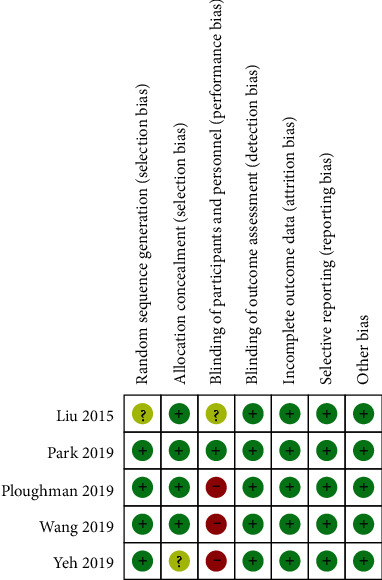
We investigated combined cognitive and exercise interventions in the literature and summarized their effectiveness in improving poststroke cognitive impairment (PSCI). . Electronic databases and trial registries were searched from their inception until July 2020. . Trials were collected with the following study inclusion criteria: (1) patients over 18 years of age who were diagnosed with PSCI; (2) combined cognitive-exercise interventions, regardless of the order of the two types of interventions or whether they were administered simultaneously; (3) any control group studied at the same time that was deemed acceptable, including no intervention/routine care, delayed intervention, sham intervention, and passive training; (4) the use of any validated cognitive neuropsychological test to evaluate cognitive function; and (5) clinically administered random trials with controls. . Five randomized controlled trials met the inclusion criteria. Two reviewers independently assessed the eligibility of the full texts and methodological quality of the included studies using the Cochrane risk of bias tool. Inconsistent results were resolved by additional discussion or decided by a third examiner, if necessary. . Meta-analysis demonstrated that the combined interventions had a significant effect on executive function and working memory [Stroop test (time), standardized mean difference (SMD) = 0.42, 95% confidence interval (CI): 0.80-0.04, = 0.02; Trail Making Test, SMD = 0.49, 95% CI: 0.82-0.16, = 0.004; Forward Digit Span Test, SMD = 0.91, 95% CI: 0.54-1.29, ≤ 0.001]. While it was impossible to conduct a meta-analysis of global cognitive function and other cognitive domains, individual experiments demonstrated that the combined interventions played a significant role in global cognition, reasoning ability, logical thinking, and visual-spatial memory function.
Our analyses demonstrated that the combined interventions had a significant effect on the improvement of PSCI, particularly in terms of executive function. However, the moderate risk of bias in the included trials and the small number of relevant studies indicated a need for more uniform diagnostic and evaluation criteria, and larger trials would provide stronger evidence to better understand the effectiveness of the combined interventions. This trial is registered with trial registration number INPLASY202160090.
我们对文献中的认知与运动联合干预进行了研究,总结了其改善卒中后认知障碍(PSCI)的效果。方法:从建库至 2020 年 7 月,我们检索了电子数据库和试验注册库。采用以下研究纳入标准收集试验:(1)年龄>18 岁、被诊断为 PSCI 的患者;(2)联合认知-运动干预,不论两种干预类型的顺序如何,或是否同时进行;(3)同时研究任何可接受的对照组,包括无干预/常规护理、延迟干预、假干预和被动训练;(4)使用任何经证实的认知神经心理学测试来评估认知功能;(5)采用对照的临床实施随机试验。结果:5 项随机对照试验符合纳入标准。两名评审员独立使用 Cochrane 偏倚风险工具评估全文的纳入标准和纳入研究的方法学质量。不一致的结果通过进一步讨论或必要时由第三名评审员决定。Meta 分析表明,联合干预对执行功能和工作记忆[Stroop 测试(时间),标准化均数差(SMD)=0.42,95%置信区间(CI):0.80-0.04, =0.02;Trail Making Test,SMD=0.49,95%CI:0.82-0.16, =0.004;向前数字跨度测试,SMD=0.91,95%CI:0.54-1.29, ≤0.001]有显著影响。虽然无法对总体认知功能和其他认知领域进行 Meta 分析,但个别试验表明,联合干预对总体认知、推理能力、逻辑思维和视觉空间记忆功能有显著作用。结论:我们的分析表明,联合干预对改善 PSCI 有显著效果,特别是在执行功能方面。但是,纳入试验存在中度偏倚风险,且相关研究数量较少,这表明需要更统一的诊断和评估标准,更大规模的试验将提供更强的证据,以更好地了解联合干预的效果。本试验已在 INPLASY202160090 号试验注册库中注册。