School of Management, Shanghai University, Shanghai 200444, China.
School of Foreign Languages, Shanghai University, Shanghai 200444, China.
Int J Environ Res Public Health. 2020 May 12;17(10):3381. doi: 10.3390/ijerph17103381.
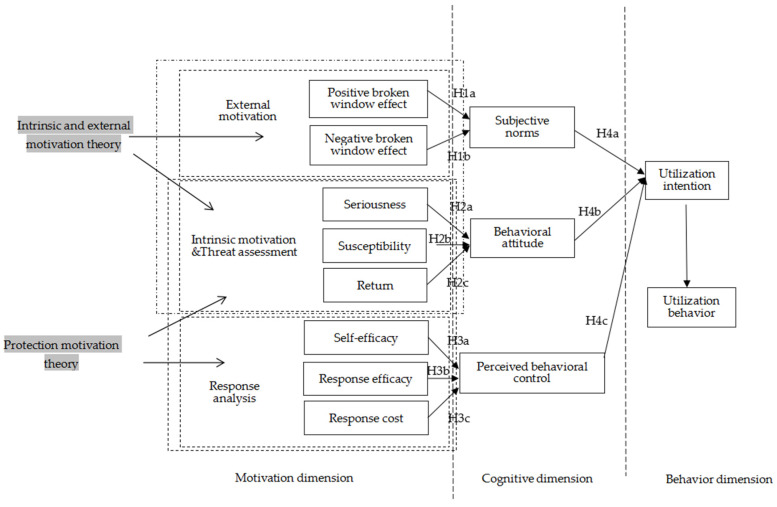
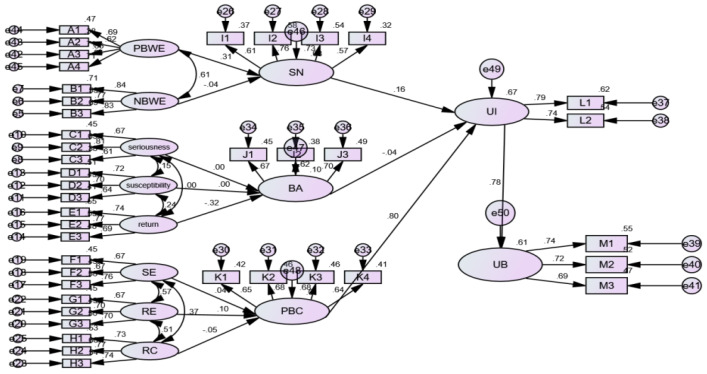
Using the theory of motivation, and the theory of planned behavior, this study establishes the "motivation-cognition-behavior" model of green utilization of agricultural waste from the perspective of farmers. In the motivational dimension, eight motivational factors were determined in three sub-dimensions of extrinsic motivation. In the cognitive dimension, three sub-dimensions of subjective norms, behavioral attitude, and perceived behavioral control are also determined. In the behavioral dimension, two sub-dimensions of utilization intention and utilization behavior are specified. Methodologically, a questionnaire on the green utilization of agricultural waste of 704 peasant households in five provinces of Jiangsu, Anhui, Shaanxi, Gansu, and Sichuan was administered. With the help of the structural equation model, the influence path and the internal mechanism was then analyzed. It is shown that: (1) in relation to the "motivational dimension → cognitive dimension," extrinsic motivation significantly promotes the cultivation of farmers' subjective norms, in which positive broken windows theory has a positive effect. In contrast, negative broken windows theory has a negative one. In intrinsic motivation, the behavior attitude of farmers is negative. In the response analysis, farmers can realize that their ability, self-efficacy, response efficacy, and response cost all have a positive impact on farmers' perceived behavioral control. (2) In relation of the "cognitive dimension → behavioral dimension," behavioral attitude slightly hinders utilization intention, while subjective norms and perceived behavioral control all contribute to a stronger utilization intention; the utilization intention maintains a positive correlation with the utilization behavior.
本研究运用动机理论和计划行为理论,从农户视角构建了农业废弃物绿色利用的“动机-认知-行为”模型。在动机维度上,确定了外驱动机的三个子维度中的 8 个动机因素。在认知维度上,确定了主观规范、行为态度和感知行为控制的三个子维度。在行为维度上,规定了利用意图和利用行为的两个子维度。在方法上,对江苏、安徽、陕西、甘肃和四川五个省份的 704 户农户的农业废弃物绿色利用情况进行了问卷调查。借助结构方程模型,分析了影响路径和内在机制。结果表明:(1)在“动机维度→认知维度”方面,外驱动机显著促进了农民主观规范的培养,其中正“破窗效应”有正向影响,负“破窗效应”有负向影响。而内在动机中,农民的行为态度是消极的。在响应分析中,农民能够认识到自身能力、自我效能、反应效能和反应成本都对农民感知的行为控制有正向影响。(2)在“认知维度→行为维度”方面,行为态度略微阻碍了利用意图,而主观规范和感知行为控制都有助于增强利用意图;利用意图与利用行为呈正相关。