Postgraduate Program in Epidemiology, Federal University of Pelotas, Rua Marechal Deodoro, nº 1160 3º andar, Pelotas, CEP 96020-220, Rio Grande Do Sul, Brazil.
Departamento de Medicina Preventiva, Faculdade de Medicina FMUSP, Universidade de São Paulo, Avenida Dr. Arnaldo, 455, 2º andar, sala 2166, São Paulo, CEP 1246-903, Brazil.
BMC Psychiatry. 2020 May 14;20(1):233. doi: 10.1186/s12888-020-02533-z.
Maternal depression may be chronic and recurrent, with negative effects both on the health of mothers and children. Many studies have shown trajectories of postnatal depressive symptoms but few studies in low- and middle-income countries have evaluated the trajectories of depressive symptoms starting during pregnancy. This study aims to identify the different trajectories of depressive symptoms among mothers in the Pelotas 2015 birth cohort, from pregnancy to the second year of the child's life.
This study used data from the 2015 Pelotas Birth Cohort, a longitudinal study of all live births occurred in 2015 in Pelotas, Brazil. Maternal depressive symptoms were assessed using the Edinburgh Postnatal Depression Scale (EPDS). Mothers who completed the EPDS on at least three follow-up visits beginning to the antenatal follow-up visit were included in the analyses. The trajectory of maternal depressive symptoms was estimated through group-based trajectory modeling.
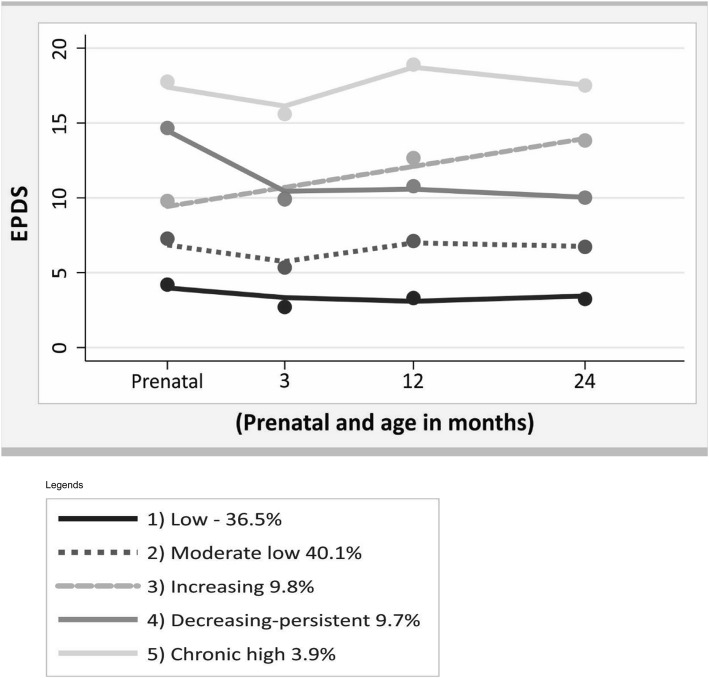
A total of 3040 women were included in the present analysis. We identified five groups of maternal depressive symptoms trajectories, with 23.4% of the mothers presenting persistent depressive symptoms and 3.9% showing chronic high depressive symptoms throughout the study period. The probability of having persistent depressive symptoms increased among mothers with greater socioeconomic vulnerability.
This study shown the persistence of maternal depressive symptoms since pregnancy until 2 years postnatal. Additionally, alongside the known risk factors, pre-gestational depression and antenatal depressive symptoms are important risk factors for the persistence and severity of depressive symptoms. These findings support the need to provide mental health evaluation and care for women from pregnancy to the late postnatal period.
母亲的抑郁可能是慢性和复发性的,对母亲和孩子的健康都有负面影响。许多研究已经表明产后抑郁症状的轨迹,但在中低收入国家,很少有研究评估从怀孕开始的抑郁症状轨迹。本研究旨在确定佩洛塔斯 2015 年出生队列中母亲的抑郁症状轨迹不同,从怀孕到孩子生命的第二年。
本研究使用了 2015 年佩洛塔斯出生队列的数据分析,这是一项对巴西佩洛塔斯 2015 年所有活产婴儿的纵向研究。使用爱丁堡产后抑郁量表(EPDS)评估产妇抑郁症状。至少完成三次随访的母亲被纳入 EPDS 评估,从产前随访开始。通过基于群组的轨迹建模来估计产妇抑郁症状的轨迹。
共有 3040 名妇女纳入本分析。我们确定了五种母亲抑郁症状轨迹组,23.4%的母亲在整个研究期间表现出持续的抑郁症状,3.9%表现出慢性高抑郁症状。社会经济脆弱性较高的母亲出现持续抑郁症状的可能性增加。
本研究表明,母亲的抑郁症状从怀孕持续到产后 2 年。此外,除了已知的风险因素外,孕前抑郁和产前抑郁是抑郁症状持续和严重的重要风险因素。这些发现支持在从怀孕到产后晚期为妇女提供心理健康评估和护理的必要性。