Centre de Recherche Cerveau et Cognition (CerCo), CNRS UMR 5549, Université Toulouse III, 31000 Toulouse, France.
Laboratoire de Psychologie et Neurocognition (LPNC), CNRS UMR 5105, Université Savoie Mont Blanc, Université Grenoble Alpes, 38000 Grenoble, France.
J Exp Child Psychol. 2020 Aug;196:104859. doi: 10.1016/j.jecp.2020.104859. Epub 2020 May 11.
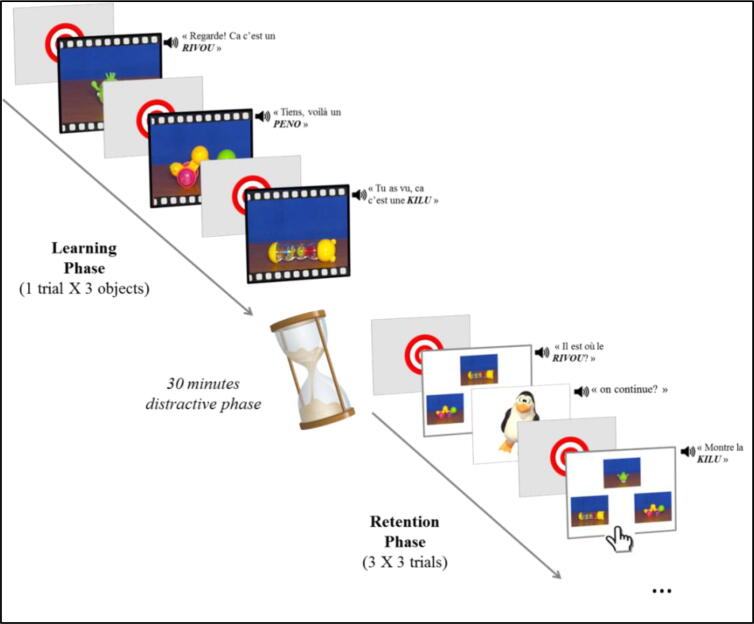
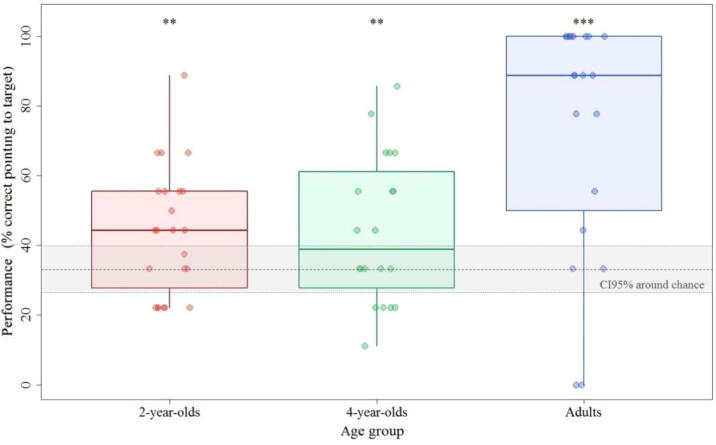
In the context of word learning, it is commonly assumed that repetition is required for young children to form and maintain in memory an association between a novel word and its corresponding object. For instance, at 2 years of age, children are able to disambiguate word-related situations in one shot but are not able to further retain this newly acquired knowledge. It has been proposed that multiple fast-mapping experiences would be required to promote word retention or that the inferential reasoning needs to be accompanied by explicit labeling of the target. We hypothesized that when 2-year-olds simply encounter an unambiguous learning context, word learning may be fast and maintained in time. We also assumed that, under this condition, even a single exposure to an object would be sufficient to form a memory trace of its name that would survive a delay. To test these hypotheses, 2- and 4-year-olds were ostensively taught three arbitrary word-object pairs using a 15-s video sequence during which each object was manually displayed and labeled three times in a row. Retention was measured after a 30-min distractive period using a forced-choice procedure. Our results provide evidence that declarative memory does not need repetition to be formed and maintained, for at least a 30-min period, by children as young as 2 years. This finding suggests that the mechanisms required for extremely rapid and robust word acquisition not only are present in preschoolers with developed language and cognitive skills but also are already operative at a younger age.
在词汇学习的背景下,人们普遍认为,对于幼儿来说,需要重复才能在记忆中形成和保持新单词与其对应物体之间的联系。例如,在 2 岁时,儿童能够一次性辨别与单词相关的情况,但无法进一步保留这种新获得的知识。有人提出,需要多次快速映射经验来促进单词的保留,或者需要推理思维伴随着目标的明确标记。我们假设,当 2 岁的孩子只是遇到一个明确的学习环境时,词汇学习可能会很快并持续一段时间。我们还假设,在这种情况下,即使只接触一次物体,也足以形成对其名称的记忆痕迹,这种记忆痕迹可以在延迟后幸存下来。为了检验这些假设,我们使用 15 秒的视频序列对 2 岁和 4 岁的儿童进行了明示教学,在该序列中,每个物体连续手动显示并标记三次。在分散注意力的 30 分钟后,通过强制选择程序进行保留测试。我们的研究结果表明,对于至少 2 岁的儿童来说,陈述性记忆不需要重复就可以形成和保持,至少可以保持 30 分钟。这一发现表明,对于具有发达语言和认知技能的学龄前儿童来说,快速而稳健的词汇习得所需的机制不仅存在,而且在更小的年龄就已经开始运作。