DeLTA Center, Department of Communication Sciences and Disorders, University of Iowa, Iowa City IA, USA.
Front Psychol. 2014 Mar 6;5:164. doi: 10.3389/fpsyg.2014.00164. eCollection 2014.
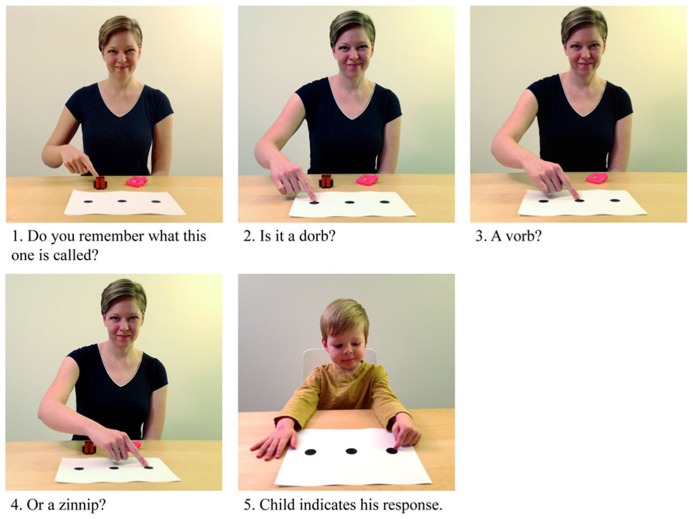
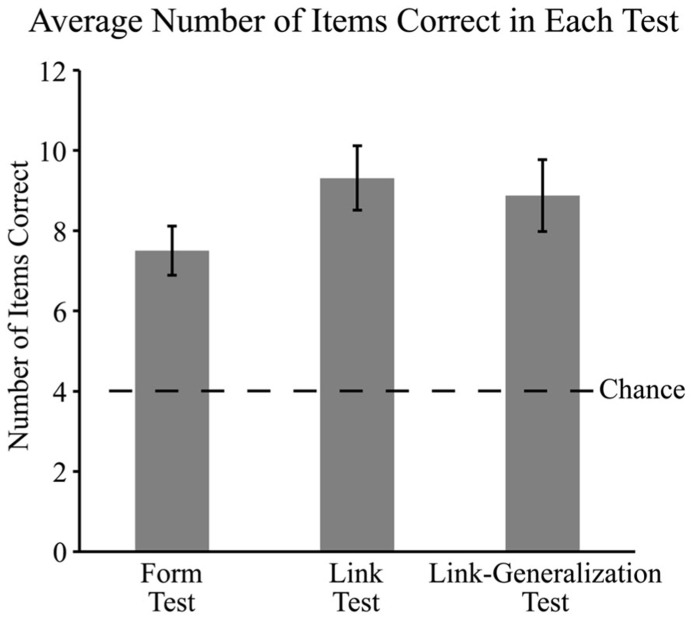
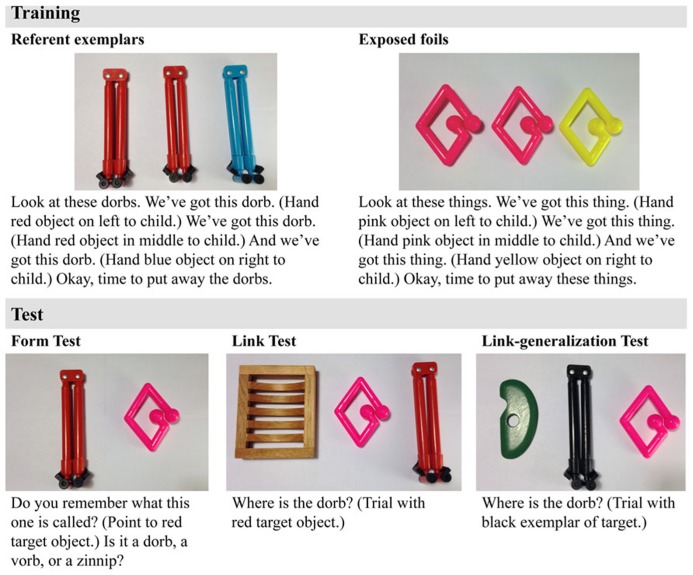
Children's memories for the link between a newly trained word and its referent have been the focus of extensive past research. However, memory for the word form itself is rarely assessed among preschool-age children. When it is, children are typically asked to verbally recall the forms, and they generally perform at floor on such tests. To better measure children's memory for word forms, we aimed to design a more sensitive test that required recognition rather than recall, provided spatial cues to off-set the phonological memory demands of the test, and allowed pointing rather than verbal responses. We taught 12 novel word-referent pairs via ostensive naming to sixteen 4- to 6-year-olds and measured their memory for the word forms after a week-long retention interval using the new spatially supported form recognition test. We also measured their memory for the word-referent links and the generalization of the links to untrained referents with commonly used recognition tests. Children demonstrated memory for word forms at above chance levels; however, their memory for forms was poorer than their memory for trained or generalized word-referent links. When in error, children were no more likely to select a foil that was a close neighbor to the target form than a maximally different foil. Additionally, they more often selected correct forms that were among the first six than the last six to be trained. Overall, these findings suggest that children are able to remember word forms after a limited number of ostensive exposures and a long-term delay. However, word forms remain more difficult to learn than word-referent links and there is an upper limit on the number of forms that can be learned within a given period of time.
儿童对新习得的单词与其所指对象之间的联系的记忆一直是过去广泛研究的焦点。然而,在学前儿童中,很少评估他们对单词形式本身的记忆。当涉及到这种记忆时,孩子们通常被要求口头回忆单词的形式,而他们在这类测试中的表现通常都很差。为了更好地衡量儿童对单词形式的记忆,我们旨在设计一种更敏感的测试,该测试要求识别而不是回忆,提供空间提示以抵消测试的语音记忆需求,并允许用手指而不是口头来回答。我们通过明示命名向 16 名 4 至 6 岁的儿童教授了 12 对新的单词-所指对象对,并在一周的保持间隔后使用新的空间支持的形式识别测试来测量他们对单词形式的记忆。我们还使用常用的识别测试测量了他们对单词-所指对象联系的记忆以及对未训练的所指对象的联系的泛化。儿童对单词形式的记忆表现出高于机会水平的记忆;然而,他们对形式的记忆比他们对训练或泛化的单词-所指对象联系的记忆差。当犯错时,儿童选择与目标形式接近的干扰项的可能性并不比选择最大不同的干扰项的可能性更大。此外,他们更常选择正确的形式,这些正确的形式在最先被训练的六个形式中,而不是最后六个中。总的来说,这些发现表明,儿童在有限数量的明示暴露和长期延迟后能够记住单词形式。然而,与单词-所指对象联系相比,单词形式更难学习,并且在给定的时间内,能够学习的形式数量存在上限。