Esterline Katherine, Gómez Rebecca L
Psychology Department, The University of Arizona, Tucson, AZ 85721, USA.
Brain Sci. 2021 Oct 5;11(10):1320. doi: 10.3390/brainsci11101320.
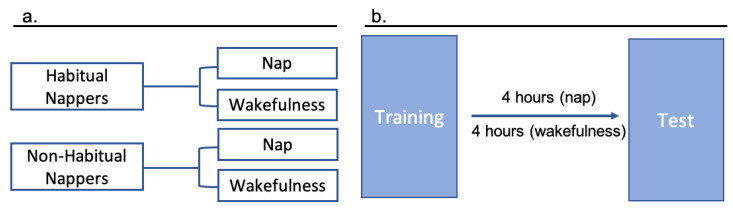
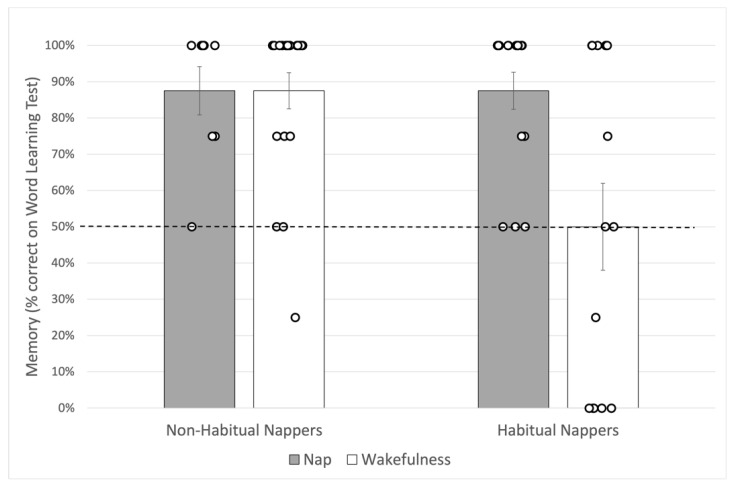
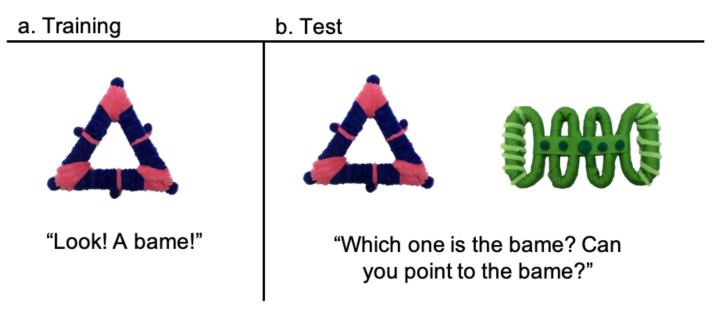
Daytime napping contributes to retention of new word learning in children. Importantly, children transition out of regular napping between ages 3-5 years, and the impact of this transition on memory is unclear. Here, we examined the performance of both non-habitually napping children (nap 0-3 days per week, = 28) and habitually napping children (nap 4-7 days per week, = 30) on a word learning task after a delay including either sleep or wakefulness. Children ages 3.5-4.5 years old experienced a brief exposure to two novel labels and their referents during training, a scenario that replicates learning experiences children encounter every day. After a 4-h delay, children were tested on the object-label associations. Using mixed effects logistic regression, we compared retention performance. Non-habitual nappers and habitual nappers displayed a different pattern of retention such that non-habitually napping children did equally well on a test of retention regardless of whether they napped or stayed awake during the delay. In contrast, habitually napping children needed a nap after learning to retain the novel object-label associations 4 h later. As a group, habitual nappers who remained awake after learning performed no better than chance on the retention test. As children transition out of naps, they may be less susceptible to interference and are better able to retain newly learned words across a delay including wakefulness.
白天小睡有助于儿童对新学单词的记忆。重要的是,儿童在3至5岁之间会逐渐不再有规律地小睡,而这种转变对记忆的影响尚不清楚。在此,我们研究了非习惯性小睡儿童(每周小睡0 - 3天,n = 28)和习惯性小睡儿童(每周小睡4 - 7天,n = 30)在经过包括睡眠或清醒的延迟后,在单词学习任务中的表现。3.5至4.5岁的儿童在训练期间短暂接触了两个新标签及其指代物,这一情景再现了儿童日常遇到的学习经历。经过4小时的延迟后,对儿童进行物体 - 标签关联测试。我们使用混合效应逻辑回归比较了记忆表现。非习惯性小睡者和习惯性小睡者表现出不同的记忆模式,即非习惯性小睡的儿童在记忆测试中的表现同样良好,无论他们在延迟期间是小睡还是保持清醒。相比之下,习惯性小睡的儿童在学习后需要小睡才能在4小时后记住新的物体 - 标签关联。总体而言,学习后保持清醒的习惯性小睡者在记忆测试中的表现不比随机水平好。随着儿童不再小睡,他们可能较不易受到干扰,并且在包括清醒状态的延迟期间更能记住新学的单词。