Chelsea and Westminster NHS Foundation Trust, 369 Fulham Road, London, SW10 9NH, UK.
North West London Pathology, Imperial College Healthcare NHS Trust, Fulham Palace Road, London, W6 8RF, UK.
Sci Rep. 2020 May 14;10(1):7965. doi: 10.1038/s41598-020-64739-1.
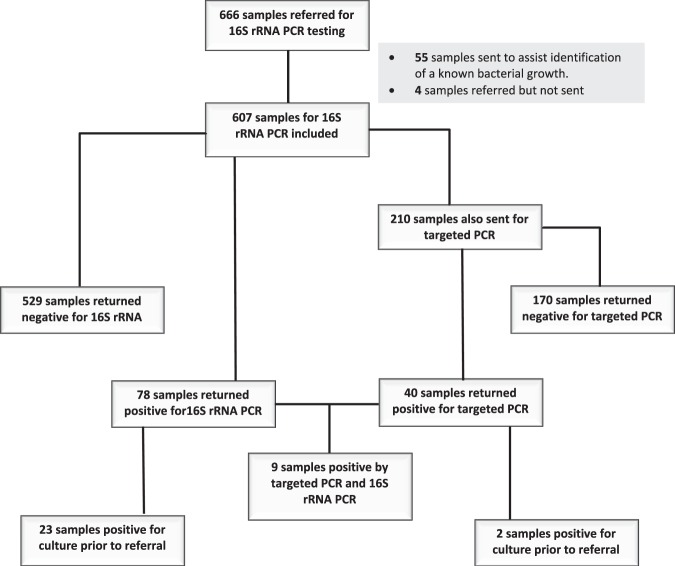
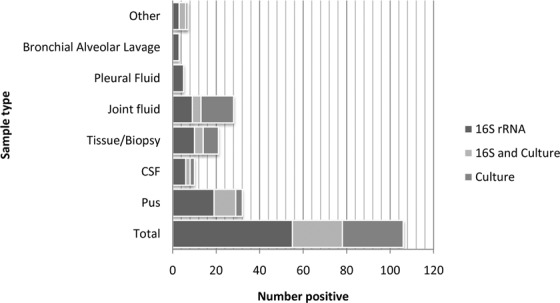
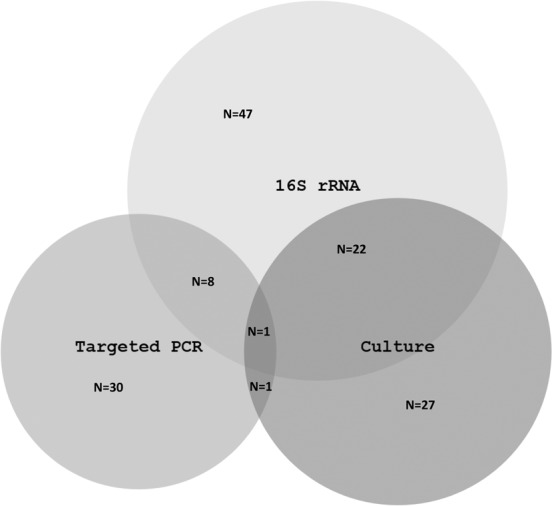
16S ribosomal-ribonucleic acid polymerase chain reaction (PCR) and targeted PCR aid microbiological diagnosis in culture-negative clinical samples. Despite routine clinical use, there remains a paucity of data on their effectiveness across a variety of clinical sample types, and cost-effectiveness. In this 4 year multicentre retrospective observational study, all clinical samples referred for 16S PCR and/or targeted PCR from a laboratory network serving seven London hospitals were identified. Laboratory, clinical, prescribing, and economic variables were analysed. 78/607 samples were 16S PCR positive; pus samples were most frequently positive (29/84; p < 0.0001), and CSF least (8/149; p = 0.003). 210/607 samples had targeted PCR (361 targets requested across 23 organisms) with 43/361 positive; respiratory samples (13/37; p = 0.01) had the highest detection rate. Molecular diagnostics provided a supportive microbiological diagnosis for 21 patients and a new diagnosis for 58. 14/91 patients with prescribing information available and a positive PCR result had antimicrobial de-escalation. For culture-negative samples, mean cost-per-positive 16S PCR result was £568.37 and £292.84 for targeted PCR, equating to £4041.76 and £1506.03 respectively for one prescription change. 16S PCR is more expensive than targeted PCR, with both assisting in microbiological diagnosis but uncommonly enabling antimicrobial change. Rigorous referral pathways for molecular tests may result in significant fiscal savings.
16S 核糖体核糖核酸聚合酶链反应(PCR)和靶向 PCR 有助于在培养阴性的临床样本中进行微生物诊断。尽管在常规临床中使用,但针对各种临床样本类型和成本效益,其有效性的数据仍然很少。在这项为期 4 年的多中心回顾性观察研究中,确定了来自为 7 家伦敦医院服务的实验室网络中所有送检 16S PCR 和/或靶向 PCR 的临床样本。分析了实验室、临床、处方和经济变量。78/607 个样本 16S PCR 阳性;脓液样本最常呈阳性(29/84;p<0.0001),脑脊液样本最不易呈阳性(8/149;p=0.003)。607 个样本中有 210 个进行了靶向 PCR(23 种生物的 361 个靶标),其中 43 个阳性;呼吸道样本(13/37;p=0.01)的检测率最高。分子诊断为 21 名患者提供了支持性微生物学诊断,并为 58 名患者提供了新的诊断。在有处方信息和 PCR 阳性结果的 14/91 名患者中,有 14 名患者进行了抗菌药物降级。对于培养阴性的样本,16S PCR 的平均阳性结果成本为 568.37 英镑,靶向 PCR 的平均阳性结果成本为 292.84 英镑,分别相当于一次处方改变的 4041.76 英镑和 1506.03 英镑。16S PCR 比靶向 PCR 更昂贵,两者都有助于微生物学诊断,但很少能改变抗菌药物的使用。分子检测的严格转诊途径可能会带来显著的财政节省。